
Mahtari Vandana Yojana: How a monthly women’s welfare payout in Chhattisgarh turned into the state’s biggest recurring publicity event for the Chief Minister.
Thank you for reading this post, don't forget to subscribe!October 7, 2026|CoreSignal
Days before Sharadiya Navratri lit up Chhattisgarh, Chief Minister Vishnu Deo Sai was on stage in Durg, pressing a button that sent money into more than 67 lakh bank accounts at once. The occasion was the 32nd instalment of the Mahtari Vandan Yojana — and, as has become customary with this scheme, the timing was no accident.
The 32nd Mahtari Vandana Yojana Instalment, Days Before Navratri
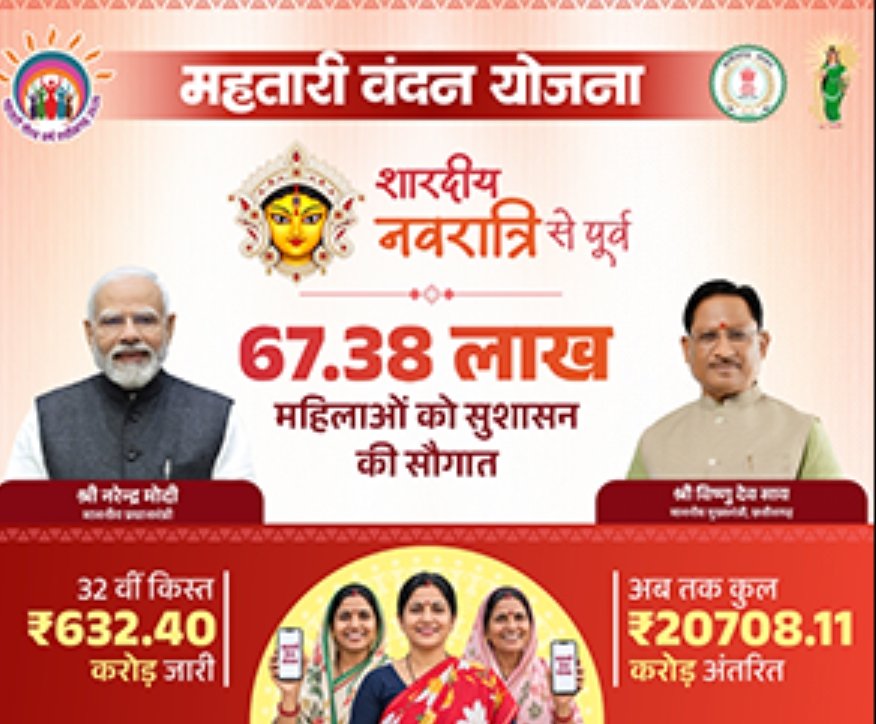
On October 8, 2026, Sai released ₹632.40 crore to 67,38,217 women beneficiaries under the scheme, reported from the Durg event. With Sharadiya Navratri beginning October 11 and running through October 20 this year, per Free Press Journal’s festival calendar, the release landed squarely in the pre-Navratri window — a pattern the government has leaned on before. The 31st instalment, released in late August, was explicitly pitched as a Raksha Bandhan “gift” to the state’s women, as The Hitavada noted at the time. Lining up a payout with a major Hindu festival devoted to goddess worship, just as it did with Raksha Bandhan, fits a now-familiar rhythm: each instalment timed to land alongside an occasion the state’s women are already marking.
With the 32nd release, cumulative disbursement under the scheme crossed ₹20,708 crore since its March 2024 launch — a figure the government has repeated at successive instalment events as proof of the scheme’s scale.
A Scheme Built Around the Release Date
Mahtari Vandan Yojana pays ₹1,000 a month to eligible married, widowed, divorced, and deserted women aged 21 and above who are permanent residents of Chhattisgarh, transferred directly via Direct Benefit Transfer. Women already receiving smaller amounts through other social-assistance schemes get topped up to ₹1,000. More than 67 lakh women are currently enrolled, according to figures cited in Drishti IAS’s overview of the programme.
What distinguishes it from a routine monthly transfer is the ceremony attached to each release. Roughly every 30 days, the Chief Minister appears at a public function, delivers remarks on women’s empowerment, and triggers the DBT transfer on stage — a format that has repeated across instalment after instalment:
| Instalment | Date | Amount Released | Beneficiaries |
|---|---|---|---|
| 29th | July 11, 2026 | ₹626.25 crore | ~66 lakh women |
| 30th | Late July 2026 | ₹630 crore | ~67 lakh women |
| 31st | Late August 2026 (ahead of Raksha Bandhan) | — | — |
| 32nd | October 8, 2026 (Durg, ahead of Navratri) | ₹632.40 crore | 67,38,217 women |
Documents and How to Apply
Women who haven’t yet enrolled can apply through the official portal at mahtarivandan, though the offline route through local offices remains the more reliable path, per report’s coverage of the scheme’s rollout.
Documents needed:
- A recent, self-attested passport-size photograph
- Proof of permanent address (ration card, voter ID, or residence certificate)
- Aadhaar card of the applicant and her husband
- PAN card of the applicant and her husband, where available
- Marriage certificate
- Death certificate (for widows) or abandonment certificate (where applicable)
- Proof of date of birth — a 10th or 12th marksheet, transfer certificate, PAN card, voter ID, or driving licence
- Bank account number, branch address, and IFSC code, along with a photocopy of the passbook
- A completed self-declaration form and application form
Steps to apply:
- Collect the application form from the official website, or in person from the nearest anganwadi centre, ward office, gram panchayat, or a special camp organised by the state.
- Fill in the application and self-declaration forms.
- Self-attest photocopies of all supporting documents.
- Submit the forms along with original documents (for verification) and photocopies at the anganwadi, ward office, gram panchayat, or camp.
- Collect the acknowledgement receipt issued on submission.
- Watch for an SMS on the registered mobile number confirming the application status.
Checking Mahtari Vandana Yojana Application Status: on the official portal, selecting the “Mahtari Vandana Yojana Application Status” tab, entering a mobile number or Serial number along with the captcha code, and submitting brings up the status on-screen. Given how enrolment phases and portal availability have shifted since the scheme’s 2024 launch, confirming current requirements with the local anganwadi or ward office before submitting documents remains the safer route.
Why It’s Called the Most Advertised Scheme in the State
No other Chhattisgarh welfare programme generates the same density of recurring publicity. Each release is preceded and followed by government advertisements and press notes in Hindi and English dailies across the state, timed in step with the event itself. Television channels and the government’s own social media accounts carry the staged ceremony live, giving the Chief Minister a guaranteed, scheme-branded media appearance roughly once a month — a cadence confirmed by the steady run of instalment reports filed by outlets like Indian Masterminds. Large hoardings pairing Sai’s photograph with the scheme’s branding remain a fixture on highways and city roads between releases, keeping the scheme visible even in the weeks it isn’t making news.
The language used around the scheme has also stayed consistent. Government statements routinely describe it as “a symbol of women’s economic self-reliance,” a phrase that recurs in CM speeches, press releases, and advertising copy alike, as captured in report from an earlier instalment. That repetition, instalment after instalment, festival after festival, is what has made Mahtari Vandan Yojana as recognisable for its publicity cycle as for the ₹1,000 that actually reaches each beneficiary’s account.
Not every headline attached to the scheme has been favourable, however. Reports of fake or mismatched entries in the beneficiary list, including a case where a Bollywood actress’s name turned up erroneously in official data, drew a round of blame-trading between the BJP and Congress, ETV Bharat reported at the time — a reminder that the scheme’s high visibility cuts both ways when something goes wrong.
