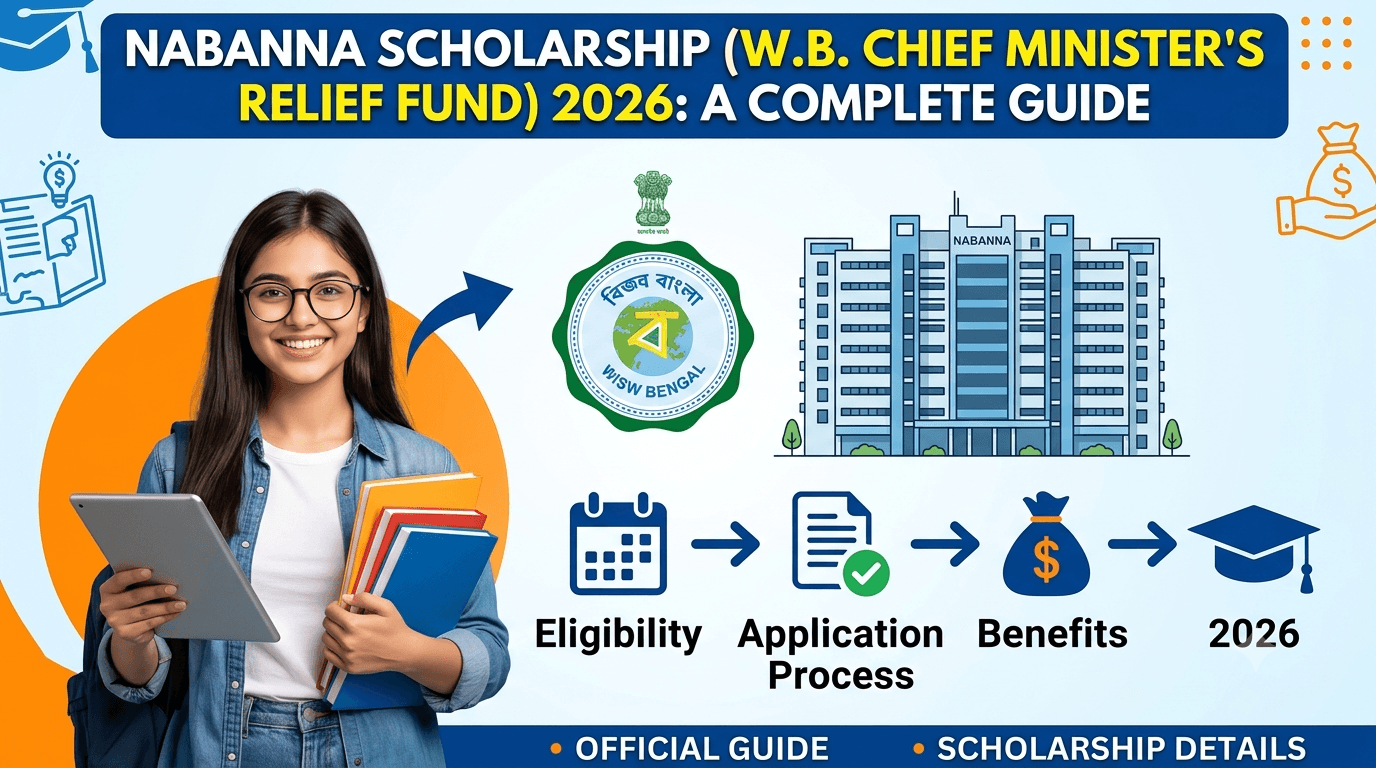
A complete guide to eligibility, benefits, and the online application process for the West Bengal Chief Minister’s Relief Fund education scholarship
Thank you for reading this post, don't forget to subscribe!September 27, 2026|CoreSignal
The Nabanna Scholarship, formally known as Financial Assistance for Education under the West Bengal Chief Minister’s Relief Fund (CMRF), is a state financial aid scheme that supports students from economically weaker families who want to continue their education within West Bengal. Its popular name comes from Nabanna, the West Bengal state secretariat building in Howrah from where the fund is administered.
Unlike scholarships that reward only top scorers, Nabanna is designed for students with moderate marks and genuine financial need — students who are hardworking but don’t necessarily rank at the very top, and who are struggling to pay for books, fees, and other education-related costs.
What Makes Nabanna Different
Most West Bengal scholarships (like SVMCM) require high marks. Nabanna instead targets a specific band of students — those who cleared their exams respectably but fall just short of the higher merit thresholds required elsewhere, and whose family income is very low. It functions as a safety net for students who might otherwise not qualify for merit-based state scholarships.
Eligibility Criteria
- Residency: Applicant must be a permanent resident of West Bengal.
- Institution: Must be studying at an institution located within West Bengal, after passing Secondary, Higher Secondary, or Undergraduate examinations from a recognised Board, Council, or University in the state.
- Marks band (Higher Secondary/Undergraduate assistance): Must have scored at least 50% but less than 60% aggregate marks in the Madhyamik (or equivalent) or Higher Secondary (or equivalent) examination respectively.
- Marks band (Postgraduate assistance): Must have scored at least 50% but less than 53% aggregate marks in the undergraduate examination.
- Income limit: Annual family income must not exceed ₹1,20,000 — notably stricter than SVMCM’s ₹2.5 lakh threshold.
- No overlapping benefits: Applicant must not already be receiving any other government or non-government scholarship/stipend for the same stage of study. Sources also note that students who are eligible for SVMCM are generally not eligible for this fund, since the two are meant to cover different bands of students.
- Application frequency: An applicant can register only once within a 365-day period.
Scholarship Amount
Selected students receive ₹10,000 per academic year, credited directly to the student’s bank account after verification by the CMRF Cell.
Documents Required
Based on the application process, applicants typically need:
- Marksheet of the last qualifying examination
- Admission/enrollment receipt for the current course
- Residential certificate
- Income certificate
- Bank passbook details
- Passport-size photograph
(Exact document formats and file-size limits are specified on the CMRF portal at the time of application — the portal generally requires documents in PDF, kept under 500 KB per file.)


Step-by-Step Application Guide
The process is entirely online through the official CMRF portal.
Step 1: Visit the official website
Go to Chief Minister’s Relief Fund Portal→ avoid third-party sites claiming to be official.
Step 2: Start the application
Click the button labeled “Apply for Financial Assistance for Education“ on the homepage.
Step 3: Register
Click Sign Up, enter your mobile number, verify it via OTP, and set a password.
Step 4: Log in
Use your registered mobile number and password to log in to your account.
Step 5: Fill in the application form
Enter your personal, academic, and bank details carefully, matching them exactly to your supporting documents.
Step 6: Upload documents
Scan and upload each required document as a PDF, keeping each file within the prescribed size limit.
Step 7: Preview and submit
Review all entries carefully, then submit the form and save your system-generated reference number for future tracking.
Note: Once registered, applicants are typically given a window (reported as around 90 days by some trackers) to upload documents and complete submission — check the portal for the exact current window at the time you register.
Verification and Disbursement Process
- Verification: Carried out by the CMRF Cell at the Chief Minister’s Office, and may be forwarded to the District Magistrate or the Commissioner of Police, Kolkata, for further checks where needed.
- Processing time: Generally around three months or more from submission.
- Disbursement: The sanctioned amount is transferred directly to the applicant’s bank account via DBT.
- Recommendation requirement: Some sources note that final selection may also require a recommendation letter from the local MLA/MP, alongside successful document verification.
Renewal
The scholarship is renewable annually for the duration of the course, provided the student:
- Continues studying in the same course
- Secures passing marks in the previous year’s examination
- Does not start receiving any other scholarship for the same stage of study
Important Dates
Unlike SVMCM, Nabanna Scholarship has no fixed annual deadline — applications are accepted online throughout the year on a rolling basis. That said, since funds are limited and processing can take three months or more, applicants are advised to apply as early as possible in the academic session rather than waiting.
Contact for Queries
Address: Chief Minister’s Office, Nabanna, 325 Sarat Chatterjee Road, Howrah – 711102
(For an official helpline number and email specific to CMRF education assistance, verify directly on cmrf.wb.gov.in, as this wasn’t consistently listed across sources.)
Key Benefits at a Glance
- Targets students with moderate marks and genuine financial hardship — not just top scorers
- Rolling, no-deadline application model reduces last-minute rush
- Direct bank transfer of ₹10,000/year with no processing fee
- Renewable annually if eligibility conditions continue to be met
- Complements (rather than duplicates) merit-heavy schemes like SVMCM by covering a different applicant band