Opposition demands the Chief Election Commissioner’s resignation as reports of internal dissent over the electoral roll revision deepen a long-running credibility row
Thank you for reading this post, don't forget to subscribe!September 30, 2026|CoreSignal
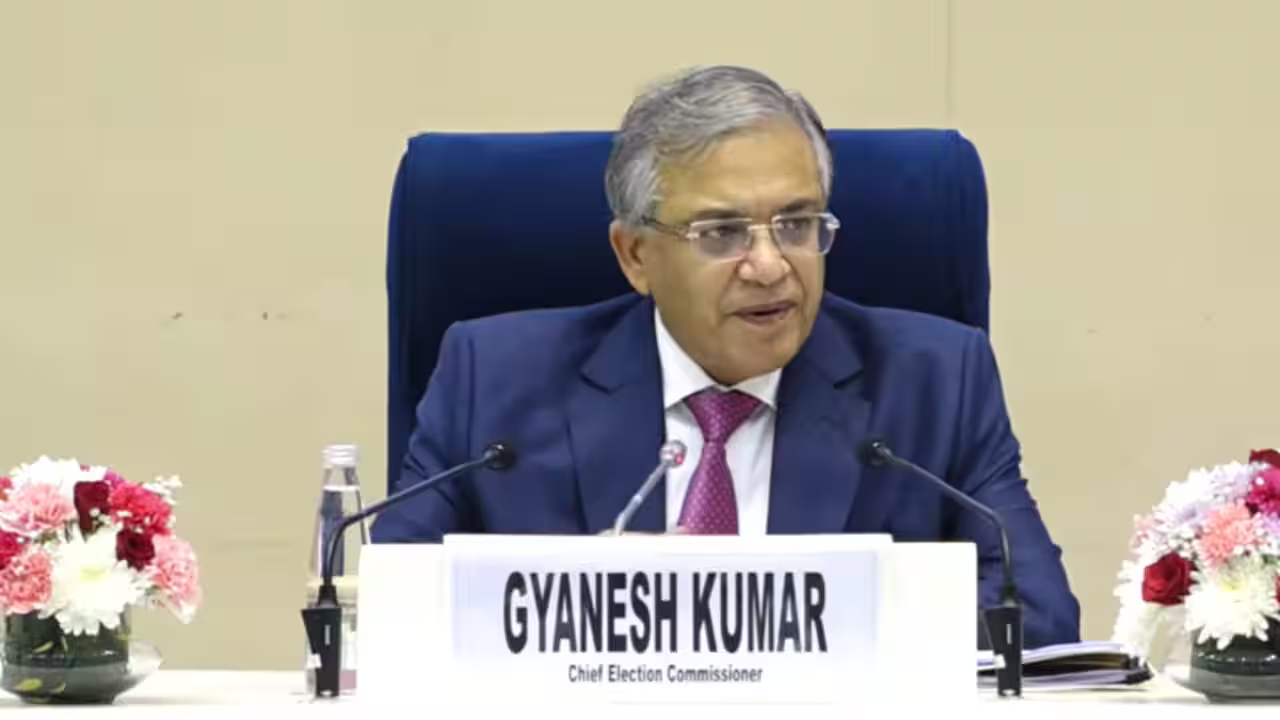
An umpire is only as strong as the trust players place in the whistle. That is the problem now confronting Gyanesh Kumar, whose standoff with the Opposition has become known as the Gyanesh Kumar and the Voter Roll Row. Opposition groups are demanding his resignation over allegations of widespread voter-list manipulation during the verification of the country’s roughly one billion voters, Reuters reports. The charges are contested, and the Election Commission of India (ECI) maintains that everything it has done follows the law.
Inside the Voter Roll Row: The Report That Lit the Fuse
The latest storm began with an investigation by The Indian Express, which Scroll summarised. The paper found that Election Commissioners Sukhbir Singh Sandhu and Vivek Joshi had objected in writing at least 14 times over ten months to decisions on the Special Intensive Revision (SIR) of electoral rolls, saying they were made without their knowledge. The objections ranged from the registration of new voters to the deletion and restoration of names and the security of the rolls themselves. One flashpoint was a change to Form 6, the new-voter registration form, which Sandhu reportedly called unauthorised and illegal.
The Commission answered on September 23. It did not dispute that internal notes exist. Its case is that written notes and differing views are a normal part of how a three-member body deliberates, and that the decisions of the past year, SIR included, were unanimous decisions of the full Commission.
Politics Takes Over in Gyanesh Kumar and the Voter Roll Row
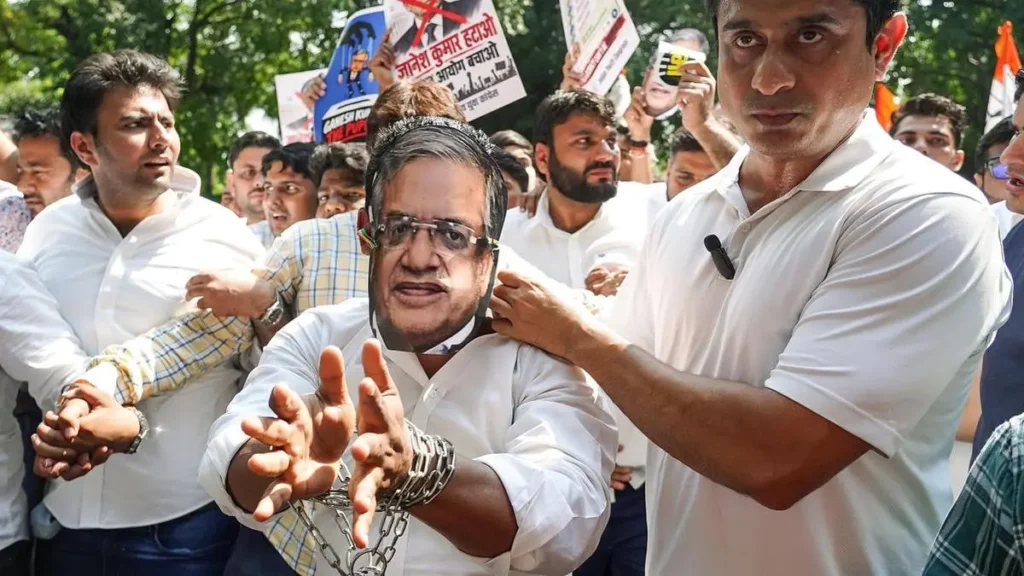
Opposition parties were not in a mood to accept that explanation. Leaders accused Kumar of running a “one-man autocracy,” and Congress’s Jairam Ramesh alleged mass disenfranchisement through the SIR. DMK president M K Stalin said Kumar has no right to remain in office, and Jammu and Kashmir Chief Minister Omar Abdullah said the reports raise serious questions.
The dispute is now moving outdoors. The Congress-led INDIA bloc has announced nationwide protests, and the Cockroach Janta Party has threatened its own from October 2 if Kumar stays put.
The BJP Steps In to Defend the Umpire
The ruling party wasted little time in coming to the Commission’s defence. At a press conference in New Delhi on September 23, BJP spokesperson Sambit Patra rejected the Opposition’s charges, and The Wire reported his main lines of argument.
Patra’s central point was that the correspondence among the three commissioners, which the Indian Express counted at 14 instances, proves the opposite of what critics claim. In his telling, letters and deliberations are the sign of a healthy, working democracy inside the poll body, not of a dictatorship. He argued that the Congress has an answer for every outcome: if the commissioners simply agreed on everything, that would be called dictatorship, and when they exchange views, that is called dictatorship too. He also pointed to the Commission’s own statement, which says that after all the official deliberation, the conduct of the SIR was unanimous.
He then widened the argument. Patra denied any role for the government and described the allegations as an attempt by the Congress to discredit the institutions of India. He also claimed the party, unable to win elections, had turned to attacking those institutions instead.
Critics see a gap in that defence. The reported complaint from the two commissioners was not that deliberation happened, but that certain decisions were taken without their knowledge. Whether the record supports the BJP’s account or the Opposition’s remains the heart of the dispute.
The Fight Reaches the Supreme Court
The row has now landed before the country’s top court. A petition filed by Rakesh Kumar Singh under Article 32 of the Constitution asks the Supreme Court to suspend Kumar from functioning as CEC while the case is heard, and to declare that decisions of the Election Commission cannot be taken unilaterally by its Chairman.
The legal argument is built on the wording of the Constitution. Article 324 vests the superintendence, direction and control of elections in “a Commission,” the petition says, not in an individual Chief Election Commissioner. It also leans on Section 18 of the 2023 appointments law, which says the Commission’s business should as far as possible be transacted unanimously, with differences settled by majority. The petitioner asks the Court to require Kumar to show under what authority he has acted, through a writ of quo warranto.
The plea revisits several of the disputes at the heart of the dissent report:
- Form 6: The petition says the form was altered in July 2026 despite a May note by Joshi, later backed by Sandhu, saying it could not lawfully be changed without amending the rules. Sandhu later described the change as unauthorised and illegal.
- The roll database: It cites Joshi’s concern about the “gradual centralisation” of the electoral roll database, and Sandhu’s note that state-level officials lacked proper access to the ERONet portal.
- West Bengal appeals: It says about 16.10 lakh appeals were filed in the Commission’s name in West Bengal, and quotes a Sandhu note asking who had authorised them.
The petitioner also seeks a judicial inquiry or special investigation team headed by a retired Supreme Court judge, and the preservation of the Commission’s records. One caution stands out in the plea itself: the petitioner says it is not asking the Court to decide, at the first instance, whether each disputed step was in fact taken without lawful authority. That question, it says, depends on internal records that are not in the public domain, and it asks for those records to be produced and examined. The claims are the petitioner’s, not findings of any court. LiveLaw’s coverage does not report a hearing date, and other pleas over the same controversy have also been reported, including one in the Bombay High Court.
Why Gyanesh Kumar Is Hard to Remove
Getting rid of a Chief Election Commissioner is meant to be difficult. Under Article 324(5), the CEC can be removed only in the way a Supreme Court judge can, and only for proved misbehaviour or incapacity, as Business Standard explained.
In practice, that means:
- A notice signed by at least 100 Lok Sabha or 50 Rajya Sabha members.
- Admission of the notice by the Speaker or Chairman, followed by an inquiry committee of a Supreme Court judge, a High Court Chief Justice and a jurist.
- A special majority in both Houses, even if the charges are found proved.
No CEC has ever been removed this way. The Opposition has already tried once: notices signed by 63 Rajya Sabha and 130 Lok Sabha members were rejected by the presiding officers in April, and a second Rajya Sabha notice from April 24 is still pending. A fresh one is now being prepared for both Houses.
The Man in the Middle
Gyanesh Kumar is a 1988-batch IAS officer of the Kerala cadre. He joined the Commission as an Election Commissioner in March 2024 and took over as CEC in February 2025, at a selection meeting where Rahul Gandhi filed a dissent note over the process. The government went ahead anyway. Critics have been sceptical of him ever since, while supporters see a bureaucrat doing a thankless job under relentless political fire.
The timing adds an awkward twist. The resignation demands arrive barely a month after US President Donald Trump praised Kumar for insisting that Indian voters prove their identity with photo ID, something the US does not require.
What Comes Next
Four things will decide how far the voter roll row goes:
- The Supreme Court plea: whether the Court takes it up, and whether it orders the Commission’s internal records to be produced.
- The fresh removal notices: whether they gather the signatures and whether the Speaker and Chairman admit them this time.
- The street response: how large the protests from October 2 turn out to be.
- A fuller explanation from the ECI: on how differences among its members were handled during the SIR, which would test the BJP’s “healthy deliberation” defence against the commissioners’ own written record.
This report is based on published news coverage as of September 29, 2026. The allegations described are made by political parties, petitioners and media reports and have not been proved. The Election Commission has denied wrongdoing.