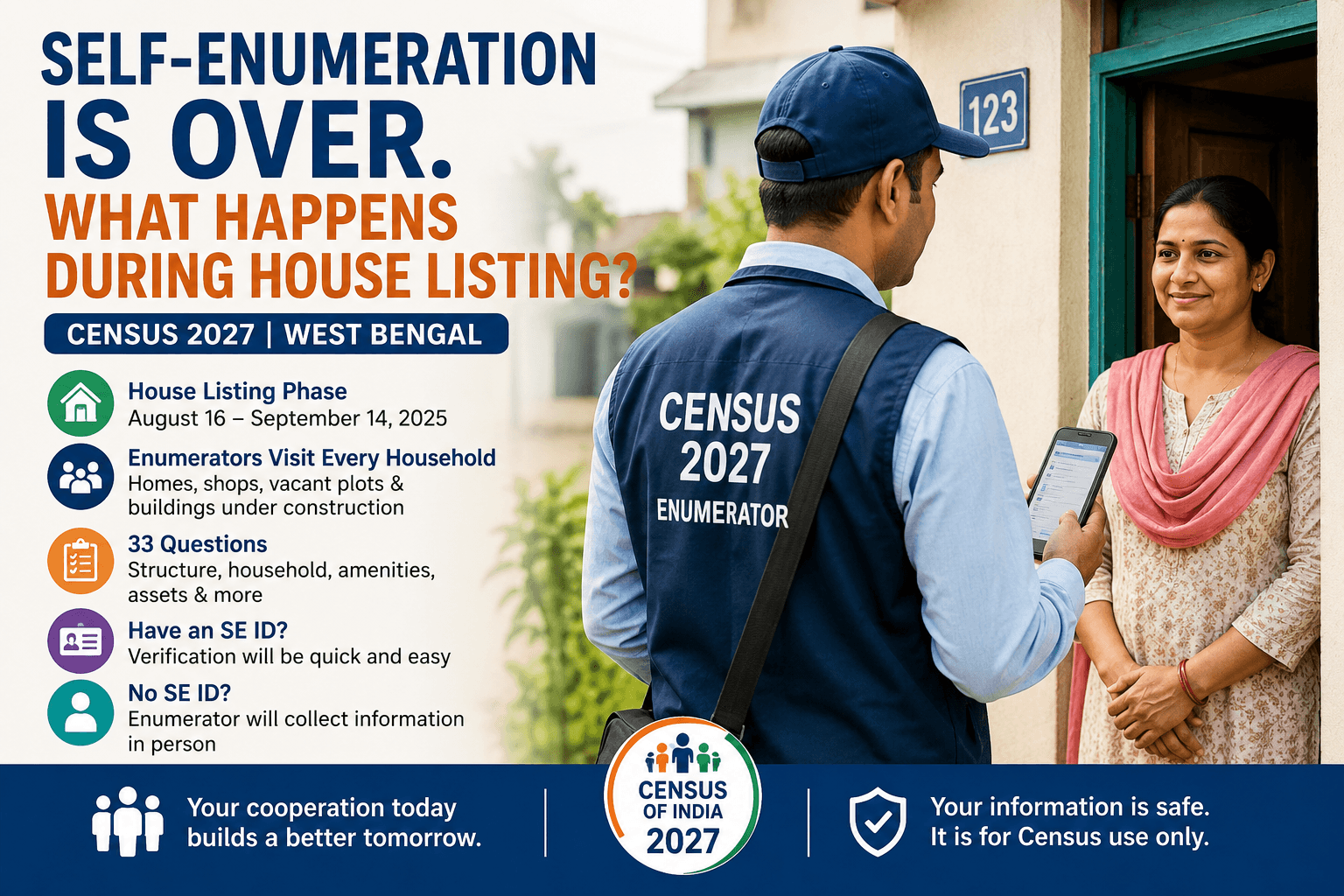
With self-enumeration closed, Census 2027 moves into its door-to-door House Listing phase across West Bengal from August 16 to September 14. Here’s what enumerators will verify, what households without an SE ID can expect, and why this phase matters.
Thank you for reading this post, don't forget to subscribe!August 16, 2026|CoreSignal
Self-Enumeration Is Over: What If You Missed It?
The 15-day window for online self-enumeration in West Bengal has now closed, having run from August 1 to August 15. With that phase behind us, the Census machinery shifts into its next and far more visible stage — the House-listing and Housing Census, which began on August 16 and will continue until September 14. For the next month, trained enumerators will be visiting homes across the state in person, marking the point where the Census moves from something residents could do quietly on their own phones to something that plays out, quite literally, on the doorstep.
A Quick Recap: What Did Self-Enumeration Actually Do?
For those who used it, self-enumeration allowed the head of the household to log into an official portal and fill in Census details digitally, at their own pace, without waiting for an official to show up. The process took most people under 20 minutes, and could be paused and resumed until midnight on August 15. Once submitted, the portal generated a unique 11-digit Self-Enumeration ID, or SE ID — essentially a receipt confirming the household had already provided its information.
It’s worth remembering that this step was never mandatory. It existed purely to make the process smoother and cut down on data-entry errors, not to replace the in-person visit altogether. Every household, whether they self-enumerated or not, will still be visited by an enumerator during the house-listing phase.
What Changes Now That Self-Enumeration Has Ended?
With the online window shut, the burden shifts entirely to field enumerators. Over the coming weeks, they’ll be going building by building, house by house, covering every residential and non-residential structure in their assigned areas — homes, shops, vacant plots, buildings under construction — to make sure the record is complete.
For households that already have an SE ID, the visit should be relatively quick. The enumerator will ask for the ID, use it to pull up the details already submitted, and simply verify that everything is accurate rather than starting the questionnaire from the beginning. Officials have described this SE ID as proof that the household has already done its part, meant to streamline what would otherwise be a longer in-person process.
For everyone else — households that either didn’t get around to self-enumerating or chose to skip it entirely — the enumerator will walk through the full set of questions in person, recording every answer directly through an official mobile application.
What Questions Are Asked During House Listing?
Regardless of whether a household is being verified or enumerated from scratch, the underlying questionnaire runs to 33 questions, broadly falling into a few categories:
- The structure itself — building number, census house number, the material used for the floor, walls and roof, and the overall condition of the house
- The household — household number, total number of people normally residing there, and basic details about the head of the household, including name and sex
- Ownership and space — whether the house is owned or rented, and how many rooms it has
- Amenities — main source of drinking water, access to a toilet, the type of fuel used for cooking, and electricity connection
- Assets — presence of a television, internet access, a computer or laptop, mobile or landline phones, and vehicles ranging from bicycles to cars
- A few closing details — the main cereal consumed in the household, and a mobile number collected solely for Census-related communication
Notably, some of these questions — mostly around household assets and amenities — were never part of the online self-enumeration form in the first place. That means even families that completed self-enumeration may find the enumerator asking a handful of additional questions when they visit in person, simply to fill in what the digital form didn’t cover.
Why Does the House Listing Phase Matter?
House-listing isn’t just about counting buildings — it’s about creating a structural map of the state, right down to geo-tagging individual buildings and assigning each one a unique identification number. That groundwork feeds into everything from disaster response planning to urban development decisions well beyond the Census itself.
What it doesn’t cover, at least not yet, is anything about individual residents beyond the head of the household — no questions on age, education, caste or religion. Those details are reserved for the second phase, Population Enumeration, scheduled for February 2027, when enumerators return for a far more detailed, individual-level count.
What Should You Do During the House Listing Phase?
With self-enumeration no longer an option, the only thing left for households to do is be available and cooperative when the enumerator arrives. Those with an SE ID should keep it handy to speed up the verification process; those without one should simply be prepared to answer the full questionnaire when asked. Either way, officials have stressed that the accuracy of this phase sets the foundation for everything the Census aims to capture over the next year.