
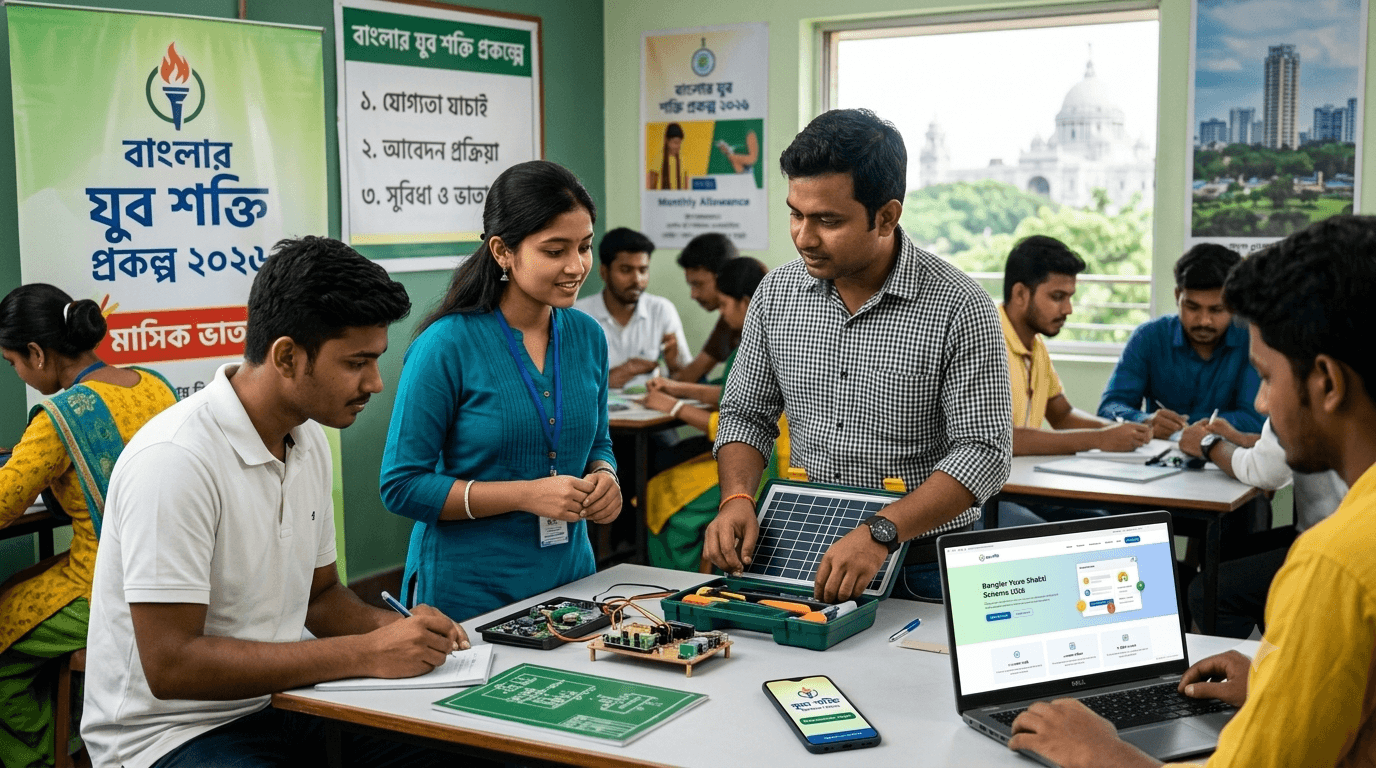
How to apply, eligibility criteria, monthly allowance, and expected launch date for West Bengal’s Banglar Yuva Shakti Scheme.
Thank you for reading this post, don't forget to subscribe!August 22, 2026|CoreSignal
Synopsis: Banglar Yuva Shakti
Banglar Yuva Shakti is West Bengal’s new unemployment allowance scheme, confirmed in the state’s 2026–27 Budget, offering ₹3,000 a month to unemployed graduates and ₹2,000 a month to other eligible unemployed youth aged 21–45. While the benefit amount and broad eligibility criteria have been confirmed, key details — including the exact income limit, the official application portal, and the launch date — are still unsettled across available reports, with estimates ranging from mid-2026 to October 2026. This piece breaks down what’s confirmed, what’s still uncertain, and how the scheme differs from the similarly named Banglar Yuva Sathi.
If you’re an unemployed youth in West Bengal, you’ve probably come across the name “Banglar Yuva Shakti” (also seen as Yuva Shakti, Yuva Sakti, or Jubo Sakti) more than once in the past few months — usually alongside a promise of ₹2,000 to ₹3,000 a month. The scheme has been through several rounds of announcements, a budget confirmation, and more than a few unofficial websites trying to get ahead of the actual rollout. Here’s what’s actually known so far, and just as importantly, what still isn’t confirmed.
What is the Banglar Yuva Shakti Scheme?
Banglar Yuva Shakti is West Bengal’s unemployment allowance scheme, introduced by the state’s BJP government as one of its election promises. It’s officially referred to in Bengali as যুব শক্তি (Jubo Sakti), and the West Bengal Budget 2026–27, presented on June 22, 2026 by Finance Minister Swapan Dasgupta, referred to this support under the name Bhorsa Karmasathi Scheme — so you may see it called any of these names depending on the source: Banglar Yuva Shakti, Yuva Shakti, Yuva Sakti, Jubo Sakti, Yuva Shakti Bharosa Card, or Bhorsa Karmasathi.
The scheme is meant to give unemployed youth a monthly financial cushion while they search for work, prepare for competitive exams, or build skills — not unlike Karnataka’s Yuva Nidhi scheme, which has run since January 2024 on a similar model.
An important distinction — please read this carefully: Banglar Yuva Shakti is a different scheme from Banglar Yuva Sathi, an earlier unemployment allowance programme (₹1,500/month, ages 21–40, Madhyamik pass) that had already begun registering beneficiaries through camps across all 294 assembly constituencies starting February 2026. Given how similar the two names sound — Yuva Shakti versus Yuva Sathi — it’s easy to assume they’re the same scheme with a typo. They are not. Banglar Yuva Sathi is the older scheme; Banglar Yuva Shakti is the newer, BJP-government scheme with different benefit amounts and a wider age band. If you’re checking your eligibility or searching for an application portal, double-check which of the two names you’re actually dealing with before proceeding.
Monthly allowance under Banglar Yuva Shakti
According to the West Bengal Budget 2026–27 announcement, the benefit structure is:
- ₹3,000 per month for unemployed graduates
- ₹2,000 per month for other eligible unemployed youth (those with at least a Class 10 or equivalent qualification)
This is a change from the original pre-election promise of a flat ₹3,000 for all eligible applicants — the government revised this into two separate categories once the budget was finalized.
The scheme also reportedly includes an additional one-time benefit: a ₹15,000 grant for youths actively preparing for state and central government competitive exams (such as WBCS, SSC, and Railways). This detail comes from an unofficial source discussing the party’s election manifesto rather than a confirmed budget line item, so treat it as a proposed benefit rather than a guaranteed one until an official notification confirms it.
Eligibility criteria
Based on the budget announcement and scheme descriptions circulating so far, the eligibility criteria are expected to include:
- Permanent resident of West Bengal
- Age between 21 and 45 years
- Currently unemployed, and not employed in any government job
- Not already receiving benefits under another government social protection or unemployment scheme
- For the ₹3,000 benefit: must be a graduate from a recognized university
- For the ₹2,000 benefit: must have passed at least Class 10 (or equivalent)
One eligibility detail has conflicting figures across sources: one report describes an annual family income cap of under ₹1 lakh, while another cites a much higher threshold of under ₹12 lakh per annum. Given how significant a gap that is, this is not something to take at face value from either source — wait for the official notification to confirm the actual income limit before assuming you do or don’t qualify based on income alone.
Required documents for Banglar Yuva Shakti (expected)
Based on how similar schemes have been structured, applicants are likely to need:
- Aadhaar card
- Voter ID
- Bank passbook (for DBT transfer)
- Educational certificates
- Passport-size photograph
- Proof of West Bengal residence
The government has not yet released a final, official document checklist, so this list should be treated as a reasonable expectation rather than a confirmed requirement.
Banglar Yuva Shakti application process and launch timeline
This is where the picture gets the least settled. Different sources report different things:
- One report says online applications had already started, with disbursement of the first tranche expected from June 1, through a portal called ju-boshokti.in.
- Other, more recent sources say the scheme’s implementation is expected to begin around October 2026, with online registration opening once the ongoing Annapurna Bhandar scheme’s registrations stabilize.
- A symbolic launch event was held in Kolkata on April 16, 2026, where sports figures Leander Paes and Vijender Singh distributed sample Bharosa Cards — but a symbolic launch event is not the same as the scheme’s actual operational start date.
- For now, the only confirmed official portal is West Bengal’s Banglar Yuva Shakti site — this currently handles applications for the separate Banglar Yuva Sathi scheme, and it’s worth monitoring for updates until a dedicated Banglar Yuva Shakti portal is officially announced.
A caution on portals: searches for this scheme turn up several different unofficial-looking websites (yubashakti.co.in, jubosakti.co.in, jubosakti.com, yubashakti.in, among others) that aren’t confirmed government domains. None of these should be assumed to be the official application portal unless the West Bengal government explicitly names it in an official notification. If you’re applying, wait for confirmation from an official West Bengal government press release or the state’s official web presence rather than registering through the first site that appears in a search.
Given how much this timeline has already shifted, the most reliable approach right now is to check for updates through official West Bengal government channels rather than rely on any single date circulating online.
What to do while you wait
Since the scheme’s exact application process and final eligibility rules haven’t been officially notified yet, here’s what’s actually useful to do in the meantime:
- Keep your documents ready — Aadhaar, Voter ID, bank passbook, and educational certificates, since these are almost certainly going to be required regardless of which final version of the rules gets notified.
- Check whether you already qualify for Banglar Yuva Sathi (not Shakti) — the separate, earlier scheme — if you’re between 21–40 and have passed Madhyamik. This one has already had active registration camps running, so it’s worth confirming you’re not missing out on an existing, live scheme while waiting on the newer one.
- Watch for the official notification rather than acting on any specific portal, date, or income threshold currently circulating, since several of these details are still inconsistent across available sources.

আমি একটি ব্যবসা শুরু করতে চাই তাই লোনের জন্য আবেদন