
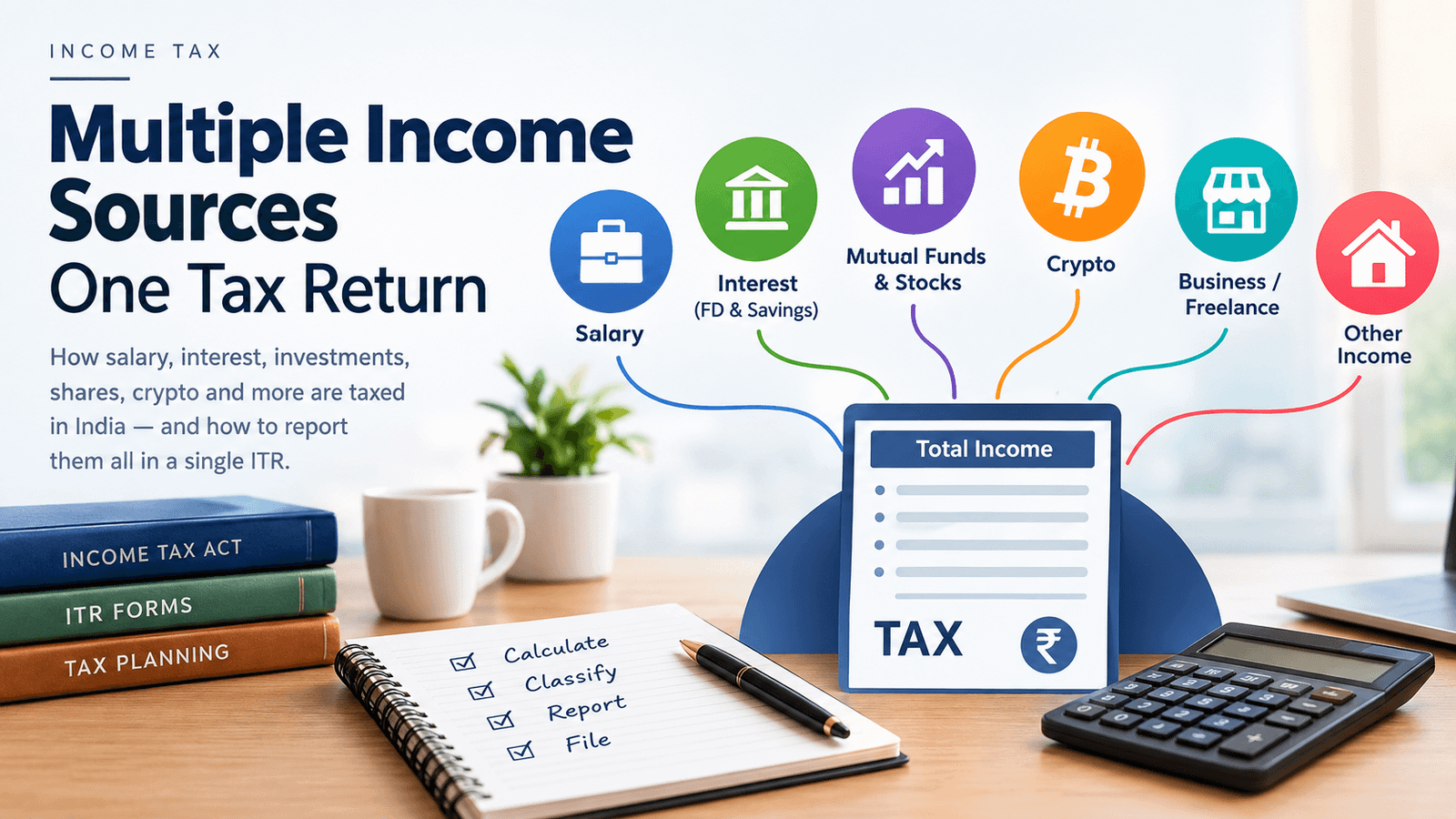
Multiple Income Sources can mean different tax rules—here’s how salary, bank interest, freelance income, investments, shares and crypto are combined and reported in one ITR.
Thank you for reading this post, don't forget to subscribe!September 16, 2026|CoreSignal
If you have a salary, and you also earn interest from a fixed deposit, made some money trading stocks, hold a bit of crypto, or run a small side business — you’re not alone. Most working Indians today have more than one source of income. But when it comes to filing your Income Tax Return (ITR), all of that has to come together into a single, coherent picture.
The problem is that most people research their taxes one income type at a time. They’ll search “is FD interest taxable” one day and “is crypto taxable” another, without realizing that the Income Tax Department doesn’t look at these in isolation — it looks at your total income, worked out under different rules for different sources, and then applies tax accordingly.
This guide walks through exactly how that works — salary, business income, bank interest, mutual funds, stocks, and crypto — and ends with a worked example that ties it all together, so you know exactly what applies to you and which ITR form you’ll need.
The 5 Heads of Income: How Multiple Income Sources Are Taxed
Under the Income Tax Act, every rupee you earn falls into one of five categories, known as “heads of income”:
- Income from Salary
- Income from House Property
- Profits and Gains from Business or Profession
- Capital Gains
- Income from Other Sources
Here’s the part that trips most people up: your salary and business income get added together and taxed at your applicable slab rate. But capital gains (from stocks, mutual funds) and certain other income (like crypto) are often taxed at special, fixed rates, separate from your slab. Understanding which bucket each income falls into is the first step to understanding your real tax liability.
Salary Income: The Base That Everything Else Builds On
For most salaried individuals, this is the most familiar territory. Your employer deducts TDS (Tax Deducted at Source) every month and issues a Form 16 at year-end summarizing your salary, deductions, and tax already paid.
What’s important here isn’t just how salary itself is taxed — it’s that your salary effectively sets your “base slab.” Any additional income you earn from other sources gets added on top of this, which can push you into a higher tax bracket than your salary alone would suggest. Someone earning ₹9 lakh in salary might feel comfortably placed in one slab, but once ₹2 lakh of freelance income and ₹50,000 of FD interest are added, their effective taxable income — and tax rate — can shift meaningfully.
Business or Freelance/Side-Hustle Income
Running a business on the side, freelancing, or consulting work falls under “Profits and Gains from Business or Profession.” There are two broad ways this gets taxed:



- Presumptive taxation (Section 44AD / 44ADA): If your turnover is below the prescribed limits, you can declare a fixed percentage of your revenue as profit (typically 8% or 6% for businesses depending on the mode of receipt, and 50% for specified professionals under 44ADA) without maintaining detailed books.
- Regular books of accounts: If you exceed the presumptive limits, or choose not to opt for the scheme, you’ll need to maintain proper accounts and declare actual profit.
This income adds directly to your salary income and is taxed at slab rates. It’s also usually the point where taxpayers are pushed from the simpler ITR-1 form into ITR-3 or ITR-4, since ITR-1 doesn’t accommodate business income at all.
Bank Interest and Fixed Deposit (FD) Income
FD interest and savings account interest fall under “Income from Other Sources” — and here’s the detail that catches a lot of people off guard: there’s no special tax rate for this. It’s taxed at your full marginal slab rate, just like salary.
Banks typically deduct TDS at 10% on FD interest above the threshold limit. But that 10% is often not your final tax liability — if you’re in the 20% or 30% slab, you owe the difference when you file your return. This is one of the most common reasons people get a tax demand notice they didn’t expect: they assumed TDS deduction meant the tax was “settled,” when in fact it was only a partial deduction.
Always cross-check this against your Form 26AS and AIS (Annual Information Statement) before filing, since banks report this interest income directly to the tax department regardless of whether you remember to declare it yourself.
Mutual Fund Income
Mutual funds are taxed differently depending on the type of fund and how long you’ve held the units.
- Equity mutual funds: Gains held for more than 12 months qualify as Long-Term Capital Gains (LTCG), taxed at 12.5% on gains above ₹1.25 lakh in a financial year. Gains held for less than 12 months are Short-Term Capital Gains (STCG), taxed at 20%.
- Debt mutual funds: Following the 2023 rule change, gains from debt funds are now added to your income and taxed at your slab rate, regardless of holding period — the earlier indexation benefit for long-term holding no longer applies to most debt funds purchased after the rule change.
- Dividends from mutual funds: These are taxed separately under “Income from Other Sources,” added to your total income at slab rate.
Stock Market Income
This is where classification really matters, because the same activity — buying and selling shares — can be taxed in two completely different ways depending on how you do it.
- Delivery-based investing (holding shares in your demat account): This is treated as capital gains. Same LTCG/STCG rules and rates as equity mutual funds apply — 12.5% LTCG above ₹1.25 lakh exemption, 20% STCG for holdings under 12 months.
- Intraday trading or Futures & Options (F&O): This is treated as business income, not capital gains. Intraday trading is considered “speculative business income,” while F&O is “non-speculative business income.” Both get added to your total income and taxed at slab rate — and crucially, they also require maintaining records and, above certain turnover thresholds, a tax audit.
Getting this classification wrong is one of the most common errors taxpayers make, and it directly affects which ITR form applies and how losses can be set off.
Crypto and Virtual Digital Assets (VDAs)
Cryptocurrency and other Virtual Digital Assets have their own distinct — and stricter — set of rules:
- Flat 30% tax on gains, regardless of your income slab or how long you held the asset.
- No loss set-off: Losses from one crypto asset cannot be set off against gains from another crypto asset, and crypto losses cannot be set off against any other income at all.
- 1% TDS is deducted on crypto transactions above specified thresholds.
- No deductions or indexation are allowed against crypto gains — the 30% applies to the gross gain.

Because these rules are so different from every other income type, crypto is often the income source people either forget to report or misreport by lumping it in with regular capital gains.
Putting It All Together: A Worked Example
Let’s say a salaried professional in a financial year has:
- Salary income (after standard deduction): ₹9,00,000
- FD interest: ₹60,000
- Freelance/consulting income (presumptive basis): ₹1,50,000
- Equity mutual fund LTCG: ₹2,00,000
- Crypto trading profit: ₹40,000
Here’s how this breaks down:
- Slab-rate income = Salary + FD interest + Freelance income = ₹9,00,000 + ₹60,000 + ₹1,50,000 = ₹11,10,000, taxed according to the applicable slab rates for that total.
- LTCG on equity MF = ₹2,00,000 minus ₹1,25,000 exemption = ₹75,000 taxed at 12.5% = ₹9,375.
- Crypto profit = ₹40,000 taxed flat at 30% = ₹12,000.
Notice that the mutual fund and crypto gains are not added into the slab-rate calculation — they’re taxed separately at their own fixed rates. The final tax liability is the sum of tax computed on the slab-rate portion, plus the LTCG tax, plus the crypto tax (plus applicable cess and surcharge where relevant).
This is exactly why two people with the same “total income” on paper can end up with very different tax bills — it all depends on which heads that income falls under.
Which ITR Form Do You Need?
As your income sources multiply, the ITR form you need typically changes too:
- ITR-1: Salary income only, no capital gains, no business income, total income within prescribed limits.
- ITR-2: Salary plus capital gains (stocks, mutual funds) — but no business or professional income.
- ITR-3: Includes business or professional income, including F&O and intraday trading.
- ITR-4: Presumptive business or professional income under 44AD/44ADA, along with salary and limited other income.
Someone with salary, FD interest, and equity mutual fund gains would generally need ITR-2. Add freelance income or F&O trading, and it becomes ITR-3.
Common Mistakes to Avoid
- Skipping small FD interest because it seems too minor to matter — banks report it to the tax department regardless, and it will show up in your AIS.
- Misclassifying stock trading — treating F&O or intraday activity as capital gains instead of business income (or vice versa) can lead to notices and incorrect tax computation.
- Forgetting to report crypto entirely — the 1% TDS trail means the department already has visibility into most crypto transactions.
- Not reconciling with Form 26AS and AIS before filing — these documents show what the department already knows about your income; mismatches are a common trigger for notices.
- Assuming TDS equals final tax — for FD interest, freelance payments, and several other income types, TDS is only a partial credit, not the complete tax liability.
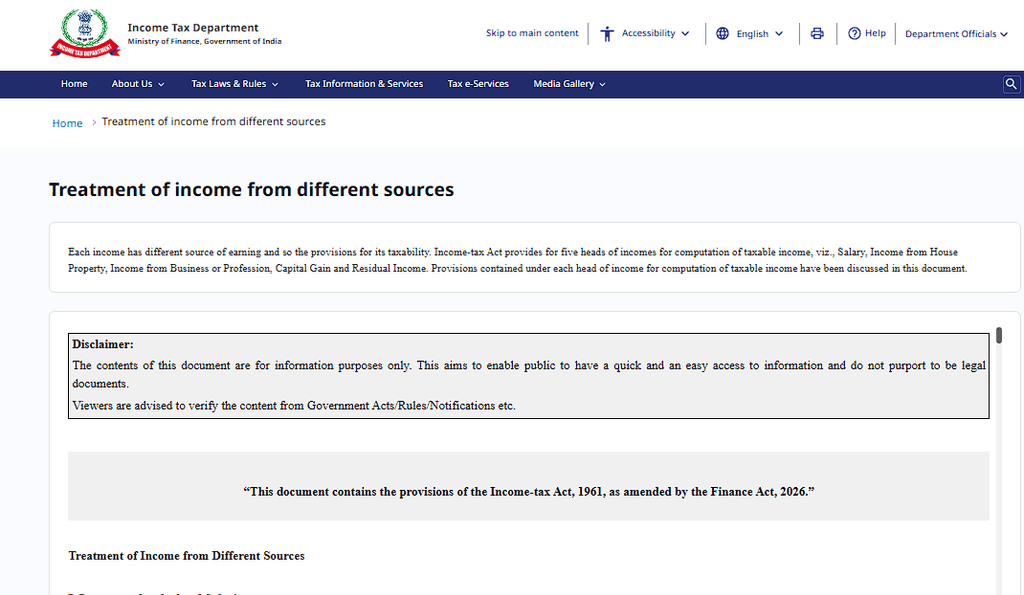
Please refer to the official Income Tax Portal if you’re having multiple income sources.
Frequently Asked Questions
I earn ₹8 lakh from salary, ₹6 lakh from savings interest, ₹15 lakh gain from crypto in 2026, ₹8 lakh from FDs, ₹4 lakh long-term gain from mutual funds, and ₹13 lakh from other investments. What will be my income tax for 2026?
Let’s work through this step by step, using the new tax regime slabs applicable for FY 2025-26 (AY 2026-27). Note that for a calculation like this to actually be meaningful, the nature of each figure matters a lot — “₹4 lakh from mutual funds” could mean sale proceeds, profit, or dividends, and each is taxed completely differently. Below, the mutual fund figure is treated specifically as long-term capital gain, and the crypto figure as taxable gain after acquisition cost (not gross sale value) — real numbers will need the same precision.
Assumptions: Standard deduction of ₹75,000 is applied to salary; the ₹4 lakh mutual fund figure is treated as the long-term capital gain itself (not sale proceeds) from an equity-oriented fund held over 12 months; the ₹15 lakh crypto figure is treated as the taxable gain from VDA transfers after the permitted acquisition-cost deduction (not gross sale value); “other investment” income is assumed to be taxed at slab rate (e.g., non-equity gains or other-source income) — this category needs clarification in real filing since the tax treatment varies a lot depending on what it actually is.
Step 1 — Slab-rate income: Salary (₹8,00,000 − ₹75,000 standard deduction) + Savings interest (₹6,00,000) + FD interest (₹8,00,000) + Other investment (₹13,00,000) = ₹34,25,000
Tax on this under the new regime slabs (4% Nil, 4–8L @5%, 8–12L @10%, 12–16L @15%, 16–20L @20%, 20–24L @25%, above 24L @30%) works out to approximately ₹6,07,500.
Step 2 — Mutual fund LTCG: Taking the ₹4,00,000 as long-term capital gain under Section 112A: ₹4,00,000 − ₹1,25,000 (the Section 112A threshold, below which LTCG on listed equity/equity funds isn’t taxed) = ₹2,75,000, taxed at 12.5% = approximately ₹34,375.
Step 3 — Crypto: Taking the ₹15,00,000 as the taxable gain from VDA transfers (i.e., sale value already net of the permitted cost of acquisition), tax at the flat 30% VDA rate under Section 115BBH = ₹4,50,000. No deduction other than cost of acquisition is allowed against this gain, no indexation applies, and it cannot be set off against any loss — from another VDA or any other income source.
Step 4 — Surcharge and cess: Total income here works out to ₹34,25,000 + ₹4,00,000 + ₹15,00,000 = ₹53,25,000, which crosses the ₹50 lakh surcharge threshold. A surcharge (10% at this income level under the new regime, subject to marginal relief) applies on the tax computed above, followed by a 4% health and education cess on the final amount.
Adding these together — slab tax + LTCG tax + crypto tax + surcharge + cess — the approximate total liability comes to around ₹12.3–12.5 lakh, though the exact figure depends on the precise nature of the “other investment” income and marginal relief calculations on the surcharge. Given the size of this liability and the number of income categories involved, this is a case where a CA’s exact computation is worth the fee — small classification differences (for instance, whether “other investment” is really capital gains, business income, or interest) can shift the final number by tens of thousands of rupees.
If my only income is ₹11 lakh in salary, do I pay any tax at all?
Under the new tax regime, taxable income up to ₹12 lakh is effectively tax-free due to the Section 87A rebate (combined with the standard deduction, salaried individuals get relief up to roughly ₹12.75 lakh in gross salary). So in this case, yes — your tax liability would be nil, provided this is your only income and you don’t have capital gains or other special-rate income, since the rebate doesn’t apply to those.
I have salary income plus ₹50,000 in F&O trading losses. Can I offset that loss against my salary?
No. F&O losses are classified as non-speculative business income/loss, and can be set off against other business income or certain other heads (excluding salary) in the same year, and carried forward for up to 8 years against future business income — but they cannot be set off against salary income.
I sold equity mutual fund units within 8 months of buying them. What tax rate applies?
Since the holding period is under 12 months, this qualifies as Short-Term Capital Gains (STCG) on equity, taxed at a flat 20%, rather than the 12.5% long-term rate. There’s no ₹1.25 lakh exemption for STCG — the full gain is taxable at 20%.
I made both crypto profits and crypto losses in the same year across different coins. Can I net them off?
No. This is one of the strictest rules under Indian tax law — losses from one Virtual Digital Asset cannot be set off against gains from another VDA, even within the same financial year. Each crypto transaction’s gain is taxed individually at 30%, and losses simply cannot reduce your tax liability at all, from crypto or any other income source.
Do I need to report FD interest if TDS was already deducted by the bank?
Yes. The bank deducting TDS (typically at 10%) is not the same as your final tax being settled. You still need to report the full FD interest as income in your ITR, claim credit for the TDS already deducted, and pay any additional tax due if your slab rate is higher than 10% (which it will be for most taxpayers above the basic exemption limit).
The Bottom Line
Having multiple income sources isn’t a complication to be afraid of — it’s simply a matter of knowing which bucket each type of income falls into, and how each bucket is taxed. Salary and business income build your slab-rate base. Capital gains from stocks and mutual funds follow their own holding-period-based rates. Crypto sits entirely outside the normal system with its flat 30% rule. Get the classification right, reconcile against your Form 26AS and AIS, and choose the correct ITR form — and filing with multiple income sources becomes a straightforward exercise rather than a source of anxiety every filing season.
Disclaimer: This article is intended for general informational purposes only, to help readers get a quick and simple understanding of how tax on multiple income sources works. It is not tax, legal, or financial advice, and should not be relied upon as a substitute for one. Tax rates, thresholds, and rules referenced here are subject to change, and individual circumstances can significantly affect actual liability. Readers are strongly advised to verify current provisions against official Income Tax Department notifications, Acts, and Rules, and to consult a qualified Chartered Accountant or tax professional before making any filing or financial decisions.