Kolata, July 1, 2026|CoreSignal
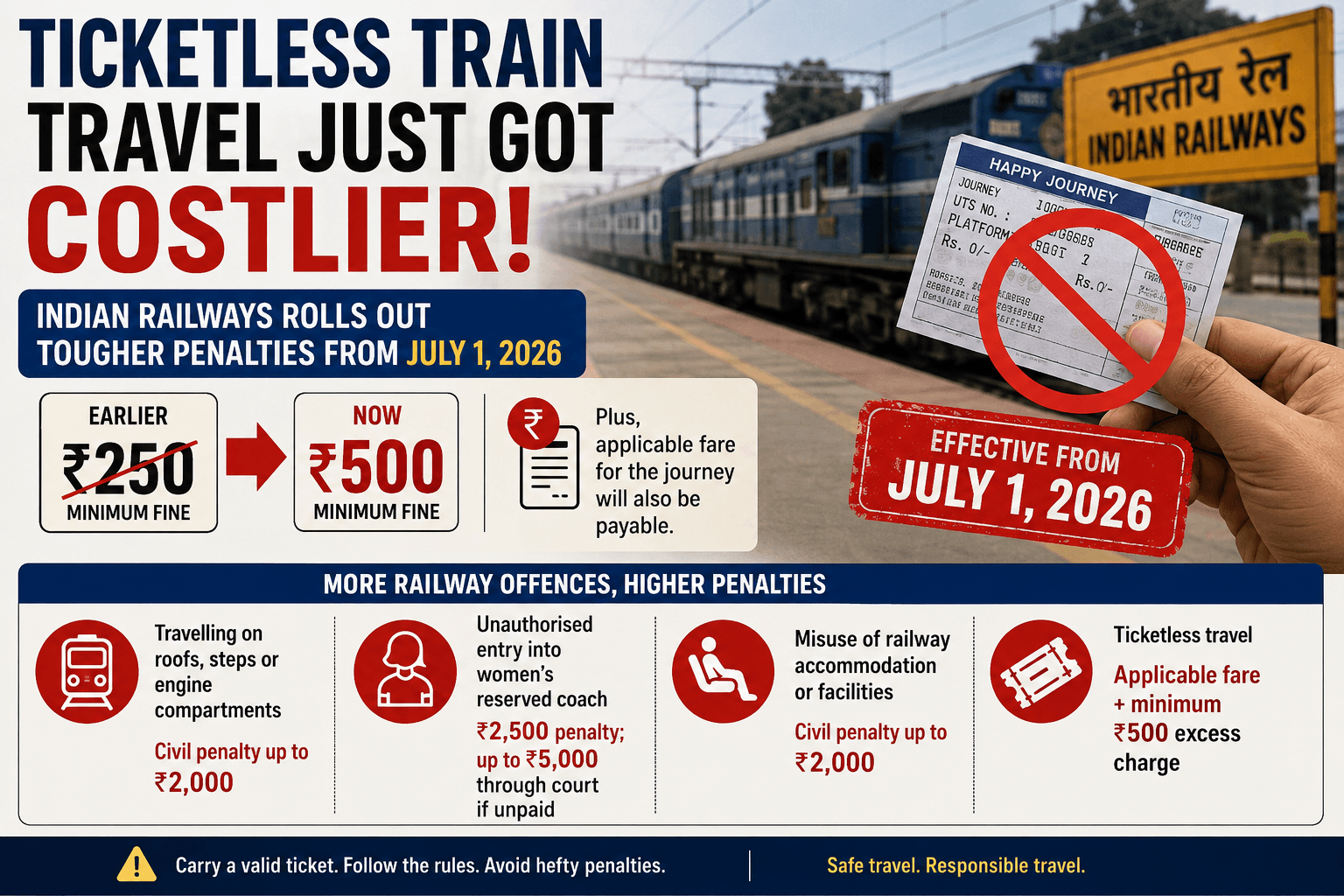
Thank you for reading this post, don't forget to subscribe!Ticketless Train Travel Just Got Costlier as Indian Railways has rolled out stricter penalty rules from July 1, 2026. Under the Jan Vishwas (Amendment of Provisions) Act, 2026, the minimum excess charge for travelling without a valid ticket has been doubled from ₹250 to ₹500, marking one of the most significant revisions to railway passenger penalties in recent years.
The revised rules are aimed at discouraging fare evasion while improving compliance with railway regulations. Passengers caught travelling without a valid ticket will not only have to pay the applicable fare but will also be liable to pay the revised excess charge, meaning the total amount payable may be substantially higher depending on the journey.
What’s Changed From July 1?
Under the revised provisions of Sections 137 and 138 of the Railway Act, passengers found travelling without a proper ticket will now have to pay:
- The applicable fare for the journey, plus
- An excess charge, with the minimum penalty increased from ₹250 to ₹500.
Depending on the circumstances-such as where a passenger boarded the train and the applicable fare-the total amount payable may be substantially higher than ₹500. In some cases, if the fare cannot be determined, railway authorities may calculate it from the train’s originating station or the last ticket-checking point as permitted under the law.
According to the government, the revised penalties are intended to reduce fare evasion, improve passenger discipline across the railway network, and encourage travellers to purchase valid tickets before boarding.
The July 1 changes are part of a broader revision of railway penalties. Indian Railways has also increased fines for several other violations, including unauthorised entry into coaches reserved for women, travelling on train roofs or engine compartments, and misuse of railway facilities. The objective is to improve passenger safety, strengthen discipline, and reduce misuse of railway services.
Not Just Ticketless Travel: More Railway Offences Now Attract Higher Penalties
The revised law also targets one of the most dangerous practices on the railway network.
Passengers found travelling on:
- Train roofs
- Footboards or steps
- Engine compartments
- Any part of the train not meant for passengers
may now face a civil penalty of up to ₹2,000, replacing the earlier fine of up to ₹500. If the penalty is not paid, the person may be produced before a court, which can impose a fine of up to ₹2,000.
Entering Women’s Reserved Coaches Will Be Costlier
The amendments also strengthen protection for women passengers.
A man found entering or remaining in accommodation reserved for women can now face:
- A ₹2,500 civil penalty.
- Removal from the coach by railway staff.
- If the penalty is refused, court proceedings may follow, with a fine of up to ₹5,000.
The revised provision expressly exempts transgender persons from proceedings under this section.
Misusing Railway Facilities? Higher Penalties Apply
Indian Railways has also increased penalties for misuse of railway accommodation and certain railway facilities.
The previous maximum fine of ₹150 has been replaced with a civil penalty of up to ₹2,000. If the offender fails to pay the penalty, the matter may be referred to a court.
Why Ticketless Train Travel Just Got Costlier?
The July 1 amendments are part of the government’s broader effort to decriminalise several minor railway offences while strengthening compliance through higher civil penalties. The objective is to reduce fare evasion, improve passenger safety, discourage misuse of railway facilities, and simplify enforcement by replacing criminal prosecution with monetary penalties in several cases.
At a Glance: What Changed From July 1?
| Offence | Revised Penalty (From July 1, 2026) |
|---|---|
| Ticketless travel | Applicable fare + minimum ₹500 excess charge |
| Travelling on train roofs, footboards, steps or engine compartments | Civil penalty up to ₹2,000 |
| Unauthorised entry into women’s reserved accommodation | ₹2,500 civil penalty; court may impose up to ₹5,000 if unpaid |
| Misuse of railway accommodation or facilities | Civil penalty up to ₹2,000 |
CoreSignal Take
The July 1 amendments represent a significant shift in the way Indian Railways enforces passenger rules. Rather than relying primarily on criminal prosecution for several minor offences, the revised framework places greater emphasis on higher financial penalties while retaining legal action for non-compliance. For passengers, the message is clear: travel with a valid ticket, respect reserved spaces, and follow railway regulations to avoid substantially higher penalties.
Also Read
Why Has Indian Railways Increased the Fine?
Every year, ticketless travel results in significant revenue losses and contributes to overcrowding on trains. By imposing stricter penalties, Indian Railways aims to encourage passengers to purchase valid tickets before boarding and improve the overall travel experience.
The move comes as Indian Railways continues to report large numbers of ticketless travellers during routine ticket-checking drives across the country. The government says the revised penalties are intended to:
- Reduce ticketless travel and revenue loss.
- Improve discipline across the railway network.
- Encourage passengers to purchase valid tickets before boarding.
- Simplify enforcement by relying more on monetary penalties under the Jan Vishwas framework.
What Should Passengers Do?
To avoid penalties:
- Buy a valid ticket before boarding the train.
- Carry your ticket (printed or digital) throughout the journey.
- Travel only in the coach for which you are authorized.
Final Word
The revised railway rules mark one of the biggest overhauls of passenger penalties in recent years. From ticketless travel to unauthorised entry into reserved coaches and unsafe travel on train roofs or footboards, several offences now attract significantly higher penalties. Passengers are advised to familiarise themselves with the updated rules before travelling to avoid unnecessary fines and ensure a safe, hassle-free journey.