August 5, 2026|CoreSignal
Thank you for reading this post, don't forget to subscribe!Synopsis
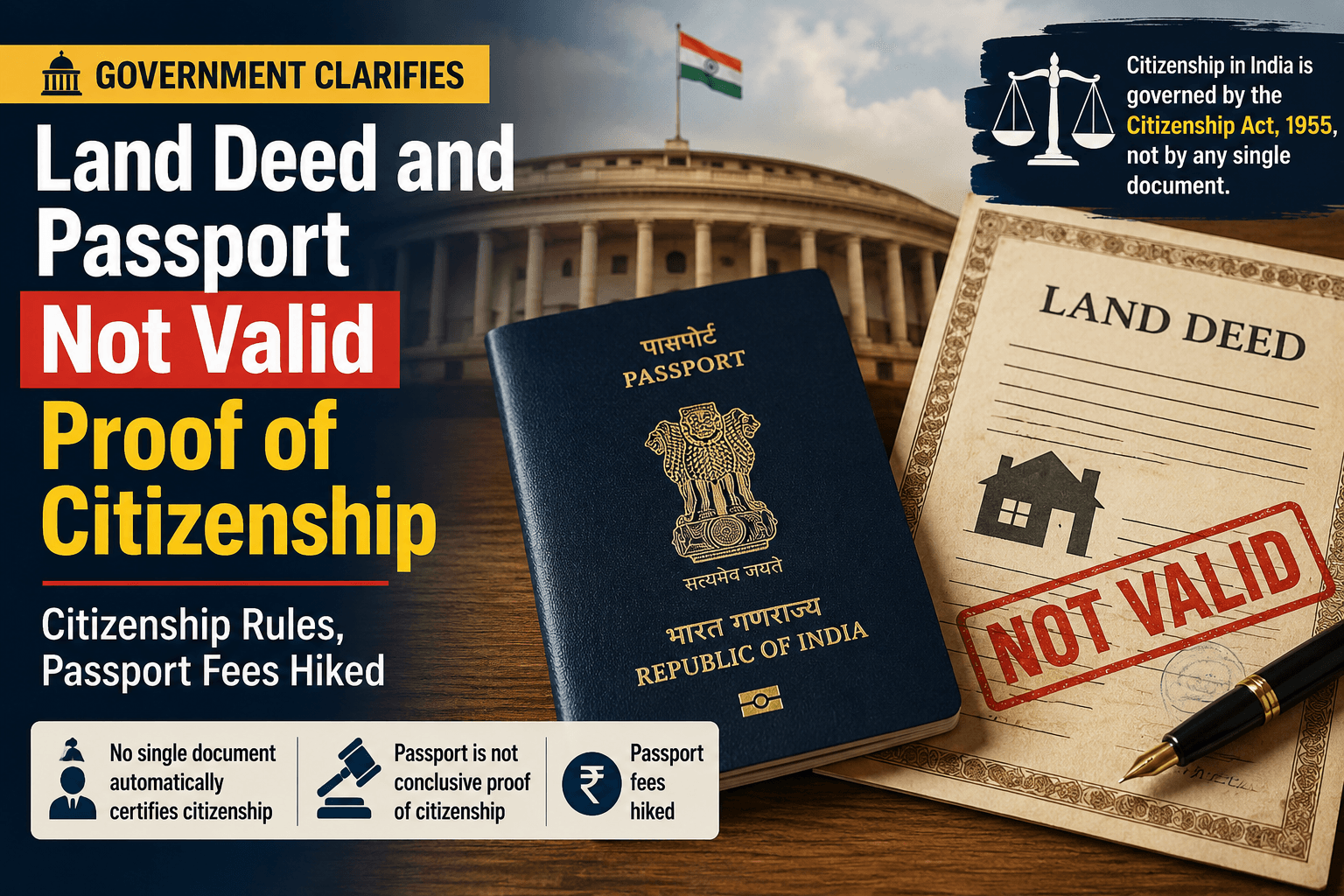
The Indian government has rolled out the steepest passport fee hike in nearly 14 years, and it has arrived alongside a pointed legal clarification from the Ministry of External Affairs (MEA): an Indian passport is a travel document, not proof of citizenship. That position has been echoed in the courts too — the Calcutta High Court recently ruled that land records showing property ownership are equally insufficient to establish Indian citizenship. Together, these developments have made citizenship documentation one of the most talked-about administrative and legal topics of 2026.
Why Govt Says Land Deed and Passport Not Valid as Proof of Citizenship?
The government and courts have drawn a clear line between documents that establish identity or legal transaction rights and documents that establish citizenship, and passports and land deeds fall into the former category, not the latter. A passport is issued under the Passports Act, 1967, primarily to enable travel and prove identity abroad — and the law itself permits passports or travel documents to be issued to certain non-citizens, which is precisely why courts, including the Bombay High Court in 2013, have ruled that possessing one cannot be treated as conclusive proof of nationality. Land deeds fail the same test from a different angle: Indian law allows foreign nationals to legally purchase and own immovable property in India under specified conditions, so a person’s name on a land record reflects a property transaction, not a citizenship status. In both cases, the underlying logic is the same — these documents can be lawfully held by non-citizens, so neither can serve as definitive legal proof of who is and isn’t an Indian citizen. That determination instead rests on the Citizenship Act, 1955, and is typically established through birth certificates, parentage records, and similar documentation tied directly to nationality.
Speaking around Passport Seva Diwas in late June, an MEA official reiterated that while passports are issued only to citizens, their core purpose is to enable international travel and establish identity abroad — not to certify nationality. That distinction rests on the Passports Act, 1967, which allows the government to issue passports or travel documents to non-citizens under specific circumstances. Because of that provision, courts — including the Bombay High Court in a 2013 ruling — have held that holding a passport cannot be treated as conclusive proof of citizenship.
The remark reignited a debate that had already been building, with citizenship and identity documentation under scrutiny following disputes over the Special Intensive Revision (SIR) of electoral rolls and various citizenship-related court cases. Land ownership records have come under the same scrutiny. Hearing a plea from a man detained in West Bengal on suspicion of being a Bangladeshi national, the Calcutta High Court held that a foreign national buying property in India does not automatically make that person an Indian citizen — meaning land deeds, like passports, are not treated as conclusive proof either.
Taken together, these rulings raise an obvious follow-up question for the public: if neither a passport nor a land deed proves citizenship, what does? Legally, citizenship in India is governed by the Citizenship Act, 1955, and there is no single universal document that automatically certifies it — birth certificates, parentage records, and other evidence generally carry more weight in disputed cases than any one identity or property document.
If Passports and Land Deeds are Not Proof of Citizenship, What is?
The honest answer is that no single document automatically certifies Indian citizenship. Citizenship is a legal status governed by the Citizenship Act, 1955, not something conferred simply by possessing a particular document.
For example, a person born in India before July 1, 1987 is generally a citizen by birth, regardless of their parents’ nationality. In such cases, a birth certificate or other reliable records establishing the person’s date and place of birth can be important evidence in support of a citizenship claim, even though they are not, by themselves, a formal “certificate of citizenship.”
This naturally raises a question: if passport applicants must establish that they are Indian citizens and declare that they do not hold another country’s citizenship—since India does not permit dual citizenship—shouldn’t a passport itself count as proof of citizenship? The distinction lies between evidence used to issue a document and conclusive legal proof. Passport authorities rely on the applicant’s declarations and supporting documents during verification; the passport itself does not independently establish citizenship. Moreover, the Passports Act, 1967 allows passports or travel documents to be issued to certain non-citizens in limited circumstances. For that reason, the Bombay High Court has held that the mere possession of a passport cannot be treated as definitive proof of Indian citizenship. A passport is the result of an administrative process based on supporting evidence—not, in itself, a standalone legal certificate of citizenship.
The Revised Passport Fees, Effective July 1, 2026
The fee revision came through the Passports (Amendment) Rules, 2026, which replaced the fee schedule that had been in place since 2012. It applies to fresh applications, renewals, Tatkal (expedited) services, and lost or damaged passport replacements — both within India and at Indian missions abroad.
For adults (18 and above):
- 36-page passport, Normal processing: ₹2,500 (up from ₹1,500)
- 36-page passport, Tatkal: ₹5,000
- 60-page passport, Normal processing: ₹3,500
- 60-page passport, Tatkal: ₹6,000
For minors (below 18):
- 36-page passport, Normal processing: ₹1,750
- 36-page passport, Tatkal: ₹4,250
Replacement fees for lost or damaged passports have been aligned with the new Tatkal rates. A Passport Seva Kendra (PSK) service charge of ₹500 applies on top of the application fee for every category, including Tatkal.
A concession remains in place: a 10% discount on the normal fee continues to apply to fresh (not reissue) applications for children up to age 8 and senior citizens above 60.
Why the Passport Fees Went Up
The MEA has attributed the increase to rising administrative costs, the security features built into India’s newer chip-based e-passports, and continued investment in the Passport Seva network — including more Seva Kendras, stronger cybersecurity, and faster digital processing. Officials describe the changes as intended to modernize infrastructure and speed up service delivery, rather than as being connected to the citizenship clarification, even though the two announcements landed close together.
What Applicants Should Know
- Timing: Applications submitted before July 1, 2026 were charged under the old fee structure; anything submitted on or after that date follows the new rates.
- Existing passports: Validity of passports already issued is unaffected — the revision applies only to new applications, renewals, and replacements going forward.
- Where the changes apply: The updated schedule covers not just standard passport issuance but also Police Clearance Certificates, Surrender Certificates, Certificates of Identity, and other passport-related services.
- Documentation: The application process itself — online submission through the Passport Seva portal, document upload, and police verification — remains largely unchanged; it’s the fee structure and the citizenship framing that are new.
Frequently Asked Questions
The Bigger Picture
Neither clarification changes how passports are processed, who is eligible to receive one, or a person’s right to own property in India — they simply restate a long-standing legal position that had rarely been said so plainly in public until now. For applicants and property owners alike, the practical takeaway is straightforward: passports remain essential for travel, and land ownership remains fully legal for both citizens and eligible foreign nationals, but for matters specifically involving proof of citizenship, other documentation — particularly birth and parentage records — carries more legal weight.