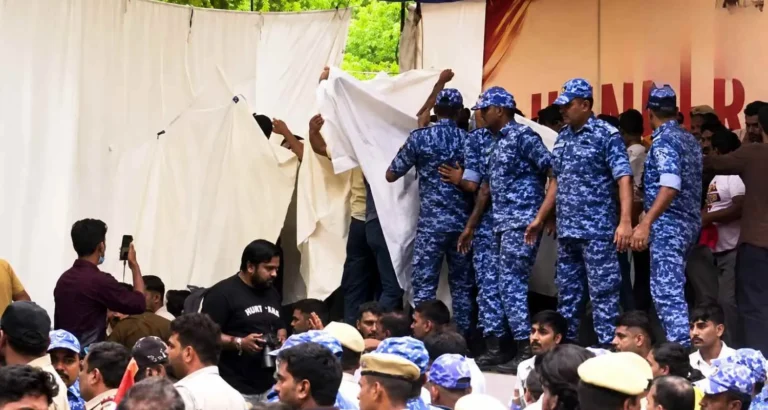
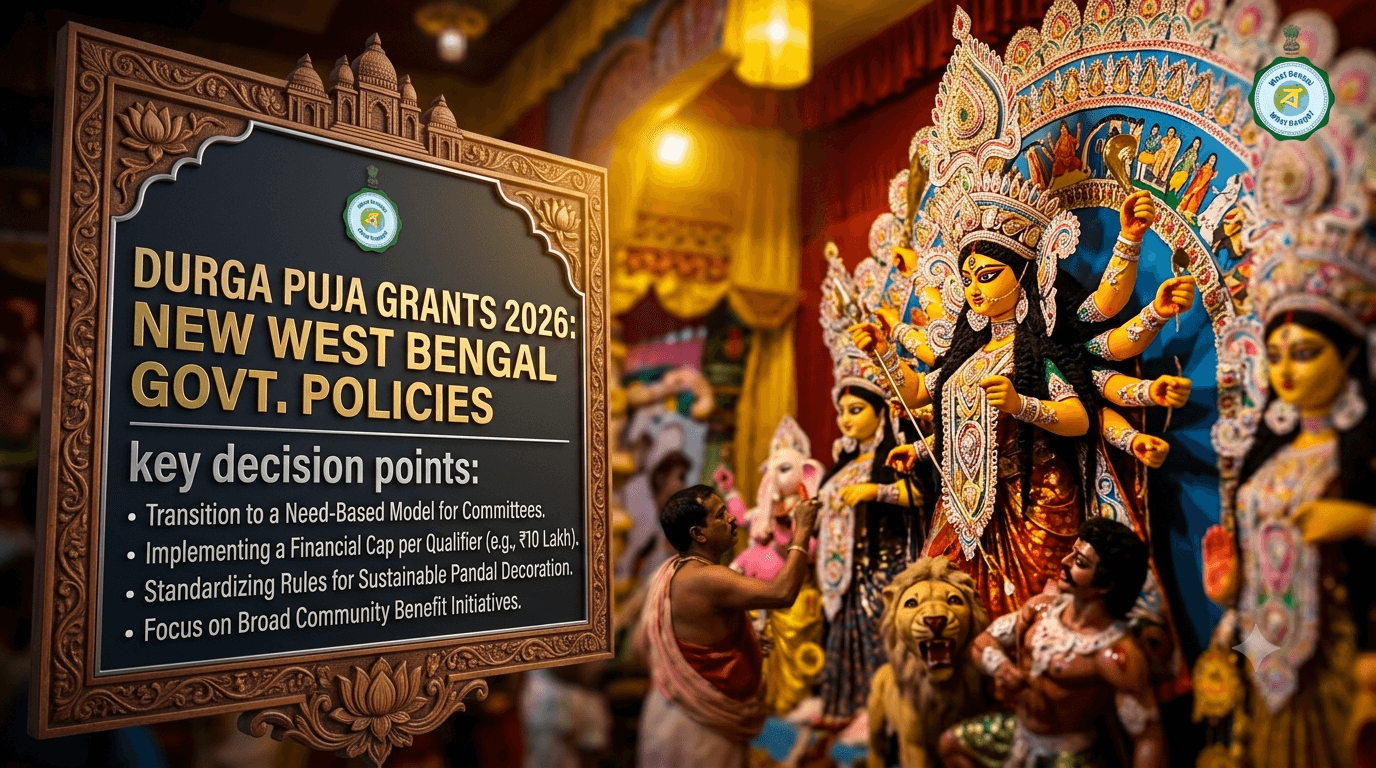
West Bengal’s new BJP government has confirmed Durga Puja Grant will continue in 2026 — but reshaped around need-based eligibility, not the flat payout every committee got under the previous TMC government.
Thank you for reading this post, don't forget to subscribe!September 7, 2026|CoreSignal
Durga Puja Grant 2026: What West Bengal’s New BJP Government Has Decided for Puja Committees
For eight years, West Bengal’s Durga Puja season came with a predictable ritual of its own: the state government handing out Durga Puja grants to puja committees, rising every year from ₹10,000 in 2018 to ₹1.10 lakh in 2024. This year, for the first time since the scheme began, the answer wasn’t a given. West Bengal has a new government, and Puja organisers across the state have spent the past four months wondering whether the money — and the goodwill that came with it — would survive the change of power.
On September 7, Chief Minister Suvendu Adhikari met representatives of Puja committees at Milan Mela in Kolkata to lay out how this year’s festival will be handled. Here’s what’s actually been decided, what’s still unclear, and why the whole question matters so much politically.
Need-Based, Not Universal
Grants are continuing in some form, but not as a blanket payout to every registered committee the way the previous Trinamool Congress (TMC) government ran it. The Adhikari government has been signalling since June that assistance would be need-based rather than universal, and government sources cited in early August suggested that only committees with a Puja budget under ₹10 lakh may qualify for financial help. At the September 7 meeting, Adhikari also announced new rules around theme pujas and used the occasion to criticise the previous government’s approach to steadily raising the grant amount every year.
Durga Puja Grant History: From Mamata’s ₹10,000 Scheme to BJP’s Political Dilemma
Durga Puja grants started in 2018 under Mamata Banerjee’s TMC government at ₹10,000 per committee and climbed steadily over the following years. By 2024, the figure had reached ₹1.10 lakh per committee, with roughly 45,336 committees across the state sharing about ₹498 crore, on top of an 80% rebate on electricity bills, plus government-arranged security, water supply and fire safety.
The BJP, then in opposition, regularly criticised the scheme as a pre-election move aimed at courting Bengal’s Hindu vote base, arguing the state should prioritise unpaid dearness allowance (DA) for government employees over festival grants. The scheme also faced legal challenges, with petitioners arguing the payouts amounted to wasteful public expenditure; the Calcutta High Court allowed the grants to continue subject to conditions.
That argument became moot in May 2026, when the BJP ended TMC’s 15-year run in West Bengal and Suvendu Adhikari was sworn in as Chief Minister. With Adhikari’s own party having spent years questioning the grants, Puja committees were left genuinely unsure whether the payments would continue at all.
From Universal Aid to Need-Based Support
Adhikari first addressed the question in mid-June, telling reporters in Kolkata that his government hadn’t yet formally discussed the issue but that any support carried over from the previous administration would likely be need-based — meaning only committees that genuinely require financial help would get it, rather than every puja regardless of budget or corporate sponsorship.
By early August, sources at Nabanna (the state secretariat) indicated the government was leaning toward restricting grants to committees with a total Puja budget below ₹10 lakh, though the final call was left to the Chief Minister and the state finance department. Around the same time, the BJP government had already announced a ₹5 lakh grant for organisers of the Jagannath Rath Yatra, showing it was willing to fund religious festivals on its own terms even while reworking the Puja scheme.
Grants, Theme Pujas and Other New Rules
At the Milan Mela meeting with Puja committee representatives, Adhikari confirmed a mix of continuity and change:
- Grants for eligible committees: assistance is being made available again this year, framed around smaller and need-based committees rather than a flat payout to all, with amounts reportedly running up to roughly ₹1 lakh for some committees — though the government has not published a single confirmed figure applicable to every organiser.
- New rules for theme pujas: the government laid out fresh guidelines for how theme-based pandals should be organised this year.
- Ashtami “dry day”: bar counters and liquor sales will be shut on Ashtami, one of the most significant days of the festival.
- No immersion carnival: the large post-Puja immersion carnival held in recent years has been scrapped. In its place, the government is planning a large public event at Eden Gardens on Mahalaya to formally inaugurate the festive season.
The Political Backdrop
The grant decision isn’t happening in a vacuum. West Bengal is headed into local body elections later this year, and the Election Commission has already announced by-elections for the Nandigram and Rejinagar assembly seats ahead of Puja. A festival that reaches nearly every neighbourhood in the state, through tens of thousands of community committees, is inevitably read as a political signal — whichever way the government leans.

There’s also a cultural dimension this year. The Vishwa Hindu Parishad has pushed for Durga Puja to be organised strictly by “sanatani” Hindus, with non-Hindus limited to visiting pandals rather than helping organise them — a break from Bengal’s tradition of sarbojaneen (community-wide) Puja involving people of all faiths. A separate, unrelated food-safety crackdown on meat and fish sellers in Kolkata in the run-up to Puja has added to the sense that this year’s festival looks and feels different, even before the grant question is settled. Some long-running Puja committees have already said they won’t hold public celebrations this year, though most haven’t stated a reason publicly.
What This Means For Puja Committees This Year
If your committee is expecting government assistance in 2026:
- Don’t assume you’ll automatically qualify the way your committee may have in past years — budget size now appears to be a key eligibility factor.
- Watch for formal guidelines from the Information & Cultural Affairs Department confirming exact grant amounts and application criteria, since specifics beyond the general “need-based, smaller-budget” framing have not been finalised in public statements as of this meeting.
- Plan for an Ashtami dry day and updated theme-puja rules regardless of whether your committee receives a grant.
- Note that the state-level immersion carnival is not happening this year, with celebrations instead centred around a Mahalaya event at Eden Gardens.
Durga Puja 2026 key dates
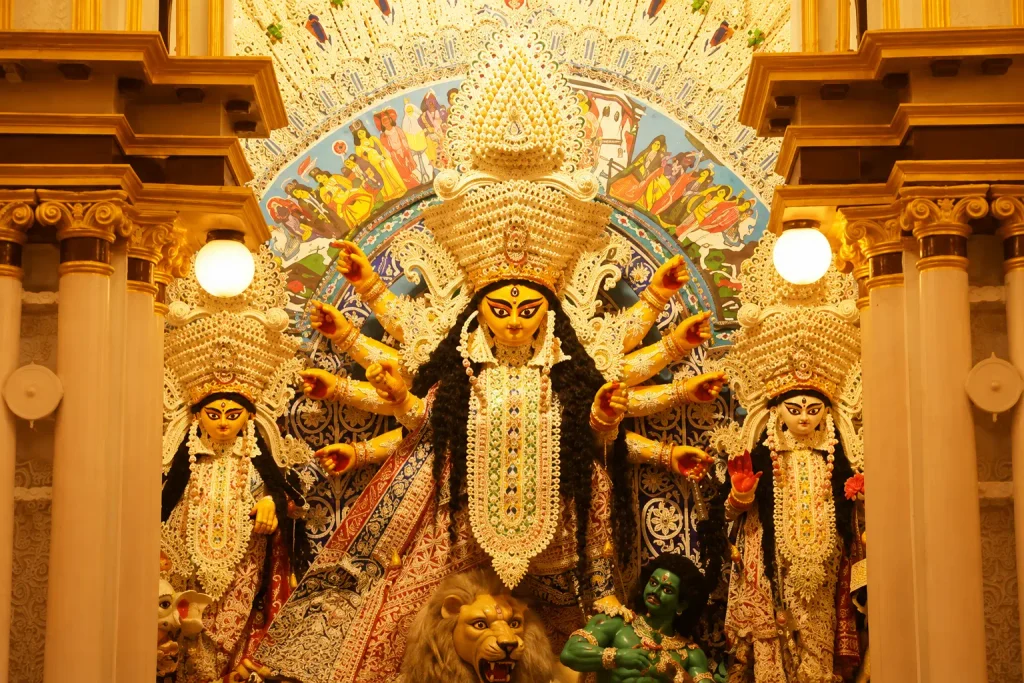
- Mahalaya: October 10, 2026
- Shashthi (Puja begins): October 16, 2026
- Maha Ashtami: October 19, 2026
- Vijaya Dashami: October 20–21, 2026 (dates vary slightly by panchang)
The Bigger Picture
Durga Puja grants in West Bengal aren’t being scrapped outright under the new BJP government, but they are being reshaped — from a universal payout that grew every year under the TMC into a smaller, need-based scheme aimed at committees that can’t fund their own celebrations. Combined with new theme-puja rules, an Ashtami dry day, and the cancellation of the immersion carnival, this year’s Puja is shaping up to look noticeably different from the last several years, even as the core festival itself remains, as Adhikari has said he wants it to be, bigger than before.
This is a developing story. Grant amounts and eligibility criteria are expected to be formalised by the Information & Cultural Affairs Department in the coming weeks — check back for updates as official notifications are released.