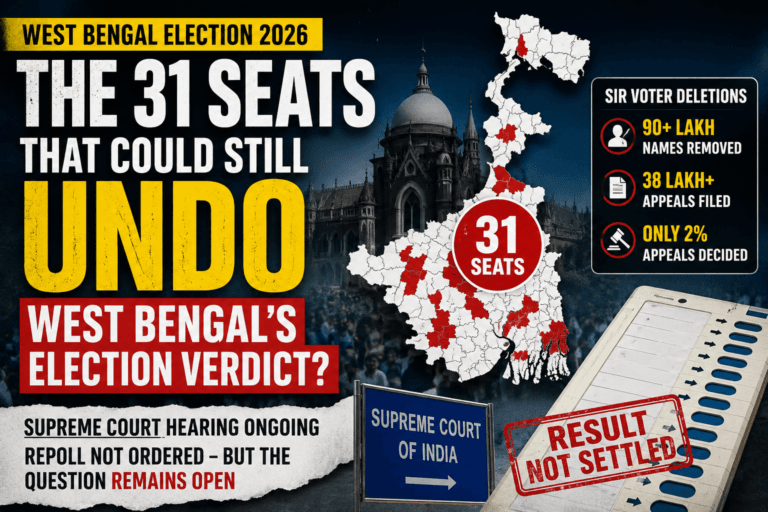
Kalyan Banerjee told the Supreme Court that SIR-related voter deletions may have affected 31 West Bengal Assembly constituencies, while the Court has questioned the link between deletions and election results.
Thank you for reading this post, don't forget to subscribe!August 29, 2026|CoreSignal
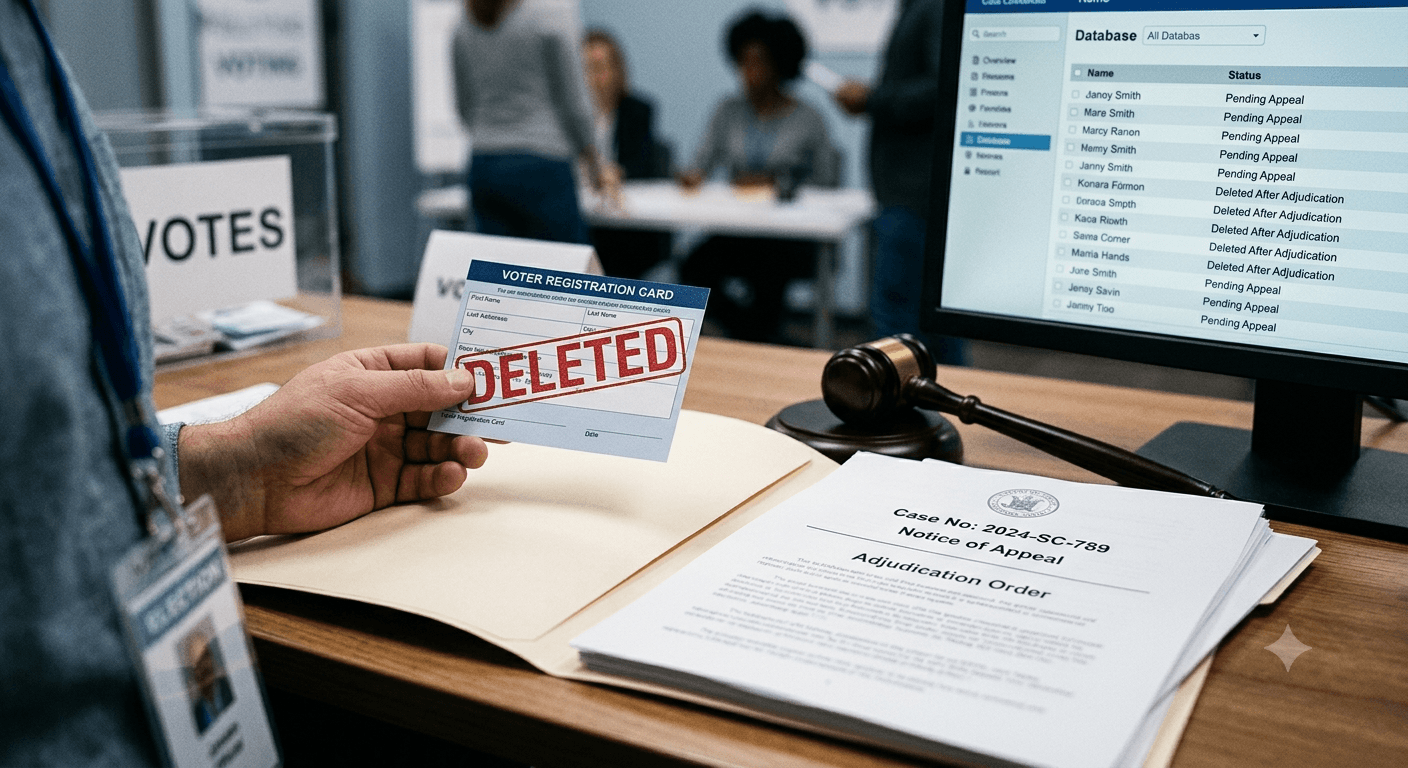
Supreme Court on Voters Deleted After Adjudication
Trinamool Congress MP and senior advocate Kalyan Banerjee told the Supreme Court on May 11, 2026 that voter deletions carried out during West Bengal’s Special Intensive Revision (SIR) may have materially altered the outcome of the state’s Assembly elections — specifically in 31 constituencies where, he argued, the number of deleted voters exceeded the BJP’s actual margin of victory. Since then, the case has moved through several more hearings, with the Court pushing back hard on the “results were affected” argument as recently as this week.
Nearly 35 Lakh Appeals Against SIR-Related Deletions Were Still Pending Before Appellate Tribunals, Kalyan Banerjee Told the Court
Appearing before a bench of Chief Justice of India Surya Kant and Justice Joymalya Bagchi, Banerjee argued that in at least 31 Assembly seats, the winning margin was smaller than the number of voters removed during the SIR adjudication process in that same constituency.
His sharpest example was Jangipara, where he said BJP candidate Prasenjit Bag won by a margin of just 862 votes — while more than 5,000 names (cited variously across reports as 5,432 or 5,550) had been deleted from the electoral rolls in that constituency during the SIR exercise. Beyond individual seats, Banerjee pointed to two statewide numbers: the overall vote gap between TMC and BJP across the state stood at roughly 32 lakh votes, while nearly 35 lakh appeals against SIR-related deletions were still pending before appellate tribunals at the time.
The scale of the deletions, in full
For context that’s become clearer since May: West Bengal’s electoral roll stood at 7,60,10,006 names in 2024. By the time the final SIR roll was published on February 28, 2026, that number had fallen to 6,44,52,609 — a drop of 1,15,57,397 voters, or just over 15%. According to reporting citing Chief Electoral Officer data, the decline cut across gender lines in similar proportion. Earlier in the process, TMC MP Derek O’Brien had separately petitioned the Court over 58,20,898 names being deleted from the draft roll without notice or personal hearing — a figure that predates the final roll numbers above and reflects an earlier stage of the process.
The appeals process: how it’s actually performing
This is where the most striking recent numbers have emerged. As of August 7, 2026, barely 2% of the nearly 38 lakh appeals filed by excluded voters had been decided — data placed before the Supreme Court this week via an RTI response from the office of West Bengal’s Chief Electoral Officer. Specifically:
- 82,782 appeals disposed of out of 37,27,838 total filed
- Of those decided, 75,443 resulted in the voter being added back to the rolls
- Only 7,339 decisions ended in exclusion
- That means over 91% of decided appeals have gone in favour of the voter
- Roughly 1 appeal decided for every 46 filed
This data came up on August 25, 2026, before a bench of CJI Surya Kant and Justices Joymalya Bagchi and V Mohana. The ECI, represented by Senior Advocate Dama Seshadri Naidu, has sought a further listing of the matter, which the Court allowed.
The Supreme Court’s most recent — and most direct — response
This is the most significant recent development, and it bears directly on the “what could the results have been” question. In a hearing reported on August 26, 2026, the Supreme Court pushed back firmly on TMC’s argument for annulling the election results over the deletions. According to the reported exchange, the Court indicated that the mere fact that a large number of voters were deleted would not, by itself, establish that the election result was affected.
Justice Bagchi specifically stressed the importance of a distinct, related question: how many of the deleted voters actually filed an appeal against their exclusion in the first place. The reasoning appears to be that a deletion which was never contested carries less weight as evidence of a wrongful or consequential removal than one that was actively appealed — meaning TMC’s argument may need to show not just gross deletion numbers exceeding win margins, but that a meaningful share of those specific deleted voters actively disputed their removal.
This lines up with the Court’s earlier position from the May hearing, when Justice Bagchi told Banerjee that any plea specifically about how deletions affected results would need to be raised through a separate, independent application — not folded into the broader SIR challenge. The Election Commission has consistently argued that election-result disputes belong in formal election petitions under law, not in a writ petition of this kind.
Timeline: how the legal fight has evolved
- January 19, 2026 — SC directs the ECI to display names on the “logical discrepancies” list; around 1.25 crore voters were on it at the time.
- February 9, 2026 — SC orders the SIR process to continue “without hindrance,” extends the document-scrutiny deadline by a week.
- February 25, 2026 — SC orders West Bengal EROs to hand over all pending voter documents to judicial officers.
- February 28, 2026 — Final SIR electoral roll published.
- March 10, 2026 — SC order leads to the ECI constituting 19 Appellate Tribunals across West Bengal, headed by former Calcutta HC Chief Justice T.S. Sivagnanam and other former HC judges, to hear appeals district by district.
- March 25, 2026 — SC verbally directs the ECI to resolve pending voter adjudications before April 6, prioritising constituencies where voting had already occurred.
- April 6, 2026 — SC directs publication of the final supplementary voter list; ~59 lakh of 60 lakh claims/objections reported resolved by this point; three retired Chief Justices/Judges appointed to monitor the 19 tribunals for speedy disposal.
- May 11, 2026 — Kalyan Banerjee’s submission on the 31 constituencies and the 32 lakh/35 lakh figures (detailed above).
- In May (a separate, earlier ruling) — The Supreme Court upheld the ECI’s authority to conduct the SIR exercise itself, while clarifying limits on the ECI’s power to determine citizenship as part of that process.
- August 7, 2026 — RTI data shows only ~2% of appeals resolved.
- August 11, 2026 — SC seeks a detailed status report from the ECI on tribunal disposal rates; matter listed for August 25.
- August 25–26, 2026 — Fresh hearing; Court questions whether deletion numbers alone can justify overturning results, and stresses the appeal-filing rate as the more relevant metric.
So, what could the results have been without the deletions?
Based on everything reported through this week, that remains an open, judicially unresolved question — and the Court’s own recent remarks suggest it’s skeptical of answering it through gross deletion numbers alone. No ruling has established a counterfactual outcome. TMC’s argument continues to rest on the 31-constituency comparison and the size of the overall statewide gap, but the Court has now twice signalled — first in May, and more pointedly in the August 26 exchange — that this argument likely needs a more specific evidentiary basis (such as how many deleted voters in those constituencies actually appealed) rather than a straightforward numbers comparison, and that it may need to be pursued as its own separate legal application rather than as part of the broader SIR challenge.