
Bangladesh edges ahead of India on 2026 per capita GDP, but IMF projections suggest the gap could reverse within a year.
Thank you for reading this post, don't forget to subscribe!August 29, 2026|CoreSignal
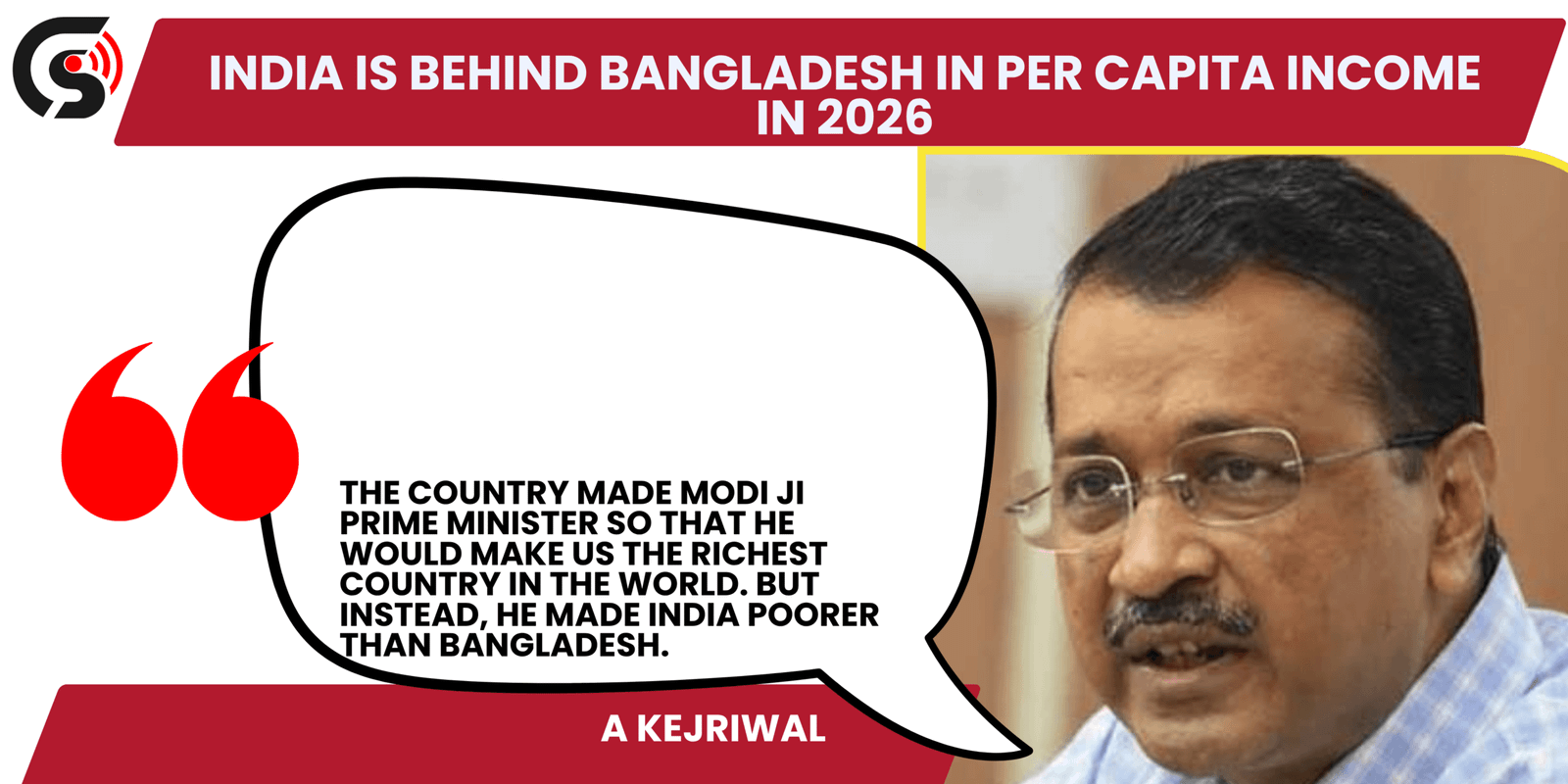
Aam Aadmi Party national convenor Arvind Kejriwal launched a sharp attack on the central government on August 21, 2026, claiming that India is behind Bangladesh in per capita income in 2026 and arguing that this reflects a broader economic decline under the current government. The claim, as it turns out, broadly aligns with the International Monetary Fund’s projections for this year, although the political framing goes beyond what the figures themselves establish.
Why Kejriwal said India Is Behind Bangladesh in Per Capita Income
Kejriwal said India’s per capita income in 2026 stands at approximately $2,800, while Bangladesh’s has climbed to around $2,900. He argued this marks a reversal from 2014, when, according to him, India’s per capita income was about $1,600 against Bangladesh’s $1,100 — meaning India was significantly ahead of its neighbour at that point.
Posting on social media, Kejriwal put it starkly: “Today, in terms of per capita income, India has fallen behind Bangladesh.
The country made Modi ji Prime Minister so that he would make us the richest country in the world. But instead, he made India poorer than Bangladesh.” He framed this as evidence that the promise of India overtaking major economies like the United States, which he said the public hoped for in 2014, has instead ended with India trailing a much smaller neighbouring economy.
Checking the numbers against IMF data
Kejriwal’s figures are close to, and directionally consistent with, actual IMF projections. According to the International Monetary Fund’s April 2026 World Economic Outlook, Bangladesh’s per capita GDP at current prices is estimated at $2,911 for 2026, against India’s $2,812 — a gap of roughly $100. This places Bangladesh 148th and India 150th globally on this specific measure.
Worth noting: this is a very recent flip. In 2025, India was actually slightly ahead, with per capita GDP of $2,675 against Bangladesh’s $2,635. The IMF’s own projections show the order reversing again in 2027, when India’s per capita GDP is estimated to reach $3,074 against Bangladesh’s $3,048 — and the IMF projects India will hold the lead through at least 2031.
Why this keeps happening — it’s not the first crossover
This isn’t a new phenomenon, and it isn’t unique to the current government either. Bangladesh was actually ahead of India in per capita GDP for over a decade, from 1989 to 2002. India then led for roughly 15 years before slipping behind again in 2018, and a similar crossover happened in 2020 as well, driven by India’s sharp COVID-era economic contraction.
Economists point to a fairly mechanical explanation for why this metric swings so easily between the two countries: the gap between them is narrow enough in absolute dollar terms that small differences in growth rates or currency movements can flip the ranking, even though India’s total economy remains roughly eight times larger than Bangladesh’s ($4.1 trillion versus roughly $510 billion in 2026). Per capita figures divide total GDP by population, and India’s vastly larger population means its per capita number is far more sensitive to marginal changes than a comparison of overall economic size would suggest.
Former World Bank chief economist Kaushik Basu, reacting to the same IMF data, reportedly described the development as “shocking” — indicating the reaction wasn’t confined to opposition politicians alone.
The broader context of the claim
Kejriwal’s underlying argument — that this reflects poorly on the government’s economic promises — taps into a debate that has recurred periodically since at least 2018, whenever this specific crossover has occurred. Congress leader Rahul Gandhi made a similar critique in 2020 when IMF data showed a comparable crossover, calling it evidence of a “solid achievement” of the government’s economic record, sarcastically.
On the other side of this recurring argument, economists have pushed back at various points on how much weight this single metric deserves. Former Chief Economic Adviser Arvind Subramanian argued in 2020 that on “more appropriate” economic metrics, Bangladesh hadn’t actually surpassed India and was unlikely to in the future — a reminder that per capita GDP at current dollar exchange rates is just one of several ways to measure comparative living standards, and it’s particularly volatile because it’s sensitive to currency fluctuations, not just underlying economic growth.
What to make of the numbers
The IMF data genuinely does show Bangladesh marginally ahead of India in current-dollar per capita GDP for 2026 — so Kejriwal’s core factual claim holds up. Where the political framing goes further than the data alone would suggest is the implication of a sustained, structural decline: IMF projections show this as a narrow, likely temporary crossover, with India expected to reclaim the lead as early as 2027 and hold it for years after. Both things can be true at once — the 2026 figures are real, and the broader trend doesn’t show one country steadily pulling away from the other on this metric.
Frequently Asked Questions
In short: Arvind Kejriwal’s claim that India has fallen behind Bangladesh in per capita income for 2026 is consistent with IMF data — Bangladesh’s per capita GDP is projected at $2,911 versus India’s $2,812 this year. However, IMF projections also show this as a narrow, likely temporary crossover, with India expected to regain the lead in 2027 and hold it through at least 2031 — a nuance that adds context to, without necessarily contradicting, Kejriwal’s underlying criticism.