As West Bengal heads toward December’s municipal polls, a stalled appeals process and 31 flagged assembly seats keep the door open to a legal challenge the Supreme Court has yet to close.
Thank you for reading this post, don't forget to subscribe!August 30, 2026|CoreSignal
West Bengal Election 2026: A Verdict That Isn’t Fully Settled
West Bengal election 2026 (assembly election 2026) was declared over in early May, with the BJP unseating Mamata Banerjee’s Trinamool Congress after more than a decade in power. But nearly four months later, the result is not entirely settled — and the reason lies buried in an unglamorous corner of the electoral process: appeals against voter deletions that nobody has gotten around to deciding.
A Verdict With an Asterisk
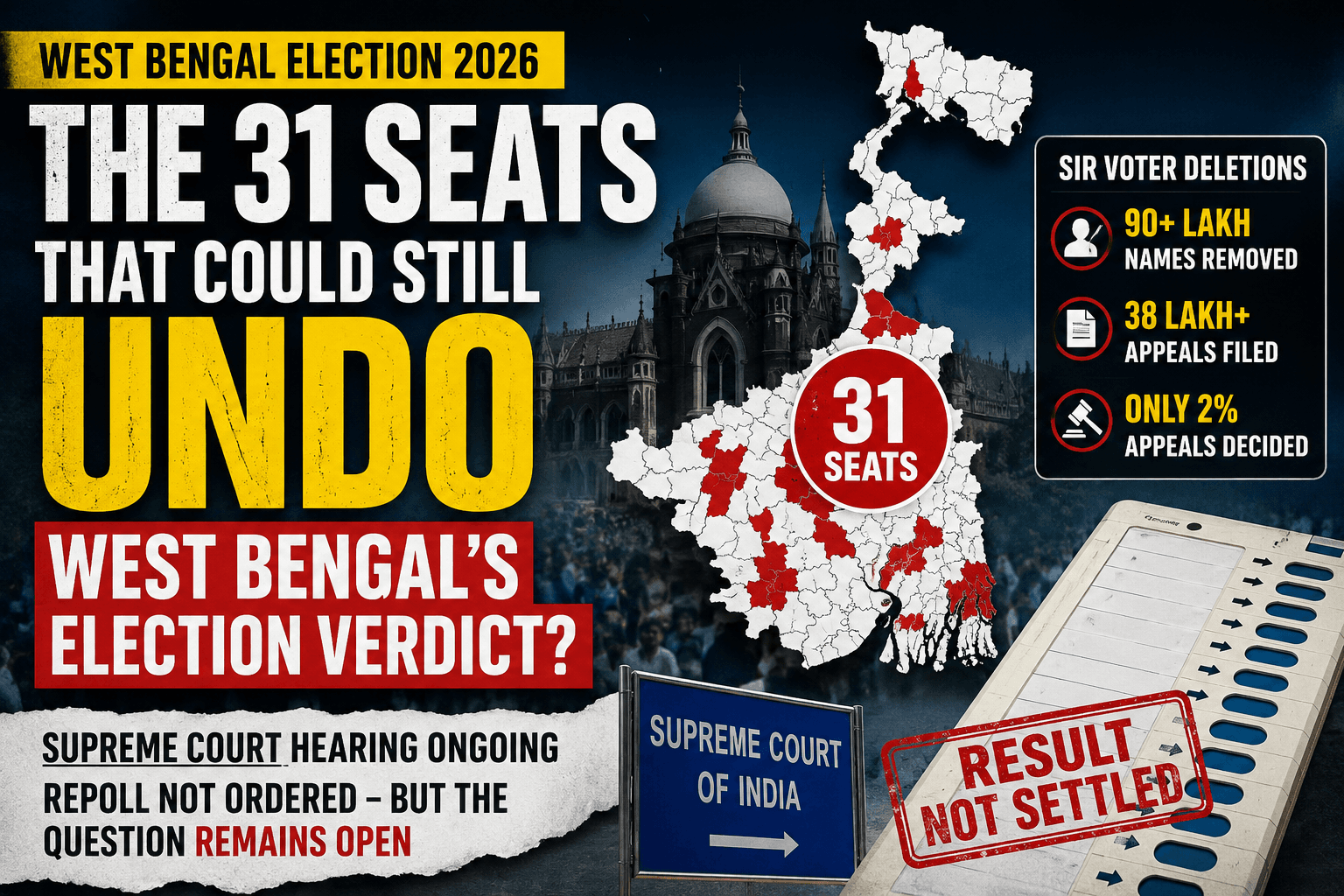
The trouble traces back to the Special Intensive Revision (SIR), the Election Commission’s roll-cleaning exercise carried out ahead of the polls. It removed more than 90 lakh names from West Bengal’s voter list. Only a fraction of those deletions — around 27 lakh — went through formal adjudication before votes were cast; the rest were left pending.
That mattered more in some places than others. When the Trinamool challenged the results before the Supreme Court in May, its counsel pointed out that in 31 assembly constituencies, the BJP’s winning margin over the Trinamool was smaller than the number of voters deleted whose appeals were still undecided. In other words, if even a modest share of those deleted voters had been reinstated and had voted the way the seat’s overall trend suggested, the outcome could plausibly have flipped.
What the Supreme Court Actually Said
A bench led by Chief Justice of India Surya Kant did not order a repoll. It also didn’t dismiss the concern. Justice Joymalya Bagchi told the Trinamool’s lawyers that any claim about results being “materially affected” by pending deletions would need to be raised through a separate, independent application — not folded into the general SIR hearings. The Election Commission’s counsel added that an election petition, the standard legal route for contesting a specific result, remained open to any aggrieved candidate.
The upshot: the Court left the door ajar rather than shutting it. No repoll has been ordered or scheduled. But the possibility has not been ruled out either, and it now sits behind a formal legal process that has yet to be triggered in most of the flagged seats.
The Backlog That Keeps the Question Alive
If anything has kept this story simmering through the summer, it’s how slowly the appeals machinery has moved. An RTI response obtained by Congress MP Isha Khan Choudhury, filed before the Supreme Court in late August, showed that of the 38 lakh appeals lodged against SIR deletions statewide, barely 2 percent had been decided as of early August. Districts like Murshidabad and Purba Bardhaman had resolution rates close to zero.
Part of the logjam, according to the petitioner pressing the case, is that more than 20 lakh of those appeals were filed by the Election Commission itself — contesting voters who had already been cleared by judicial officers — effectively clogging tribunals that should have been clearing genuine grievances.
The immediate stakes now are municipal, not legislative: Kolkata and Howrah head into civic elections in December, with newly expanded wards, and campaigners worry the same unresolved-appeal problem could disenfranchise voters there too. The petitioner has asked the Supreme Court for a time-bound schedule to clear the backlog before those polls.
So — Is a Repoll Coming?
Not imminently, and not on the Supreme Court’s own initiative. What exists is a narrow, still-untested legal pathway: the 31 constituencies where deleted-voter counts outnumbered the winning margin remain open to challenge, either through the independent application the Court invited or through formal election petitions. Neither has yet run its course.
Until one of those processes produces a ruling, “probability of a repoll” is an accurate description of where things stand — a live possibility resting on unresolved litigation — rather than a decision anyone, including the Court, has actually made.
This article reflects reporting available as of late August 2026. The underlying legal proceedings are ongoing, and outcomes may change as the Supreme Court, Calcutta High Court, and appellate tribunals continue to hear related matters.