October 6, 2026|CoreSignal
Thank you for reading this post, don't forget to subscribe!Weeks after the NALSAR row over the proposed invitation to CJI Surya Kant, Supreme Court Justice Ujjal Bhuyan returned to the Hyderabad campus with a message for its law students about democracy, the Constitution and the citizen’s right to vote. Delivering the valedictory address at the 19th NALSAR-Justice B.R. Sawhney Memorial Moot Court Competition on October 4, he also called the students “brilliant, bold and brave.”
From a Convocation Invitation to a National Controversy
The NALSAR row began in August, when around 450 of the university’s roughly 1,400 students objected to inviting CJI Surya Kant as chief guest for the convocation. Their objections were linked, among other things, to remarks attributed to the CJI during hearings on alleged police excesses against protesters in Delhi. On August 12, Vice-Chancellor Professor Srikrishna Deva Rao confirmed that the invitation had been extended. On August 17, the CJI clarified that he had never accepted it, so there was no question of his attending the ceremony or facing protests.
NALSAR Row: The BCI’s Stand Against NALSAR Graduates
The dispute took a sharper turn on August 13, when the Bar Council of India stepped in. Chairman Manan Kumar Mishra directed State Bar Councils not to enrol NALSAR’s 2026 graduates until further orders. The BCI also sought information from the university about those allegedly involved in organising the campaign against the CJI’s proposed participation.
The directive drew immediate criticism, since it threatened the professional future of an entire graduating batch over a disagreement about a university invitation. The BCI withdrew the enrolment order within hours and later announced that proceedings against the 2026 batch had been closed.
The Supreme Court Pushes Back
The matter reached the Supreme Court, where a bench headed by CJI Surya Kant took strong exception to the BCI’s move. On August 14, the bench called the action “absolutely uncalled for,” said students had a right to protest, and directed that no punitive step be taken against NALSAR students or faculty at the instance of the BCI or State Bar Councils. The Court also questioned the Council’s role in what the CJI described as a dialogue between students and the Chief Justice.
On September 3, a three-judge bench of CJI Surya Kant, Justice Joymalya Bagchi and Justice V. Mohana settled the legal question. It held that the Advocates Act gives the BCI no disciplinary jurisdiction over law students who are yet to enrol as advocates, and declared the Council’s August 13 communications on the NALSAR graduates to have been issued without jurisdiction.
The Vote as a Constitutional Right
Against that backdrop, Justice Bhuyan’s address turned to the foundations of democracy. He pointed to Articles 325 and 326 to argue that the right to vote, and the right to be registered as a voter, are constitutional rights integral to the electoral process, not merely statutory entitlements created by Parliament.
LiveLaw noted that he acknowledged several Supreme Court rulings holding that voting is not a fundamental right, yet maintained that it forms part of the Constitution’s basic structure and that universal adult suffrage was central to the freedom struggle.
No Two Classes of Citizens
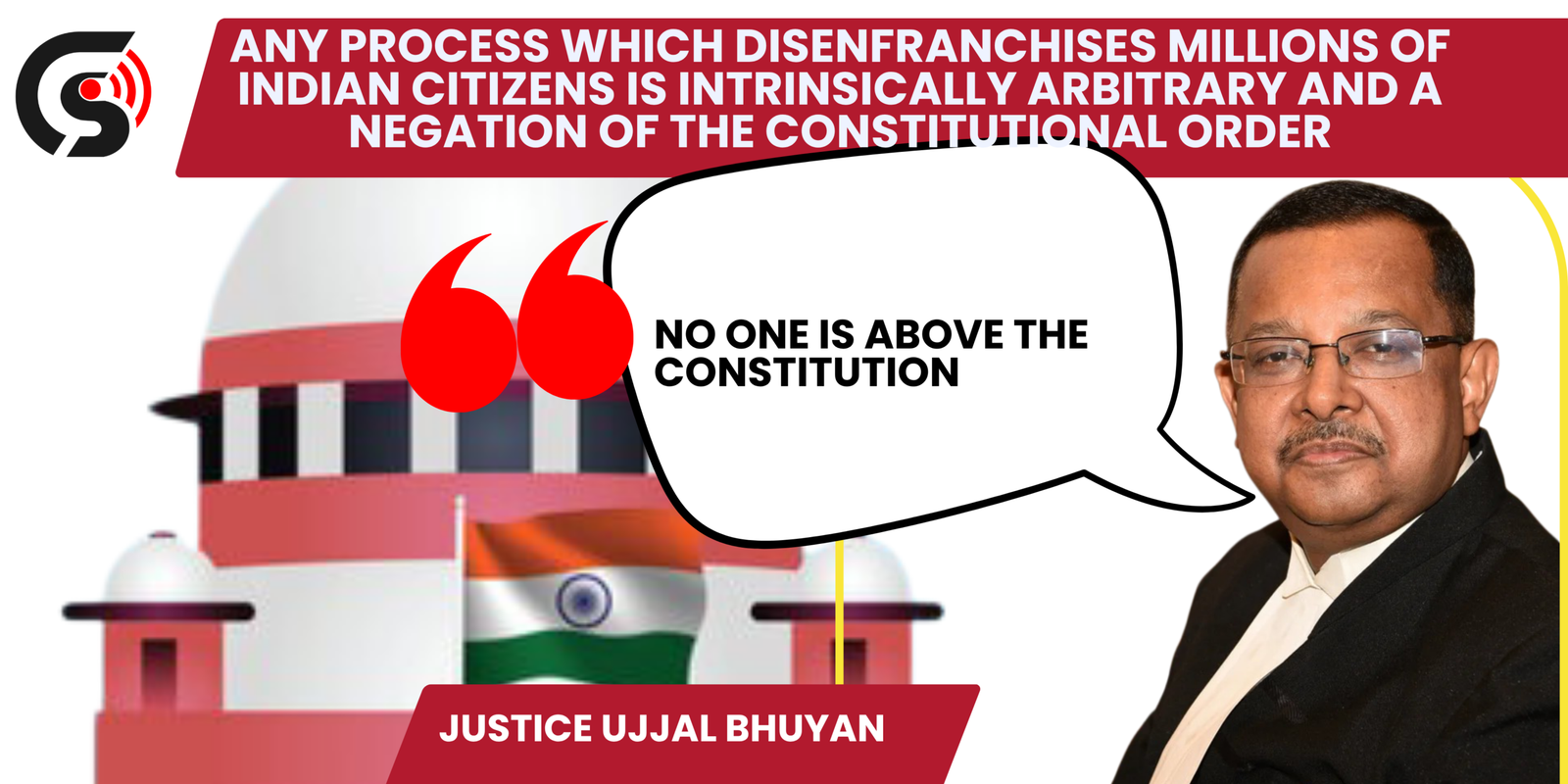
Justice Bhuyan said the Constitution does not envisage one class of citizens with voting rights and another without them. A process that disenfranchises millions would be intrinsically arbitrary, he said, and a negation of the constitutional order. The Daily Pioneer reported that he linked such a process to violations of Articles 14 and 326, adding that no court could endorse or condone it.
His central message, repeated across coverage, was that no one stands above the Constitution.
An “Act of Faith” in Ordinary Citizens
Madhyamam described how he framed universal adult franchise as the Constitution-makers’ act of faith in ordinary people, where a billionaire’s vote and a rickshaw-puller’s vote carry equal weight. Citing US Supreme Court judge Felix Frankfurter, he said the highest office in a democracy belongs to the citizen, and asked what a citizen is worth without a vote.
Precedents and Safeguards
Justice Bhuyan anchored the argument in case law, including Kihoto Hollohan v. Zachillhu, PUCL and Anoop Baranwal, as listed in India Legal’s account. On electoral rolls, he referred to Section 22 of the Representation of the People Act, 1950 and the Supreme Court’s judgment in Lal Babu Hussain.
Coverage by PTI, carried on Inkl, placed the remarks in the context of the debate over mass voter deletions during the Special Intensive Revision of electoral rolls.
Praise for NALSAR After the Row
Justice Bhuyan has a long link with the university. He served as its Chancellor during his tenure as Telangana High Court Chief Justice in 2022–23. At the event, he credited the faculty with performing their duties admirably and said Vice-Chancellor Srikrishna Deva Rao had led the university well. He made no direct reference to the NALSAR row or to CJI Surya Kant.
It would be inaccurate to read his visit as a replacement for the CJI. Surya Kant never accepted the convocation invitation, and Justice Bhuyan came for a moot court competition.
A Charge to the Next Generation
Justice Bhuyan closed by stressing that every generation carries the responsibility of preserving constitutional freedoms. Coming so soon after the NALSAR row, which tested the limits of student dissent and regulatory power, the message carried particular weight for the future lawyers listening: constitutional protections last only as long as citizens, and those who defend them, keep guarding them.