A complete, fact-checked guide to registering under PM Vishwakarma Yojana in 2026 — who qualifies, what you actually get, and how the application really works.
Thank you for reading this post, don't forget to subscribe!October 5, 2026|CoreSignal
PM Vishwakarma Yojana Online Apply: What You Need to Know Before Applying
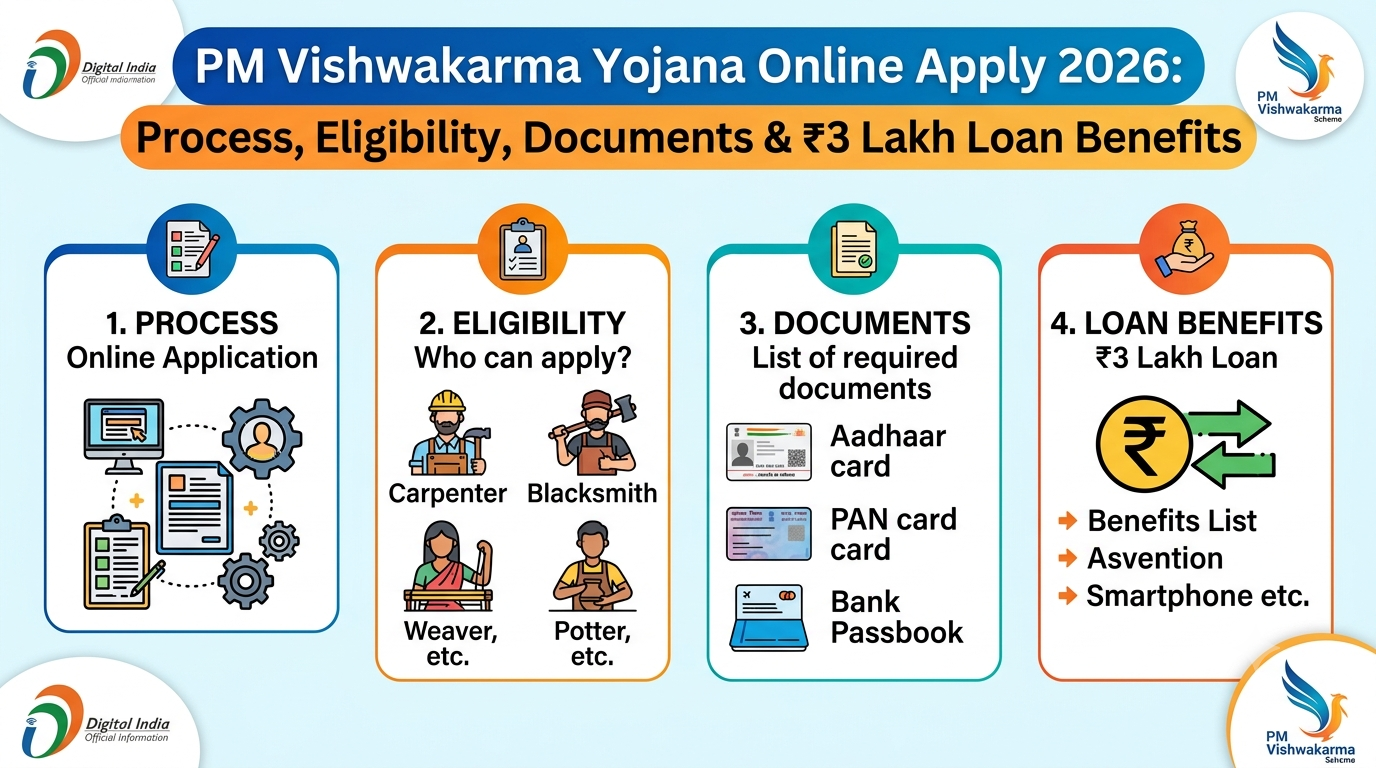
If you’re a carpenter, blacksmith, tailor, potter, goldsmith, or work in one of India’s other traditional trades, PM Vishwakarma Yojana is one of the more substantial government schemes built specifically for you — combining formal recognition, paid skill training, a toolkit grant, and low-interest credit. This guide walks through exactly what the scheme offers, who qualifies, and — importantly — how the “online apply” process actually works in practice, since there’s a common misconception worth clearing up first.
What Is PM Vishwakarma Yojana?
PM Vishwakarma Yojana (officially the PM Vishwakarma Scheme) is a central sector scheme run by the Ministry of Micro, Small & Medium Enterprises (MSME). It was announced by Prime Minister Narendra Modi in his Independence Day speech on 15 August 2023, and formally launched on 17 September 2023 — Vishwakarma Jayanti, the day traditionally associated with the divine craftsman of Hindu belief.
The scheme has a total outlay of approximately ₹13,000 crore, spread across 2023–24 to 2027–28, making it one of the larger government initiatives focused specifically on India’s informal artisan economy — craftspeople who are highly skilled but typically shut out of formal credit and recognition systems.
Which 18 Trades Are Covered?
The scheme applies specifically to these 18 traditional, family-based trades:
Carpenter, boat maker, armourer, blacksmith, hammer and toolkit maker, locksmith, goldsmith, potter, sculptor/stone carver, cobbler, mason, basket/mat/broom maker, doll and toy maker, barber, garland maker, washerman, tailor, and fishing net maker.
Note: Handloom weavers are not covered under this scheme — they fall under a separate scheme run by the Ministry of Textiles, so if that’s your trade, this particular scheme isn’t the right one to apply for.
What Benefits Do You Actually Get?
The scheme is structured as a benefit stack, where each stage is meant to build on the one before it:
- Recognition — A PM Vishwakarma certificate and ID card, issued both physically and digitally, formally recognizing you as a “Vishwakarma” artisan.
- Skill training — Basic training (typically 5–7 days) and optional advanced training (around 15 days), with a stipend of ₹500 per day during the training period.
- Toolkit incentive — A ₹15,000 e-voucher to purchase modern tools relevant to your trade, provided after basic training begins.
- Collateral-free credit — Loans up to ₹3 lakh total, disbursed in two tranches: an initial ₹1 lakh, followed by a second tranche of ₹2 lakh once the first is repaid satisfactorily. Both come at a concessional interest rate of 5%.
- Digital transaction incentives — A small cash incentive (reportedly around ₹1 per transaction, up to 100 transactions a month) to encourage digital payments in your business.
- Marketing support — Access to platforms like GeM (Government e-Marketplace), and support through initiatives like One District One Product (ODOP) to help sell your craft in wider markets.
Eligibility Criteria
Based on the scheme’s official guidelines, you generally qualify if:
- You are 18 years of age or older.
- You are engaged in one of the 18 listed trades, either through family-based traditional practice or as part of a registered organization.
- You have not availed similar credit-linked government schemes (such as PMEGP, PM SVANidhi, or Mudra loans for the same business activity) in the recent past — this is checked during verification.
- Only one member per family is generally eligible to register under the scheme, to keep the benefit distribution broad-based.
Required Documents
Keep these ready before you begin the process:
- Aadhaar card
- Mobile number linked to Aadhaar (for OTP verification)
- Bank account details/passbook
- Ration card (commonly required at CSC verification)
- Residence proof
- Recent passport-size photograph
- Details of your trade/craft and work experience
How Does the “Online Apply” Process Actually Work?
This is where a lot of search results online are misleading. While the scheme does have an official web portal, the registration itself is generally not something you can complete entirely on your own from home. Here’s the real process:
- Visit your nearest Common Service Centre (CSC). Because the scheme requires biometric authentication and e-KYC verification, most applicants complete registration through a CSC operator rather than filling the form independently online.
- Carry your documents — Aadhaar card, Aadhaar-linked mobile number, bank account details, and ration card.
- The CSC operator initiates your registration, entering your personal details, trade category, and completing biometric/e-KYC verification on your behalf.
- Your application goes through a three-stage verification process:
- Gram Panchayat/Urban Local Body (ULB) level verification
- District Implementation Committee review
- Final screening committee approval
- On approval, you receive your PM Vishwakarma certificate and ID card, after which skill training and benefit tranches (toolkit voucher, then loans) begin to unfold in sequence.
You can track registration and check status details through the official portal at pmvishwakarma➤, even though the initial registration step itself typically needs a CSC visit. There is no fee to register — if anyone asks you to pay for registration, that’s a red flag.
Current Registration Status (2026)
Reported figures on how many artisans have registered vary depending on the source and the date, so treat any specific number as a snapshot rather than a fixed figure — but public reporting through early-to-mid 2026 has cited well over 2 crore applications since the scheme’s 2023 launch, with several tens of lakhs of artisans having completed skill training and received loan disbursements so far. Implementation reports from various districts through 2026 indicate that credit disbursement — particularly the loan component — has generally progressed more slowly than registration and training, so approval timelines can vary significantly depending on your district and bank processing speed.
Common Mistakes to Avoid
- Assuming you can register entirely online without visiting a CSC — for most applicants, this isn’t accurate, and expecting otherwise leads to unnecessary confusion.
- Applying through unofficial websites or agents claiming to speed up registration for a fee — always use official CSC centres or the pmvishwakarma.gov.in portal.
- Registering more than one family member — the scheme is generally designed for one registration per family, and duplicate applications can cause delays or rejection.
- Skipping skill training — the toolkit incentive and loan tranches are sequenced after training stages, so skipping ahead isn’t how the benefit flow works.
Frequently Asked Questions
1. Can I apply for PM Vishwakarma Yojana completely online from my phone?
Not fully. While there’s an official web portal, registration typically requires biometric authentication and e-KYC verification, which is usually completed by visiting your nearest Common Service Centre (CSC) rather than filling the entire form independently from home.
2. Is there any fee to register for PM Vishwakarma Yojana?
No, registration is free. Be cautious of anyone — including agents claiming to help “speed up” the process — asking for payment.
3. How much loan can I get under PM Vishwakarma Yojana?
Up to ₹3 lakh total, disbursed in two tranches — an initial ₹1 lakh, followed by a second ₹2 lakh tranche after satisfactory repayment of the first — both at a concessional 5% interest rate.
4. Are handloom weavers eligible for PM Vishwakarma Yojana?
No. Handloom weavers are covered under a separate scheme administered by the Ministry of Textiles, not under PM Vishwakarma Yojana.
5. Can more than one person from the same family apply for PM Vishwakarma Yojana?
Generally, no — the scheme is designed for one registered beneficiary per family to ensure broader distribution of benefits across households.
6. How long does approval take after applying PM Vishwakarma Yojana?
There’s no fixed timeline, since your application goes through three stages of verification — Gram Panchayat/ULB, District Implementation Committee, and final screening. Processing times have varied by district and can take several weeks to a few months.
7. What happens after I get my PM Vishwakarma certificate?
You become eligible to begin basic skill training (with a daily stipend), followed by the toolkit incentive, and subsequently the loan tranches — each stage generally unlocks after completing the one before it.
Disclaimer: This article is intended for general informational purposes only, based on publicly available government scheme information and reporting as of the time of writing. Eligibility criteria, benefit amounts, and the application process are subject to change or update by the Ministry of MSME. Readers are strongly advised to verify current details directly on the official portal at pmvishwakarma, or at their nearest Common Service Centre, before applying or sharing any personal documents.