West Bengal Salary Advance Scheme: Eligibility, Loan Limits, Interest and Repayment Rules
Share Copy Link copied Thank you for reading this post, don’t forget to subscribe! Contents West Bengal Salary Advance Scheme Lets State Employees Borrow Against Their Pay Through Empanelled Lenders Who Is Eligible in the First Phase Short-Term and Multi-Month Advances: Loan Limits, Interest and Tenure The 50 Per Cent EMI Cap, With a Worked…
 Spotted something off?
Queries, objections or corrections are welcome. Visit the CoreSignal homepage or Contact Us.
West Bengal Salary Advance Scheme: Eligibility, Loan Limits, Interest and Repayment Rules
A digital advance for state government employees: what the Finance Department order allows, how much can be borrowed, what it costs and how it is recovered from pay.
Thank you for reading this post, don't forget to subscribe!Every government employee knows the stretch between the 20th of the month and salary day. West Bengal has now put a formal answer to that stretch on paper: an advance against pay that can be taken digitally and recovered from the next salary.
This guide sets out who qualifies, how much can be borrowed, what it costs and how it is repaid, and marks what the published sources do not yet say, including the interest ceiling and the application route.
West Bengal Salary Advance Scheme Lets State Employees Borrow Against Their Pay Through Empanelled Lenders
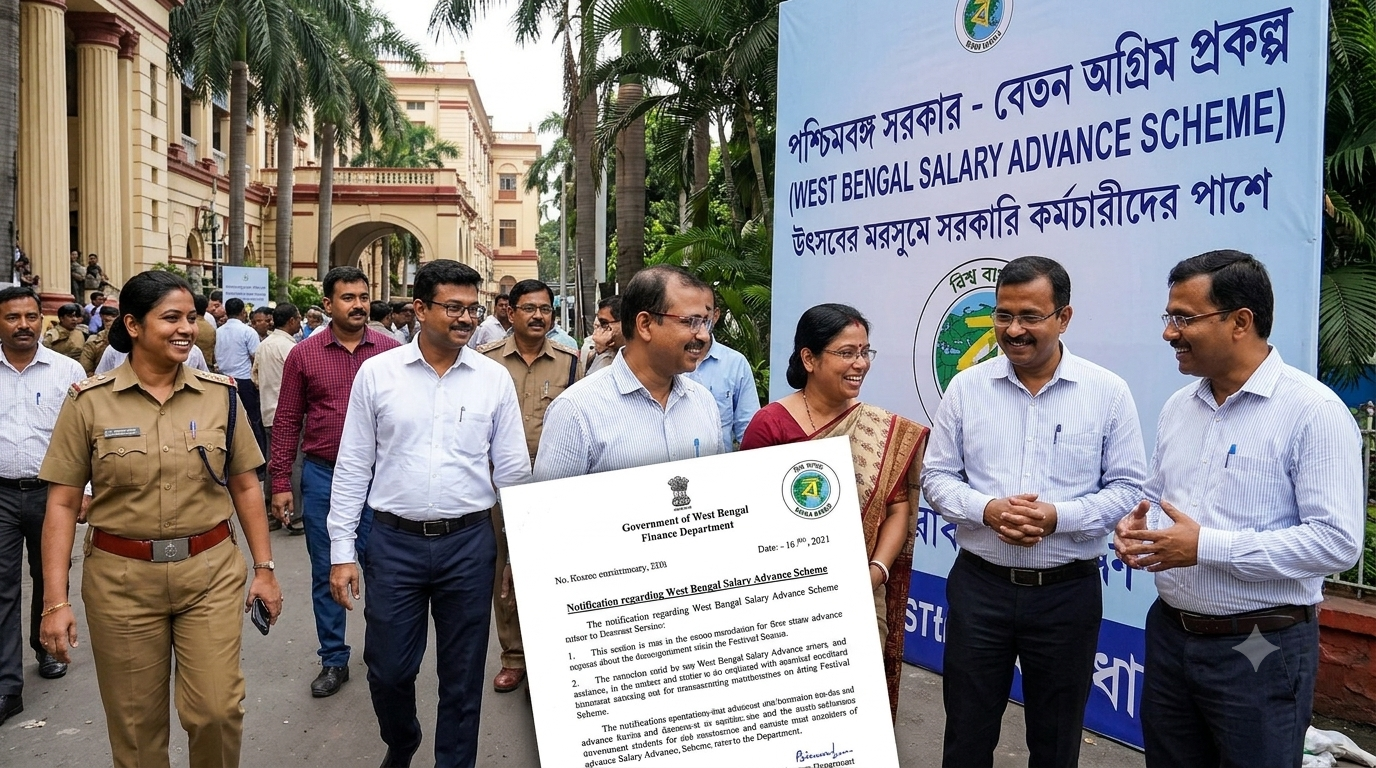
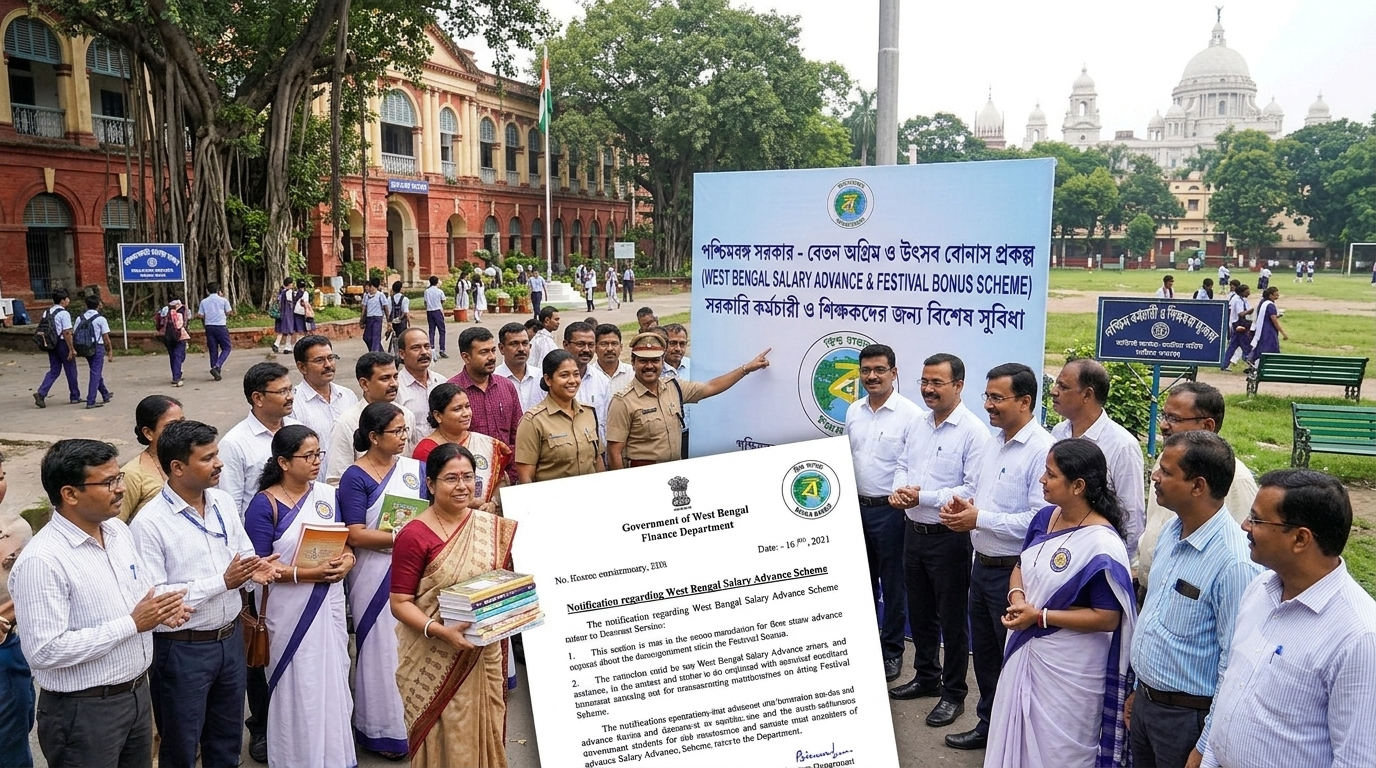
The Finance Department of the Government of West Bengal has introduced a Salary Advance Scheme for state government employees under Order No. 4035-F(eGov) dated 3 November 2026, which took effect immediately, according to the text of the order published by WBXpress. The scheme is run on a digital, consent-based platform linked to the state’s HRMS and WBIFMS systems, and the money comes from banks or NBFCs empanelled by the government, not from the state treasury.
The order is initially valid for five years. The e-Governance Group of the Finance Department is the nodal entity, and the government gives no guarantee and takes no credit risk. The lender carries it. News reports describe the scheme as meant for emergencies such as medical bills and children’s education, but the order sets no list of permitted purposes.
Who Is Eligible in the First Phase
- Employees covered: regular employees of the Government of West Bengal in Groups A, B, C and D or equivalent.
- Salary route: only those whose salary is paid through the Treasury or Pay and Accounts Office system via HRMS or WBIFMS.
- Not covered yet: other categories of employees and organisations. The order leaves it to the Finance Department to add them later.
Final eligibility for a particular employee also depends on the lender’s own assessment, so being covered by the order does not guarantee that an advance will be approved.
Short-Term and Multi-Month Advances: Loan Limits, Interest and Tenure
| Feature | Short-term advance | Multi-month advance |
|---|---|---|
| Maximum amount | Up to 50% of the net payable salary for the sanction month | Set by the lender, but not more than 30 times the net monthly payable salary |
| Interest | None if repaid within the stipulated cycle | Charged; disclosed in a Key Fact Statement before disbursal |
| Late charge | Up to 1% of the advance including GST, except where the delay is caused by the Government, the DDO or the deduction mechanism | As per the Key Fact Statement |
| Other fees | No processing, platform, convenience or subscription fee | No foreclosure or prepayment charge |
| Repayment period | Same or next salary cycle, within 60 days | 2 to 60 months, not beyond the retirement date |
The ceiling on the multi-month APR is fixed by the Finance Department when lenders are empanelled. The order text reviewed does not state that figure, so the actual interest rate can be known only from the lender’s Key Fact Statement.
The 50 Per Cent EMI Cap, With a Worked Example
Whatever the product, total recoveries under the scheme cannot exceed 50% of the net payable salary for the sanction month. For example, for an employee with a net salary of ₹40,000, the short-term advance could be up to ₹20,000, and the multi-month ceiling of 30 times salary works out at ₹12 lakh. But the monthly instalment could not exceed ₹20,000, which in practice limits how large a loan the lender will approve. The figures are illustrative, and the lender decides the final sanctioned amount.
How Repayment Works: Deduction at Source From Salary
Instalments are deducted directly from salary, after statutory deductions, standard deductions and government dues. That means the amount is taken before the employee sees the salary credit, which suits the lender but lowers take-home pay for the whole tenure.
The order lists exception events, namely resignation, retirement, death, suspension, transfer, unauthorised absence, leave without pay and termination. When one occurs, the Drawing and Disbursing Officer must inform the lender. After separation, recovery from final settlement is allowed only under the employee’s standing instruction and as the law permits, and the government is not liable for any shortfall. A long multi-month loan taken close to retirement is therefore capped by the superannuation date.
Rules That Catch Borrowers Out
- One lender at a time. Consent is exclusive to a single service provider.
- One advance at a time. A short-term and a multi-month advance cannot run together.
- Cooling-off. After a loan is closed, 30 days must pass before switching providers.
- Consent is withdrawn only on WBIFMS. Telling the lender is not enough.
- Suspension. The nodal entity can suspend the facility for all users, a group or one person.
How to Apply: What Is Known About the Process and What Is Still Missing
Neither the order text nor the news reports reviewed name an application portal or an app, and no list of empanelled lenders was found. What the order does describe is the sequence: the employee gives explicit digital consent, including a standing instruction for salary deduction, completes KYC (biometric or video KYC where required), and the lender underwrites the request. Approved money is disbursed to the employee’s bank account, usually within 60 seconds to a few hours.
Until the department or the employee’s DDO circulates the names of the empanelled providers and their official platforms, employees should not download any app or send documents to a number that claims to offer the scheme. Aadhaar details, OTPs and net-banking passwords should never be shared with a person offering to “arrange” an advance.
Not the Same as the Two-Wheeler Advance Announced the Same Day
The Finance Department’s Budget Branch issued a separate memorandum, No. 1100-F.B., also dated 3 November 2026, on the vehicle advance. A pay-calculator website reports it as up to ₹1,50,000 for an electric two-wheeler and ₹1,20,000 for a petrol motorcycle, scooter or moped, open to staff with a basic pay of ₹25,700 or more, with principal recovered over up to 60 instalments. Millennium Post carries the ₹1.20 lakh figure in its report on the salary advance window. That advance is a government loan with its own rules and mortgage conditions, and it is separate from the Salary Advance Scheme, which lends through banks and NBFCs.
Grievance Redressal and Data Safeguards
Lenders must run a 24×7 helpdesk, respond to complaints within 72 hours and usually resolve them within 7 days, with escalation to a Grievance Nodal Officer. They must also meet data-security standards and report breaches within 24 hours. No separate helpline number for the scheme was found in the reports reviewed, so employees should keep the Key Fact Statement and the acknowledgement of consent.
Official Links
Frequently Asked Questions
What is the West Bengal Salary Advance Scheme?
It is a digital scheme under a Finance Department order dated 3 November 2026 that lets eligible state government employees take short-term and multi-month salary advances from empanelled banks or NBFCs, repaid by deduction from salary.
Who is eligible for the West Bengal Salary Advance Scheme?
Regular state government employees in Groups A, B, C and D or equivalent, whose salary is paid through the Treasury or PAO system via HRMS or WBIFMS. Other categories may be added later.
How much salary advance can be taken?
A short-term advance can be up to 50% of the net payable salary for the sanction month. A multi-month advance is set by the lender and cannot exceed 30 times the net monthly salary. Total recoveries cannot exceed 50% of net salary.
Is there any interest on the short-term salary advance?
No interest is charged if the advance is repaid within the stipulated cycle. A late fee of up to 1% of the advance, including GST, may apply, except where the delay is not the employee’s fault.
What is the interest rate on the multi-month advance?
The rate is shown in a Key Fact Statement before disbursal. The Finance Department sets a ceiling on the APR when lenders are empanelled, but the order text reviewed does not state the figure.
What is the repayment period?
Short-term advances must be repaid in the same or next salary cycle and within 60 days. Multi-month advances run for 2 to 60 months and cannot extend beyond the retirement date.
How is the advance recovered?
Instalments are deducted at source from salary, after statutory deductions, standard deductions and government dues.
Can two advances be taken together?
No. Only one advance can be outstanding at a time, and consent is exclusive to one lender. After closing a loan, a 30-day cooling-off period applies before switching providers.
What happens to the loan if the employee resigns, retires or is suspended?
These are treated as exception events. The DDO informs the lender, and recovery from final settlement is allowed only under the employee’s standing instruction and as the law permits.
Where can the application be made?
The reports reviewed name no portal or app. The platform is described as integrated with HRMS and WBIFMS, and employees should wait for the department or DDO to circulate the empanelled providers.
Is the two-wheeler advance part of this scheme?
No. It is a separate government loan under Memorandum No. 1100-F.B. dated 3 November 2026, with its own limits and conditions.
The details above come from the order text as published on 3 November 2026 and from news reports in the days after it, and the list of lenders, the APR ceiling and the application route had not been made public in the sources reviewed. Before signing any consent, the Finance Department notification, the DDO’s circular and the lender’s Key Fact Statement should be read in full, and the monthly deduction should be checked against what the household can bear.
Disclaimer: This article summarises a Finance Department order as published by a third-party website and news reports, and rules may be revised. It is not financial advice. Verify with the Finance Department, your DDO or the empanelled lender before borrowing. CoreSignal is not a government body or a lender.