October 22, 2026|CoreSignal
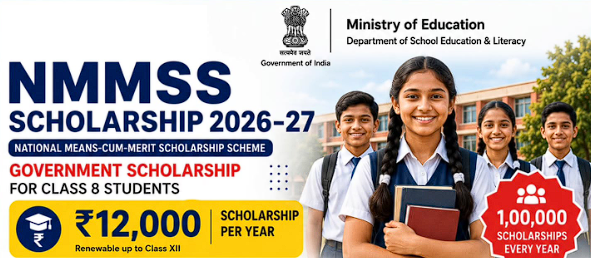
Thank you for reading this post, don't forget to subscribe!Nine days remain to apply for the National Means-cum-Merit Scholarship Scheme (NMMSS) on the National Scholarship Portal. The Ministry of Education has set 31 October 2026 as the last date for students, after two earlier extensions, as Careers360 reported when the latest notice came out. For families with a child in Class 8, though, the date needs a little unpacking, because the scheme works in two stages.
What the 31 October Deadline Covers
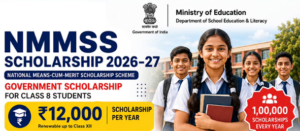
The portal form is meant for students who have already cleared their state selection exam. All India Radio’s report describes the scheme as offering one lakh fresh scholarships a year to Class 9 students who qualify in the exam run by their State or Union Territory, with the scholarship carried forward through Classes 10 to 12 by renewal. That means the 31 October window is for two groups: students now in Class 9 who qualified last year, and existing scholars renewing for Classes 10 to 12.
Students in Class 8 this year are at the first stage. The state exam comes first, and the NSP application follows after selection and promotion to Class 9. Even so, the rules below are worth learning now, since they decide who can sit the exam and what paperwork will be needed later.
| Stage | Last date (2026) |
|---|---|
| Student application on NSP (fresh and renewal) | 31 October |
| School (Institute Nodal Officer, L1) verification | 15 November |
| District Nodal Officer (L2) verification | 30 November |
The schedule is drawn from the Buddy4Study guide to NMMS 2026–27. By 30 September, the portal had recorded 88,522 fresh and 1,97,133 renewal applications, The CSR Journal noted.
How Much the Scholarship Pays
Selected students receive ₹12,000 a year, or ₹1,000 a month, from Class 9 to Class 12. Over the full four years that adds up to ₹48,000, provided the scholarship is renewed every year. The money is paid by Direct Benefit Transfer into the student’s bank account. Buddy4Study’s guide, cited above, also explains that the one lakh scholarships are shared among States and Union Territories as fixed quotas, so a student competes within their own state’s merit list.
Eligibility: Marks, School and Family Income
The conditions are the same across the country, though each state runs its own exam.
| Requirement | Detail |
|---|---|
| Class and school | Regular student in Class 8 of a government, government-aided or local body school |
| Class 7 marks (to sit the exam) | At least 55% or equivalent grade; 50% for SC/ST |
| Class 8 marks (at selection) | At least 55% or equivalent grade; 50% for SC/ST |
| Exam result | At least 40% aggregate across MAT and SAT; 32% for SC/ST |
| Parental income | Not more than ₹3.5 lakh a year from all sources |
| Not eligible | Students of private schools, Kendriya Vidyalayas, Navodaya Vidyalayas and government residential schools |
The marks conditions and the school exclusions come from Buddy4Study’s guide, while the ₹3.5 lakh ceiling is repeated in the Careers360 report on the extension. The limit was raised from ₹1.5 lakh to ₹3.5 lakh from 2021–22, as noted on Vikaspedia’s scheme page.
In everyday terms, ₹3.5 lakh a year works out to roughly ₹29,000 a month for the whole family, counting every source of income. Clearing the qualifying percentage does not guarantee an award. The final cut-off depends on the state’s merit list and its quota.
Where Class 8 Students Stand Right Now
The selection test has two papers of 90 multiple-choice questions each: the Mental Ability Test (MAT) and the Scholastic Aptitude Test (SAT), which covers science, social studies and mathematics from Classes 7 and 8. Dates vary by state. Buddy4Study lists Himachal Pradesh on 1 November, Punjab on 22 November, Andhra Pradesh on 29 November, Delhi on 5 December and Maharashtra on 20 December 2026.
In West Bengal, the Directorate of School Education has scheduled the exam for 20 December 2026, according to Karmasandhan, and registration has already closed. A FindMyCollege update puts the admit card in December and the result in May 2027. Parents elsewhere should check the state SCERT website or ask the school office, since registration usually runs through the school.
Documents to Keep Ready
The exact list can differ slightly by state, but the following come up repeatedly across Buddy4Study and CareerIndia’s application guide:
- Aadhaar card (or Aadhaar Enrolment ID for registration)
- Income certificate from the competent authority, showing parental income within ₹3.5 lakh
- Latest marksheet or report card (Class 7 or 8)
- Bank passbook for an active account in the student’s name
- Recent passport-size photograph
- Caste certificate, for SC/ST applicants
- Disability certificate, where applicable (CareerIndia adds that UDID consent is needed for disability cases)
- Proof of residence, if asked
- Head-of-institution certificate, where the state requires it
One detail trips up many families: the bank account should be linked to Aadhaar and match the student’s details. CareerIndia suggests confirming the seeding status through NPCI before applying, since a mismatch is a common reason for rejection.
Applying on the National Scholarship Portal, Step by Step
Applications are accepted only through scholarships➤
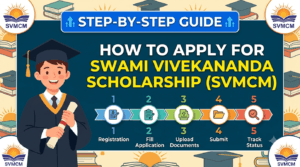
- Complete One-Time Registration (OTR). This is mandatory. Registration needs a mobile number, OTP verification and Aadhaar-based eKYC, and produces a unique 14-digit OTR ID. CareerIndia notes that parents can generate the OTR on behalf of a minor, either on the website or through the NSP OTR app.
- Log in with the OTR credentials. Choose “Apply for Scholarship” and open the NMMSS 2026–27 form under the Department of School Education and Literacy.
- Fill in personal, academic and bank details. Accuracy matters here, because mismatches with documents are what trigger defects later.
- Upload clear copies of the documents listed above.
- Review and submit before 31 October.
The School Verification Stage
Submitting the form is not the last step. Every application passes through two checks on the portal: first by the school’s Institute Nodal Officer (L1), due by 15 November, and then by the District Nodal Officer (L2), due by 30 November. CareerIndia advises students to remind the school early and track both statuses on the portal dashboard, and to correct any defect quickly with a readable re-upload.
The practical takeaway is to apply well before the last evening. An application sent on 31 October leaves the school only two weeks to verify it, and a rejected form may not leave time for a fix.
Staying on the Scholarship Until Class 12
The scholarship is not automatic after the first year. It has to be renewed on NSP annually, and Buddy4Study’s summary of the renewal rules lists the conditions: clear promotion in the first attempt for Classes 10 and 12, and at least 60% in Class 10 (55% for SC/ST) to continue into Class 11. Missing the renewal window ends the scholarship.
A change is also reported for 2026–27. The same guide says NSP has moved from “One Student – One Scholarship” to allowing one merit-based scholarship alongside welfare-based schemes. Under that arrangement, NMMSS can be held together with schemes such as Pre-Matric or Post-Matric scholarships for SC, ST, OBC or minority students, if the student qualifies for them. Two merit-based scholarships on the portal cannot be combined.
Payment, once verification closes, usually follows by DBT through the Public Financial Management System, with CareerIndia suggesting credit typically arrives in the last quarter of the year after final checks. Status can be tracked through the PFMS link on NSP.