Documents, the online process, fees, timelines, and the exact HSN/SAC codes shops and service businesses use most — updated for GST 2.0 and the 2026 Aadhaar-authentication rules.
Thank you for reading this post, don't forget to subscribe!September 19, 2026|CoreSignal
What GST Registration 2026 Actually Means
GST registration is how a business formally enters India’s Goods and Services Tax system. Once approved, you receive a 15-digit GST Identification Number (GSTIN) tied to your PAN and state, which you must quote on every invoice, return, and e-way bill from then on. Every step described below happens on the official GST portal — no third-party site can register you.
Registering isn’t optional paperwork — it’s what lets you legally charge GST, claim Input Tax Credit (ITC) on what you buy, sell across state lines without restriction, and appear on the vendor list of marketplaces like Amazon and Flipkart. Operating above the threshold without a GSTIN exposes you to penalties and interest on the tax you should have collected.
Who Needs to Register (Turnover Limits)
Registration becomes mandatory the moment your aggregate turnover in a financial year crosses these limits. “Aggregate turnover” includes all taxable, exempt, and export supplies under one PAN, computed on an all-India basis.
| Category | General category states | Special category states |
|---|---|---|
| Goods suppliers | ₹40 lakh | ₹20 lakh |
| Service providers | ₹20 lakh | ₹10 lakh |
Turnover aside, registration is mandatory regardless of turnover if you fall into any of these categories:
- Inter-state suppliers of goods
- E-commerce sellers and e-commerce operators
- Casual taxable persons and non-resident taxable persons
- Businesses required to pay tax under reverse charge
- Input Service Distributors (ISD)
- Agents supplying on behalf of other registered taxpayers
- TDS/TCS deductors under GST
Below the threshold? Voluntary registration is often worth it even if you’re not required to register — it unlocks ITC on your purchases, lets you issue GST-compliant invoices B2B buyers expect, and adds credibility when you’re opening a current account or bidding on a tender.
Types of GST Registration
| Type | Who it’s for | Key trait |
|---|---|---|
| Normal taxpayer | Most businesses above the threshold | No expiry; full ITC eligibility |
| Composition scheme | Small traders/restaurants under ₹1.5 crore (₹75 lakh in NE states); service providers under ₹50 lakh | Flat low tax rate, no ITC, quarterly payment + annual return |
| Casual taxable person | Occasional sellers with no fixed place of business in a state (e.g., exhibitions) | Valid for 90 days, extendable |
| Non-resident taxable person | Foreign entities supplying in India occasionally | Advance tax deposit required |
| Input Service Distributor | Head offices distributing ITC to branches | Distributes credit only, doesn’t supply |
Documents Required, by Business Type
Sole proprietorship
- PAN card of the proprietor (name must exactly match GST portal entry)
- Aadhaar card of the proprietor
- Passport-size photograph
- Proof of principal place of business — electricity bill, rent/lease agreement, or property tax receipt, plus an NOC from the owner if rented
- Bank account proof — cancelled cheque, first page of passbook, or bank statement
Partnership firm / LLP
- PAN of the firm and Partnership Deed / LLP Agreement
- PAN and Aadhaar of all partners
- Proof of principal place of business
- Bank account proof of the firm
- LLP Certificate of Incorporation (for LLPs)
- Authorization letter or board resolution naming the authorized signatory
Private limited / public limited company
- Certificate of Incorporation and PAN of the company
- MOA and AOA
- PAN and Aadhaar of all directors and the authorized signatory
- Board resolution appointing the authorized signatory
- Proof of registered office address
- Company bank account proof
- Digital Signature Certificate (DSC) — mandatory for companies and LLPs at the submission stage
The one detail that trips people up: Your name exactly as printed on PAN must match what you type into the GST portal, down to spacing and initials. A mismatch is one of the most common reasons applications get sent back with a query.
GST Registration 2026: Step-by-Step Process
Registration is entirely online through the GST portal (services.gst.gov.in). It runs in two parts — first you generate a Temporary Reference Number, then you complete the full application against it.
Part A — Get your TRN
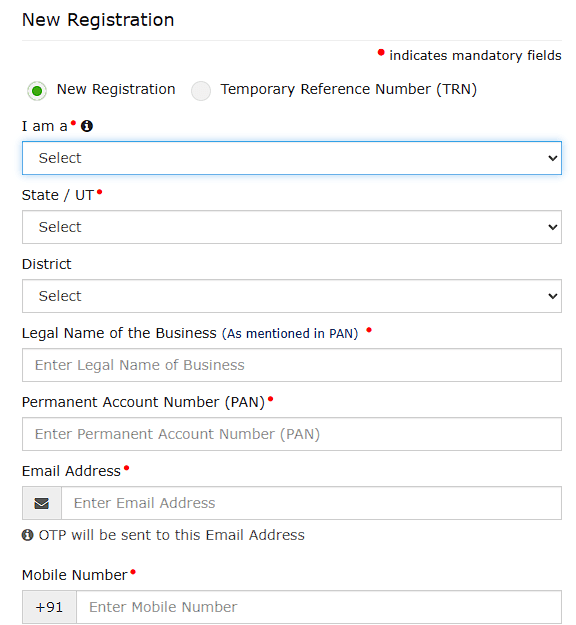
- Start a new registration — Go to Services → Registration → New Registration, and select “Taxpayer” as the type.
- Enter basic details — State, district, legal name of business (as per PAN), PAN, email, and mobile number.
- Verify with OTP — You’ll receive separate OTPs on your email and mobile. Enter both to proceed.
- Receive your TRN — A Temporary Reference Number is generated and also emailed to you — valid for 15 days.
Part B — Complete the full application
5. Log in with your TRN — Enter the TRN and the OTP sent to verify, then continue the application.
6. Business details — Trade name, constitution of business, district, and the date liability to register began.
7. Promoter/partner details — Personal details, PAN, Aadhaar, designation, and photograph for every promoter, partner, or director.
8. Authorized signatory — Name the person authorized to sign returns and correspondence on the business’s behalf.
9. Principal place of business — Full address, nature of possession (owned/rented/consent), and supporting proof upload.
10. Additional places of business — Add any godown, branch, or warehouse if applicable.
11. Goods and services details — Search and select the HSN codes for the goods you sell and SAC codes for any services you provide (see the code tables below).
12. Bank account details — Account number, IFSC, and a supporting document. In 2026, an unverified bank account can trigger suspension within 30 days, so add this promptly.
13. State-specific information — Professional tax employee code or registration certificate number, if applicable in your state.
14. Verify and submit — Submit using DSC (mandatory for companies/LLPs), e-Sign, or EVC (Aadhaar OTP) for other entity types.
15. Complete Aadhaar authentication — An authentication link is emailed to the primary authorized signatory. Complete e-KYC, or a biometric appointment at a GST Suvidha Kendra will be scheduled for higher-risk profiles.
16. Get your ARN — On successful submission you receive an Application Reference Number to track status on the portal.

What’s Different in 2026
- Aadhaar authentication is now compulsory for every new registration — there’s no opt-out route left.
- Fast-Track approval (Rule 14A) can issue a GSTIN within about three working days for Aadhaar-authenticated, low-risk applicants; other applications go through officer verification and typically clear within seven working days.
- Bank account verification within 30 days of registration is now enforced — most 2026 suspensions trace back to this step being skipped, not to any error in the original application.
- GST 2.0 rate simplification collapsed most goods into four slabs — nil, 5%, 18%, and a 40% slab for sin/luxury goods — replacing the older 12%/28% bands for the bulk of everyday items. The HSN code stays the same either way; only the rate attached to it has moved for many products.
- Apparel and footwear are now price-banded, not category-banded: 5% at or below ₹2,500 per piece/pair, 18% above that, regardless of the item.
Fees and Approval Timeline
There is no government fee for standard GST registration on the portal — it’s free to apply directly. Any fee you’re quoted is for professional assistance (a CA or consultant filing on your behalf), not a government charge.
| Route | Typical timeline |
|---|---|
| Fast-track (Aadhaar-authenticated, low risk) | ~3 working days from ARN |
| Standard, no query raised | ~7 working days from ARN |
| Query raised (Form REG-03) | Add the time you take to respond in REG-04, plus processing after |
Common Mistakes and Rejections
- Name/PAN mismatch — the single most common query trigger.
- Address proof that doesn’t match the applicant’s name — get an NOC if the utility bill or rent agreement is in someone else’s name.
- Wrong constitution of business selected — proprietorship vs. partnership vs. company changes which documents are required.
- Incomplete bank verification — the leading cause of post-registration suspension in 2026.
- Wrong or missing HSN/SAC codes — pick codes that genuinely reflect what you sell; mismatched codes cause invoice and return errors later.



If your application is rejected, the reason is in Form REG-05. There’s no penalty for reapplying — fix the specific issue and file a fresh Form REG-01; a clean, Aadhaar-authenticated reapplication is generally processed within about seven working days. If you believe the rejection was legally wrong rather than a paperwork gap, you can appeal in Form APL-01 within three months.
After You’re Registered
- Display your GST registration certificate prominently at your principal place of business.
- Issue GST-compliant invoices showing your GSTIN, the correct HSN/SAC code, and the tax breakup.
- File returns on schedule — GSTR-1 and GSTR-3B for normal taxpayers (monthly or quarterly under QRMP), a single quarterly return + annual return for composition dealers.
- Reconcile Input Tax Credit regularly against GSTR-2B to avoid mismatches at audit time.
- Keep your bank details, address, and authorized signatory updated on the portal — stale details are what trigger suspensions.
HSN & SAC Codes for Common Shops and Establishments
HSN (Harmonized System of Nomenclature) codes classify goods; SAC (Services Accounting Code) codes classify services. Businesses with turnover up to ₹5 crore must show a 4-digit HSN on B2B invoices; above ₹5 crore, a 6-digit HSN is required on all invoices. Rates below reflect the post-GST 2.0 structure — always confirm the current rate on the specific product or service on the GST portal before filing.
Kirana / general store / grocery
| Item | HSN | Rate |
|---|---|---|
| Unbranded/loose rice, cereals | 1006 | Nil |
| Branded/packaged rice | 1006 | 5% |
| Sugar | 1701 | 5% |
| Tea, coffee | 0902 / 0901 | 5% |
| Salt | 2501 | Nil |
| Edible oils | 1507–1518 | 5% |
| Ghee, butter, cheese | 0405 / 0406 | 5% |
| Biscuits, packaged snacks | 1905 / 2106 | 18% |
| Aerated drinks | 2202 | 40% |
| Retail trade service (commission-based) | SAC 9962 | 18% |
Clothing, garments & footwear
| Item | HSN | Rate |
|---|---|---|
| Stitched garments (Ch. 61/62), ≤ ₹2,500/piece | 61xx / 62xx | 5% |
| Stitched garments, above ₹2,500/piece | 61xx / 62xx | 18% |
| Footwear, ≤ ₹2,500/pair | 6403 / 6404 | 5% |
| Footwear, above ₹2,500/pair | 6403 / 6404 | 18% |
| Fabric sold by the metre (unstitched) | 50–55 chapters | 5% |
Restaurant, cafe & food service
| Service | SAC | Rate |
|---|---|---|
| Standalone restaurant, dine-in/takeaway/delivery | 996331 | 5% (no ITC) |
| Restaurant in hotel, room tariff up to ₹7,500/night | 996331 | 5% (no ITC) |
| Restaurant in hotel, room tariff above ₹7,500/night | 996331 | 18% (with ITC) |
| Outdoor catering | 996334 | 18% (with ITC) |
| Canteen / institutional mess | 996333 | 18% (with ITC) |
Salon, spa & personal care
| Service | SAC | Rate |
|---|---|---|
| Hairdressing, barbering, beauty treatment | 999722 | 18% |
| Spa, other beauty treatment n.e.c. | 999729 | 18% |
| Physical well-being / fitness centre | 999723 | 18% |
Pharmacy / medical store
| Item | HSN | Rate |
|---|---|---|
| Most retail medicines and formulations | 3004 | 5% |
| Specified lifesaving drugs | 3004 (notified list) | Nil |
| Diagnostic kits, medical devices | 3822 / 9018 | 5–18% |
Electronics & mobile shop
| Item | HSN | Rate |
|---|---|---|
| Mobile phones | 8517 | 18% |
| Chargers | 8504 | 18% |
| Earphones, headphones | 8518 | 18% |
| Laptops, tablets | 8471 | 18% |
| Mobile repair service | SAC 998719 | 18% |
Hardware, cement & building material
| Item | HSN | Rate |
|---|---|---|
| Cement | 2523 | 18% |
| Paints and varnishes | 3208 / 3209 | 18% |
| Hand tools | 8201–8205 | 18% |
| Sanitary fittings | 6910 | 18% |
Other common services
| Service | SAC | Rate |
|---|---|---|
| Real estate agent — property sale/purchase on commission | 997222 / 997223 | 18% |
| Property management services | 997221 | 18% |
| Consultancy / professional services (general) | 9983 | 18% |
| General construction/works contract services | 9954 | 18% |
Using these tables: HSN/SAC codes and their tax rates get revised through periodic CBIC notifications, so treat this as a starting reference, not a final word — search the exact product or service on the GST portal’s HSN/SAC finder before you file, especially for anything close to a rate-slab boundary.
Frequently Asked Questions
Is there a government fee for GST registration?
No. Registering directly on the GST portal is free. Any fee you pay is for a professional filing on your behalf.
How long does GST registration take in 2026?
About three working days for Aadhaar-authenticated, low-risk applicants under the fast-track route, and around seven working days for standard applications with no query raised.
Can I register voluntarily below the turnover threshold?
Yes. Voluntary registration is common among freelancers, small traders, and startups who want to claim Input Tax Credit or sell on B2B marketplaces before crossing the mandatory limit.
What happens if my registration gets suspended?
Most 2026 suspensions happen because bank account details weren’t verified within 30 days of registration. Log in, add and verify an active bank account in the business’s name, and the suspension is usually lifted within a few days.
Do I need a different HSN code for every product I sell?
Yes — each distinct product carries its own HSN code and rate. A kirana store, for instance, needs a separate code for rice, oil, biscuits, and soft drinks rather than one code for “groceries.”
What’s the difference between HSN and SAC codes?
HSN codes classify physical goods; SAC codes classify services. A shop that both sells products and offers a paid service (like a salon selling cosmetics and giving haircuts) uses both types on its invoices.