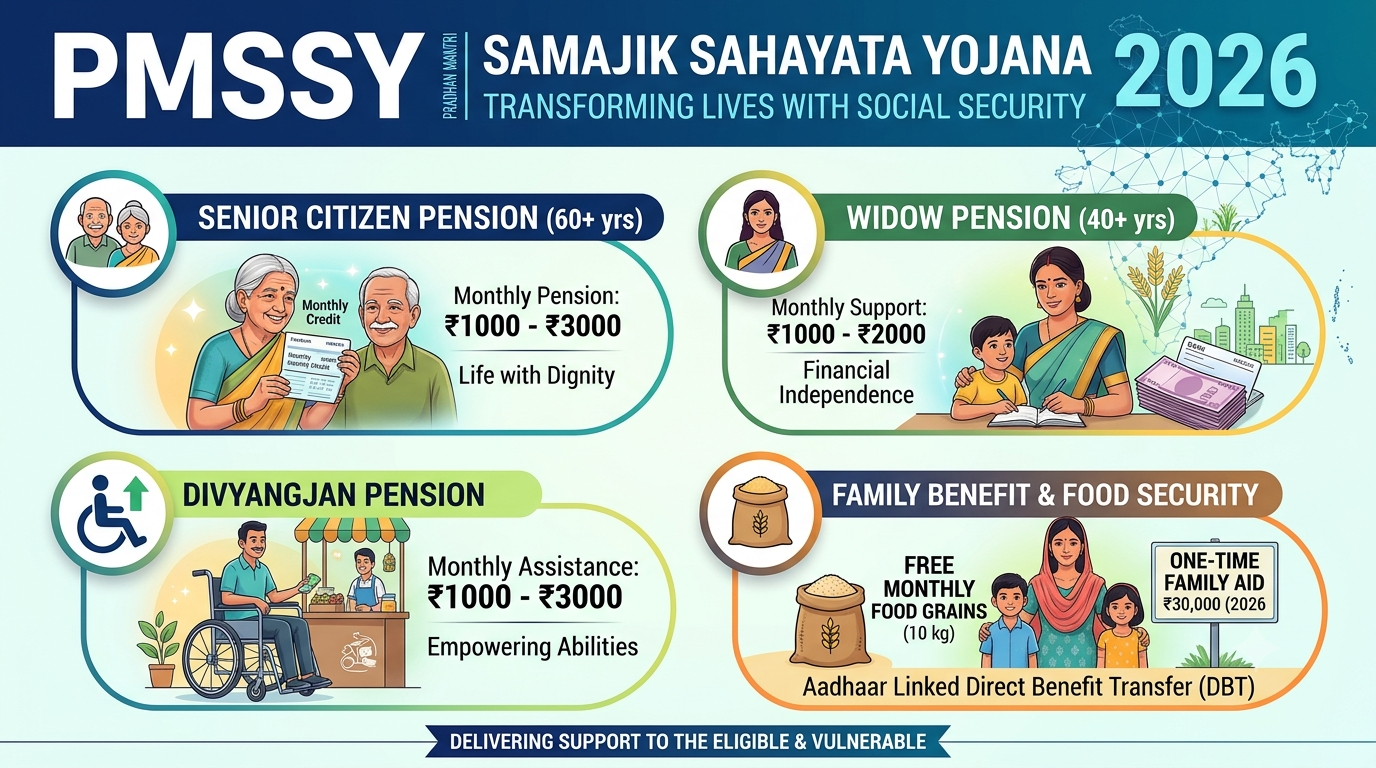
Pradhan Mantri Samajik Sahayata Yojana 2026: New Name for NSAP, Revised Disability Pension and How to Apply
Share Copy Link copied Thank you for reading this post, don’t forget to subscribe! Contents Pradhan Mantri Samajik Sahayata Yojana is the New Name for the National Social Assistance Programme (NSAP) What Each Component Pays Disability Pension: What Has Changed Who Qualifies Documents Usually Asked For How to Apply Frequently Asked Questions Spotted something off?…
 Spotted something off?
Queries, objections or corrections are welcome. Visit the CoreSignal homepage or Contact Us.
The National Social Assistance Programme now carries a new name, a ₹53,428 crore budget through 2031 and a widened disability pension.
Thank you for reading this post, don't forget to subscribe!India’s oldest social-security programme for poor households has a new identity. On 14 October 2026, the Union Cabinet approved the continuation of the National Social Assistance Programme for five years, from 2026-27 to 2030-31, with an outlay of ₹53,428 crore. The programme is now called the Pradhan Mantri Samajik Sahayata Yojana, and the Indira Gandhi prefix has been dropped from its sub-schemes.
Around 3.20 crore beneficiaries across all 36 States and Union Territories are expected to be covered.
Pradhan Mantri Samajik Sahayata Yojana is the New Name for the National Social Assistance Programme (NSAP)
The National Social Assistance Programme (NSAP) began on 15 August 1995. It rests on Article 41 of the Constitution, which directs the State to provide public assistance in cases of old age, sickness and disablement. The Centre bears the full cost so that assistance remains uniform across the country.
The Cabinet decision does three things: renames the programme and its sub-schemes, revises the disability pension, and keeps the old-age pension, widow pension and family benefit in their existing form. Anyone already receiving a pension is therefore dealing with the same programme under a different name.
| Earlier name | New name |
|---|---|
| National Social Assistance Programme (NSAP) | Pradhan Mantri Samajik Sahayata Yojana |
| Indira Gandhi National Old Age Pension Scheme | Pradhan Mantri Vridhavastha Pension Yojana |
| Indira Gandhi National Widow Pension Scheme | Pradhan Mantri Vidhawa Pension Yojana |
| Indira Gandhi National Disability Pension Scheme | Pradhan Mantri Divyangjan Pension Yojana |
| National Family Benefit Scheme | Pradhan Mantri Parivar Labh Yojana |
The Annapurna Scheme, the programme’s fifth component, which gives 10 kg of free grain a month to eligible elderly people not receiving a pension, was not part of the official renaming list.
What Each Component Pays
Central assistance under the unchanged components follows the existing NSAP rates:
| Component | Central assistance |
|---|---|
| Old-age pension | ₹200 a month for ages 60 to 79; ₹500 a month from age 80 |
| Widow pension | ₹300 a month up to age 79; ₹500 a month from age 80 |
| Family benefit | ₹20,000 one-time payment after the death of the main earning member |
| Disability pension | ₹375 a month for ages 0 to 79; ₹625 a month from age 80 (revised rates) |
Many States add their own contribution on top of the central amount, so the sum actually credited can be higher than these figures. The final amount depends on the State or Union Territory.
Disability Pension: What Has Changed
The disability pension is the one component that has been reworked rather than just renamed. According to the official release, the changes are:
- Benchmark disability: lowered from 80% to 40%.
- Minimum age: removed, so the pension can start from birth.
- Monthly assistance: ₹375 for ages 0 to 79 and ₹625 for ages 80 and above.
The government links the change to the Rights of Persons with Disabilities Act, 2016, which defines benchmark disability at 40% and requires disability-related assistance to be 25% higher than comparable schemes for other categories.
These changes are not yet in force on the ground. Guidelines covering the new eligibility rules, beneficiary numbers and assistance rates are due to be issued and implemented within three months of the approval, which points to around mid-January 2027. Until then, applicants should confirm the current position with their local authority.
Who Qualifies
Eligibility differs by component, but all of them are aimed at households below the poverty line (BPL), as identified by the State or Union Territory.
- Old-age pension: age 60 or above, from a BPL household.
- Widow pension: a widow aged 40 or above, from a BPL household.
- Disability pension: benchmark disability of 40% or more, once the revised guidelines take effect. The earlier requirement was 80%.
- Family benefit: the household must be BPL, and the deceased earning member must have been between 18 and 59 years of age at the time of death.
- Annapurna: elderly persons eligible for the old-age pension who are not receiving it.
Also read: Farmer ID (Kisan Pehchaan Patra): Registration, Status Check, and Everything Else to Know
Documents Usually Asked For
Requirements vary by State, so the final list should be confirmed with the Gram Panchayat or municipality. Applicants generally need:
- Aadhaar, Voter ID or Ration Card
- Age proof such as a birth or school certificate
- BPL household details
- Bank or post office account details
- A disability certificate (disability pension)
- A death certificate of the husband or the earning member (widow pension and family benefit)
- A recent photograph, if the form asks for one
How to Apply
Applications are made through the local body, with the process differing somewhat from State to State.
- Visit the Gram Panchayat office in rural areas, or the municipality or ward office in urban areas.
- Collect the form for the relevant component, whether old-age, widow or disability pension or the family benefit.
- Fill in personal details, BPL household information, Aadhaar number and bank or post office account details.
- Attach the supporting documents and submit the form to the designated receiving officer.
- The application is verified, and a sanctioning authority issues an order if it is approved.
- Pension amounts are credited monthly to the bank or post office account through Direct Benefit Transfer, and the family benefit is paid as a single transfer.
Online submission through the UMANG app is available in some places, but it is not uniform across States. The status of an application and past pension payments can be tracked through the official NSAP portal. A rejected application can be challenged through the appeal process notified by the State Government.
Frequently Asked Questions
What is the Pradhan Mantri Samajik Sahayata Yojana?
It is the new name of the National Social Assistance Programme (NSAP), approved by the Union Cabinet on 14 October 2026. The programme gives pensions and one-time family assistance to eligible poor households, with a ₹53,428 crore outlay for 2026-27 to 2030-31.
Is the Pradhan Mantri Samajik Sahayata Yojana a new scheme or just a renamed NSAP?
It is a renamed NSAP. The old-age pension, widow pension and family benefit continue in their existing form, and only the disability pension has revised eligibility and rates.
What are the new names of the NSAP sub-schemes?
The Indira Gandhi National Old Age Pension Scheme is now the Pradhan Mantri Vridhavastha Pension Yojana, the Indira Gandhi National Widow Pension Scheme is the Pradhan Mantri Vidhawa Pension Yojana, the Indira Gandhi National Disability Pension Scheme is the Pradhan Mantri Divyangjan Pension Yojana, and the National Family Benefit Scheme is the Pradhan Mantri Parivar Labh Yojana.
How much old-age pension is paid under the scheme?
Central assistance under the existing rates is ₹200 a month for ages 60 to 79 and ₹500 a month from age 80. Many States add their own contribution, so the amount credited can be higher.
How much widow pension is paid and who is eligible?
Eligible widows aged 40 or above from BPL households receive ₹300 a month up to age 79 and ₹500 a month from age 80 under existing central rates, plus any State top-up.
What are the new disability pension rates and eligibility rules?
The Cabinet approved ₹375 a month for ages 0 to 79 and ₹625 a month for ages 80 and above. The benchmark disability criterion falls from 80% to 40%, and the minimum age requirement is removed so the pension can start from birth.
When will the revised disability pension start?
Guidelines on the new eligibility rules, beneficiary numbers and rates are to be issued and implemented within three months of the 14 October 2026 approval, which points to around mid-January 2027. Applicants should confirm the position with their local authority.
Who is eligible for the Pradhan Mantri Samajik Sahayata Yojana?
The components are aimed at households below the poverty line (BPL). Old-age pension needs age 60 or above, widow pension needs a widow aged 40 or above, and the family benefit applies when the earning member who died was between 18 and 59 years old.
How can one apply for the pension?
Applications are made at the Gram Panchayat in rural areas or the municipality or ward office in urban areas, with the form, identity and age proof, BPL details and bank account details. Online submission through UMANG is available only in some places. Application status can be tracked on the official NSAP portal.
Do existing pensioners need to reapply after the rename?
No clarification has been issued yet. The old-age, widow and family benefit schemes continue in their existing form, which suggests sanctioned beneficiaries continue as before, but the Ministry of Rural Development’s guidelines should be checked to confirm.
Disclaimer: Pension rates, eligibility conditions and document lists can differ across States and may change once the Ministry of Rural Development issues its detailed guidelines. Applicants should verify the latest details with their Gram Panchayat, municipality or district social welfare office before applying. CoreSignal is not a government body.
