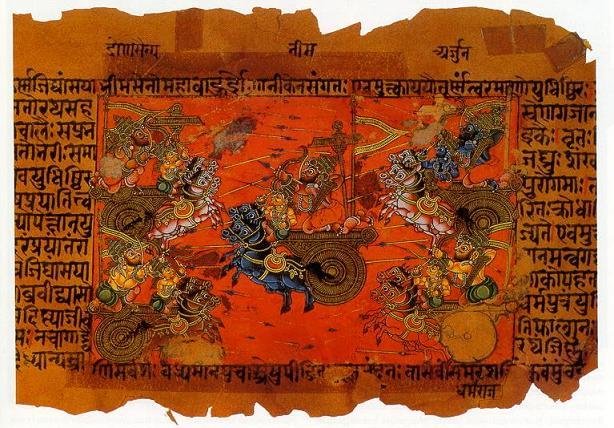
Visva-Bharati’s 307-Year-Old Mahabharata Manuscript Reportedly Gets UNESCO Memory of the World Recognition
Share Copy Link copied Contents A Santiniketan Manuscript Is Reported to Have Joined UNESCO’s Asia-Pacific Register The Manuscript: Folios, Scribe and Content What the Register Is and How India Fared at the Jakarta Meeting A Discrepancy That Still Needs Official Confirmation Lipika and the Digitisation Push Visva-Bharati and Santiniketan’s Heritage Standing Terms in Plain Language…
 Spotted something off?
Queries, objections or corrections are welcome. Visit the CoreSignal homepage or Contact Us.
Visva-Bharati’s 307-Year-Old Mahabharata Manuscript Reportedly Gets UNESCO Memory of the World Recognition
A palm-leaf Karna Parva held in Santiniketan’s Lipika repository is reported to have been added to the UNESCO Asia-Pacific register. What is known about the manuscript, and one point that still needs official confirmation.
Rabindranath Tagore’s Santiniketan is already a World Heritage site. Now a palm-leaf copy of the Mahabharata’s Karna Parva, kept in Visva-Bharati’s Lipika repository, is reported to have joined UNESCO’s regional Memory of the World register.
This report sets out what is known about the manuscript and the register, and flags one point on which the sources do not agree.
A Santiniketan Manuscript Is Reported to Have Joined UNESCO’s Asia-Pacific Register
A 307-year-old palm-leaf manuscript of the Mahabharata kept at Visva-Bharati University in Santiniketan has been included in UNESCO’s Memory of the World Asia-Pacific Regional Register, The Week reported on 12 November. Outlook Traveller carried the same account a day later and says the recognition has “reportedly” been granted.
The manuscript is a copy of the Karna Parva, the eighth of the epic’s 18 parvas. It sits in Visva-Bharati’s Lipika Manuscript Repository.
The Manuscript: Folios, Scribe and Content
| Detail | As reported |
|---|---|
| Work | Mahabharata, Karna Parva (the eighth of 18 parvas) |
| Age | 307 years |
| Format | 221 palm-leaf folios |
| Language | Sanskrit; the script is not named in the reports |
| Scribe | Haricharan Sharma |
| Held at | Lipika Manuscript Repository, Visva-Bharati, Santiniketan |
The Karna Parva covers Karna’s command of the Kaurava army after Dronacharya’s death and his fight with Arjuna. The year in which the copy was made is not stated in the reports reviewed.
What the Register Is and How India Fared at the Jakarta Meeting
The Memory of the World Asia-Pacific Regional Register is run by MOWCAP, UNESCO’s Memory of the World Committee for Asia and the Pacific. Outlook Traveller places the latest inscriptions after the committee’s 11th general meeting in Jakarta, held on 3 to 5 November 2026.
The Ministry of Culture announced India’s additions on 5 November. Organiser’s report lists three: a birch-bark Mahabharata manuscript at the Bhandarkar Oriental Research Institute in Pune, Kautilya’s Arthashastra palm-leaf manuscript at the Oriental Research Institute in Mysuru, and Kalhana’s Rajatarangini manuscript at the Oriental Research Library in Srinagar. With these, India’s entries on the register rise to six.
A Discrepancy That Still Needs Official Confirmation
The Visva-Bharati manuscript does not appear in the Ministry’s list of three as reported by Organiser. The reports on Santiniketan do not give a register entry number, an inscription date or a quote from a university official. Outlook Traveller paraphrases a university spokesperson, saying the recognition should draw more attention to the Lipika repository and encourage research.
It is possible that the manuscript is part of a wider set of inscriptions announced after the Jakarta meeting, or that it is a different kind of recognition. The register entry on the UNESCO and MOWCAP websites, or a statement from Visva-Bharati, is the way to settle it. Until then, the wording “reportedly” is the safe one.

Lipika and the Digitisation Push
Lipika holds rare works in Sanskrit, Bengali, Tamil, Arabic, Persian and Odia, and The Week quotes Anup Kumar Santra as saying that some of its holdings, including works on dramaturgy, have earlier received UNESCO recognition. The report paraphrases him and gives no further details.
Under the Gyan Bharatam Mission, announced in the Union Budget 2025-26, the Ministry of Culture aims to survey, catalogue, conserve and digitise ancient texts. Visva-Bharati has begun digitising thousands of Lipika works with technical help from the Asiatic Society.
Visva-Bharati and Santiniketan’s Heritage Standing
Visva-Bharati was established in 1921 and grew from Rabindranath Tagore’s educational experiment at Santiniketan. Santiniketan was inscribed on UNESCO’s World Heritage List in September 2023, so the manuscript recognition, if confirmed, adds a documentary-heritage listing to a place that already holds a World Heritage tag.
Terms in Plain Language
| Term | Meaning |
|---|---|
| Memory of the World | UNESCO’s programme to protect documentary heritage such as manuscripts and archives |
| MOWCAP | The Memory of the World Committee for Asia and the Pacific, which keeps the regional register |
| Parva | One of the 18 books of the Mahabharata |
| Folio | A single leaf of a manuscript, written on both sides |
Official Links
Also read: Panchayat Property Tax Collection in West Bengal Jumps 168% Between April and October
Frequently Asked Questions
Which Bengal manuscript has reportedly been recognised by UNESCO?
A 307-year-old palm-leaf manuscript of the Mahabharata’s Karna Parva, kept at Visva-Bharati University in Santiniketan.
Which UNESCO register is involved?
The Memory of the World Asia-Pacific Regional Register, run by MOWCAP.
What does the manuscript contain?
The Karna Parva, the eighth of the Mahabharata’s 18 parvas, on 221 palm-leaf folios copied by Haricharan Sharma.
Where is the manuscript kept?
In the Lipika Manuscript Repository at Visva-Bharati, Santiniketan.
When was the recognition announced?
Reports appeared on 12 and 13 November 2026. The Jakarta meeting of MOWCAP took place on 3 to 5 November, and no specific inscription date for this manuscript is given.
Is the recognition officially confirmed?
The reports say it has reportedly been granted, and the manuscript is not in the Ministry of Culture’s list of three Indian inscriptions as reported on 6 November. Official confirmation should be checked.
Which Indian manuscripts did the Ministry of Culture announce on 5 November?
The birch-bark Mahabharata manuscript in Pune, Kautilya’s Arthashastra in Mysuru and Kalhana’s Rajatarangini in Srinagar.
Is Santiniketan already a UNESCO site?
Yes. Santiniketan was inscribed on the UNESCO World Heritage List in September 2023.
This report draws on The Week, Outlook Traveller and Organiser. The UNESCO and MOWCAP register entries could not be opened, so the recognition of the Visva-Bharati manuscript is presented as reported, not as confirmed.
Disclaimer: This article is based on news reports and may differ from official UNESCO or MOWCAP records. Verify the recognition on unesco.org and with Visva-Bharati. CoreSignal is not affiliated with UNESCO or Visva-Bharati.
