Self-enumeration ends on August 15. Here’s what happens during the House Listing and Housing Census phase from August 16 to September 14.
Thank you for reading this post, don't forget to subscribe!August 16, 2026|CoreSignal
Census 2027: What Will Enumerators Ask Before House Listing Starts?
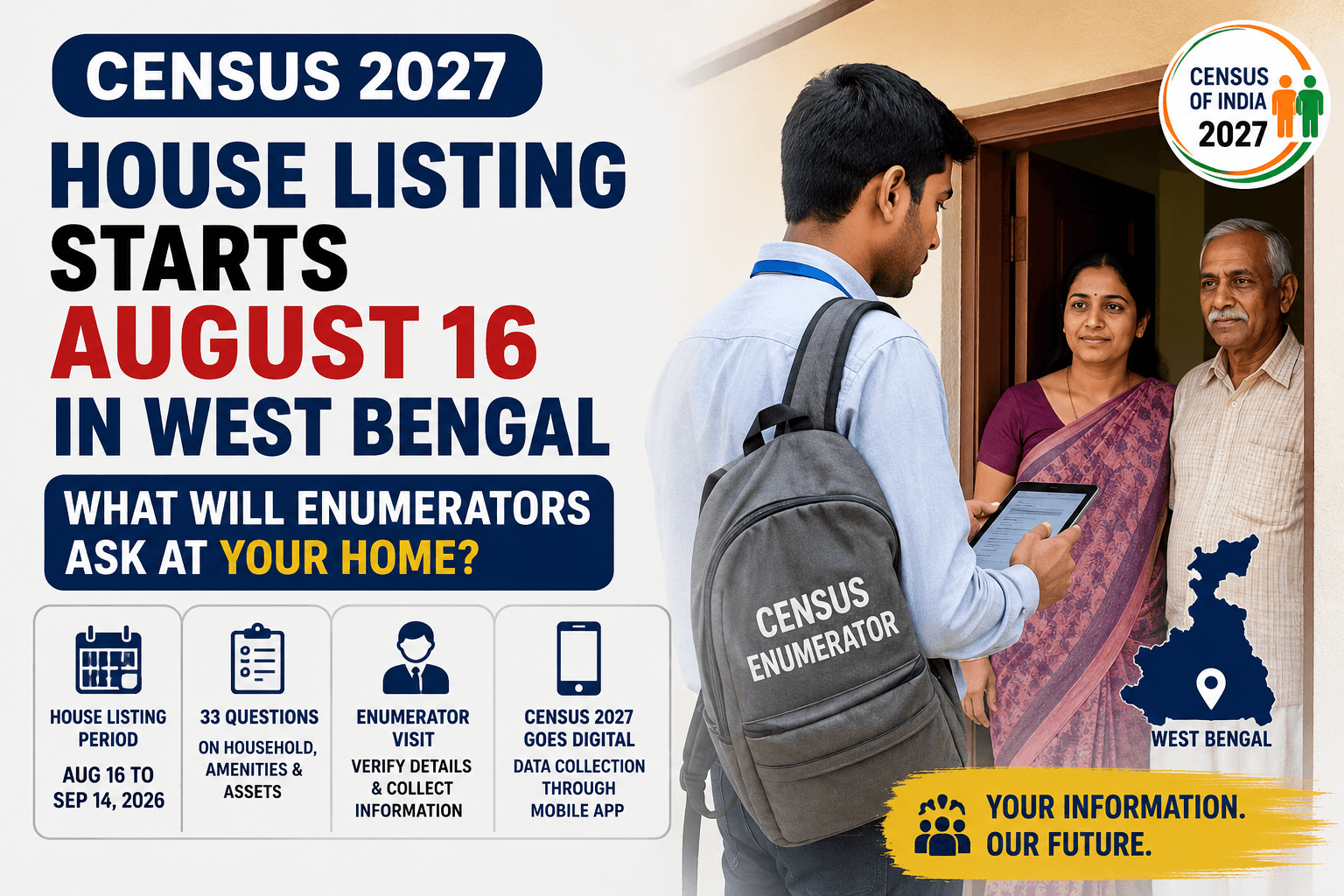
Starting Sunday, August 16, census officials will begin fanning out across West Bengal as part of the first phase of Census 2027 — the House-listing and Housing Census. The exercise will run until September 14, and over the coming month, an enumerator is expected to knock on the door of virtually every household in the state, notebook or mobile device in hand, ready to record the details that will form the very foundation of India’s 16th Census.
This isn’t a small undertaking. Across cities, towns and villages, thousands of trained enumerators will be moving door to door, systematically covering every building and structure in their assigned area — homes, shops, under-construction buildings, even vacant plots — to make sure nothing slips through the cracks. Unlike the earlier self-enumeration window, which relied on residents logging in and filling out their own details, this phase puts trained government personnel directly at the doorstep, asking questions in person and entering responses through an official mobile application in real time.
For most households, the visit itself won’t take long. If a family has already completed the self-enumeration process online and holds their 11-digit SE ID, the enumerator’s job is largely one of verification — cross-checking what’s already been submitted rather than starting from zero. But for the many households who either couldn’t or chose not to fill the form online, this in-person visit is the only touchpoint, meaning the enumerator will walk through the full set of questions from scratch, covering everything from the structure of the house itself to the amenities and assets within it.
What makes this rollout significant is its scale and timing. With the window running a full month, officials have built in enough time to reach even the more remote or hard-to-access parts of the state, while also allowing for follow-up visits in cases where a household member wasn’t available on the first attempt. Officials have repeatedly urged residents to be available and cooperative during this period, stressing that the accuracy of everything from housing policy to disaster preparedness down the line depends on how completely and correctly this data is captured right now.
Self-Enumeration Is Over. What Happens During House Listing?
This marks the 16th Census of India, and the first to go fully digital. Before enumerators even show up in person, residents were given the option to fill in their details themselves through an online self-enumeration portal, which stayed open from August 1 to August 15. According to census officials, around 3.21 lakh people in West Bengal had logged into the portal by the evening of August 2 alone — some completing the process entirely, others saving their progress partway through and returning later.
If a household already went through self-enumeration and received their 11-digit SE ID,the enumerator will verify the information submitted during self-enumeration and collect any additional information required during the field visit. — they’ll just verify the details already submitted rather than collecting everything from scratch. But self-enumeration was never mandatory. Anyone who skipped it will simply have an enumerator visit and record all the required information directly using an official mobile app.
Census 2027 What the enumerator will actually ask
The house-listing phase involves a set questionnaire — 33 questions in total — covering the building itself, the household living in it, and the assets and amenities available. Broadly, expect questions across a few categories:
- The structure — building number, census house number, what the floor, walls and roof are made of, what condition the house is in, and what it’s being used for
- The household — household number, how many people normally live there, and details about the head of the household, including name and sex
- Ownership and living space — whether the house is owned or rented, and how many rooms it has
- Basic amenities — main source of drinking water, availability of a toilet or latrine, type of fuel used for cooking, and access to electricity
- Assets — whether the household has a television, internet access, a computer or laptop, a mobile phone or landline, and vehicles ranging from bicycles and scooters to cars
- Other details — the main cereal consumed in the household, and a mobile number, collected purely for census-related communication
A few of these questions — mainly the ones about assets and amenities — are only recorded by enumerators during the physical visit and weren’t part of the online self-enumeration form, so even households that filled the form digitally may find the enumerator asking a handful of additional questions in person.
Why the data matters
This first phase is essentially about creating a foundation — enumerators will be geo-tagging buildings and assigning each structure a unique ID, information that’s expected to feed into everything from disaster response planning to urban development down the line. The actual population count, along with more personal details like age, education, caste and religion, won’t be collected now — that’s reserved for the second phase, Population Enumeration, scheduled for February 2027.
What residents should keep in mind
Officials have been keen to stress one point in particular: this Census exercise has nothing to do with the Special Intensive Revision (SIR) of electoral rolls being carried out separately. The two are unrelated processes, despite both involving household-level visits around the same period.
For now, the advice to residents is straightforward — cooperate with enumerators when they visit, keep your SE ID handy if you’ve already self-enumerated, and provide accurate information, since the data collected during this phase will form the base for the far more detailed exercise coming next year.