How to Sell Paddy at the Mandi: A Farmer’s Guide to MSP, Registration, Quality Checks and Payment
Share Copy Link copied Thank you for reading this post, don’t forget to subscribe! Contents How to Sell Paddy at the Mandi at the Government MSP in 2026-27 Suvendu Adhikari’s ₹200 Extra Per Quintal Promise: What Is Known So Far Mandi, Procurement Centre or Rice Mill: Where the Paddy Goes Registering on the e-Paddy Portal,…
 Spotted something off?
Queries, objections or corrections are welcome. Visit the CoreSignal homepage or Contact Us.
How to Sell Paddy at the Mandi: A Farmer’s Guide to MSP, Registration, Quality Checks and Payment
A field-tested walk through the process, from registering before harvest to seeing the money in the bank account.
Thank you for reading this post, don't forget to subscribe!Every year, the same scene plays out at the edge of the harvested field. The paddy is cut, threshed and stacked, and the farmer has to decide where it goes. Sell it to the village trader the same week and the cash is quick, but the rate is often well below what the government guarantees. Take it to a procurement centre and the price is better, but only if the paperwork, the moisture level and the booking are in order.
Most of the grief in paddy sales comes from that second route, and most of it is avoidable. The rules are not complicated, but they are strict, and a bag that fails on one of them can be turned away at the gate after a long ride on a loaded van. What follows is a plain account of how the process works, with West Bengal’s system as the working example, since the state runs one of the more structured online procurement set-ups in the country.
How to Sell Paddy at the Mandi at the Government MSP in 2026-27
The anchor for every sale is the minimum support price. For the 2026-27 kharif marketing season, the Centre has raised the paddy MSP by ₹72, taking it to ₹2,441 per quintal for common grade. Grade A paddy carries a slightly higher rate of ₹2,461 per quintal.
| Variety | MSP 2026-27 (per quintal) |
|---|---|
| Common paddy | ₹2,441 |
| Grade A paddy | ₹2,461 |
In West Bengal, the state has also been adding ₹20 per quintal for paddy sold at a Centralised Procurement Centre or a mobile centre. That bonus was in force in the 2025-26 season, and whether it continues in 2026-27 should be confirmed with the food department before planning a sale around it.
The MSP is not a price that arrives by itself. It is paid only when the paddy is bought by an authorised agency at an authorised centre, and only when the grain meets the quality standard. Outside that window, rates are set by the local market.
Suvendu Adhikari’s Promise of ₹200 Extra Per Quintal: What Is Known So Far
The state’s own sweetener may matter as much as the central MSP this season. Speaking at Ramnagar in East Midnapore during a Kojagari Lakshmi Puja event on 25 October, Chief Minister Suvendu Adhikari promised paddy farmers an extra ₹200 per quintal above the MSP, as reported by UNI. The Chief Minister also said that paddy and other farm output is expected to rise this year despite flooding in parts of Malda and West Midnapore, and that the government would buy the produce at an appropriate price.
The announcement leaves several practical questions open. The reports reviewed for this article do not spell out how the top-up will be paid, from which date it applies, or whether common and Grade A paddy are treated alike. If the ₹200 is added to the common-grade MSP of ₹2,441, the effective rate would come to ₹2,641 per quintal, but that arithmetic holds only once the department confirms the scheme’s terms.
A separate bonus of ₹20,000 for farmers who sell a minimum of 100 quintals does not appear in the published reports reviewed here, so the amount and the 100-quintal condition remain unconfirmed. Until the food department issues an order or circular, farmers should not plan around that figure. The block office, the e-Paddy portal and the helplines listed later in this guide are the places to check for the official terms.
Mandi, Procurement Centre or Rice Mill: Where the Paddy Goes
In West Bengal, farmers do not have a single mandi to choose from. The state department’s procurement portal lists several channels through which paddy can be sold at the support price:
- Centralised Procurement Centres (CPCs), usually located in block-level krishak mandis or similar premises.
- Mobile procurement centres, which operate in areas and periods where the harvest is heavy, mostly between November and February.
- Purchase centres run by FPOs, self-help groups, societies, LAMPS and PAMS, acting on behalf of the government.
- Registered rice mills, which buy directly under the procurement scheme.
Centres generally work from 9 a.m. to 3 p.m. on working days, and are closed on Sundays and notified holidays unless the department orders otherwise. Procurement for a season typically begins around November and runs on well into the following year. The block development office or the local food office can say which centre is open nearest to a given village, and the 2025-26 season alone saw more than 3,000 procurement centres in operation across the state.
Other states run their own versions of this system. Punjab and Haryana rely heavily on the arhtiya-based mandi network, while several states use separate online registration portals for farmers. The broad logic is the same everywhere: register, bring clean and dry grain, pass the quality check, get paid into the bank account. The specific portal, documents and limits differ, so farmers outside West Bengal should check with their state’s food or agriculture department.
Registering on the e-Paddy Portal, Step by Step
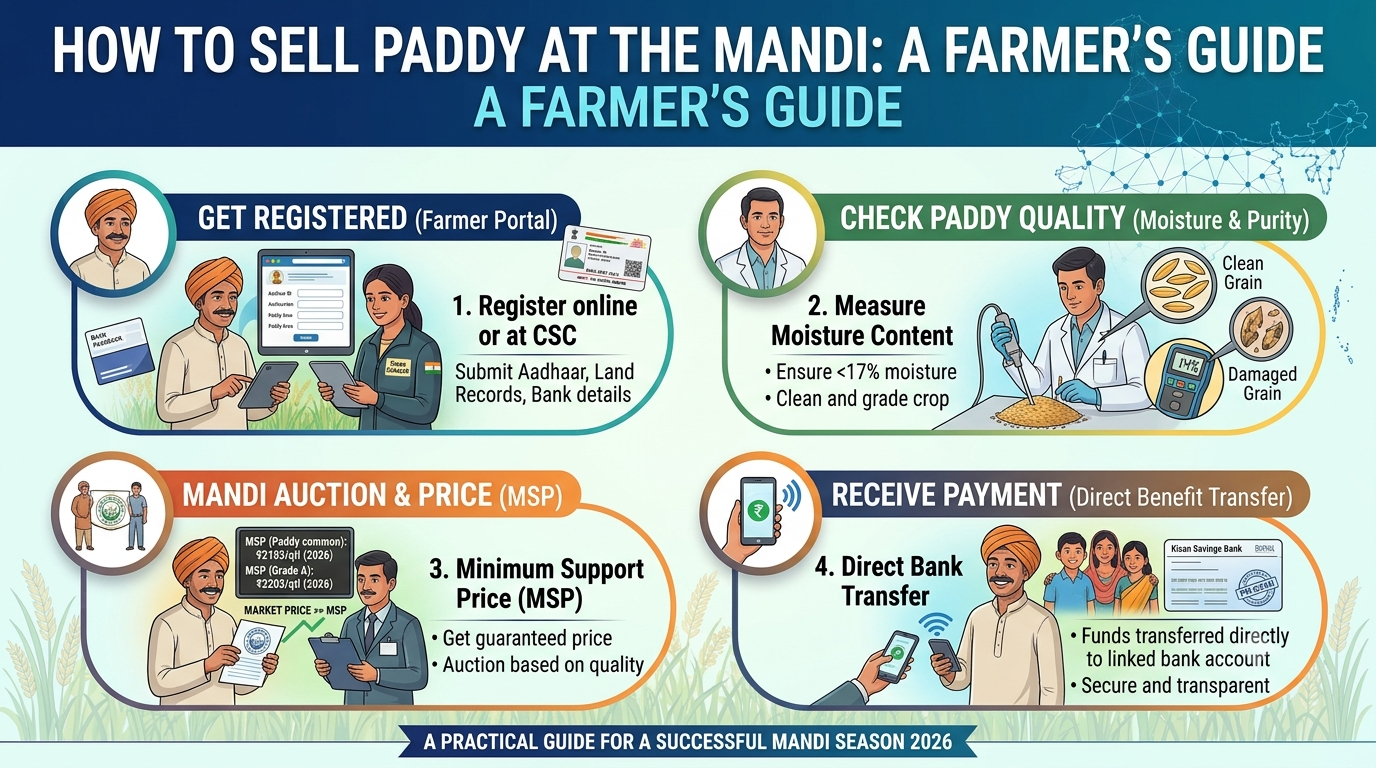
Walking in with a trolley of paddy and hoping to be weighed is no longer how it works in West Bengal. Registration comes first, and the state’s e-Paddy portal is where it happens. The process, as laid out in the food department’s own material, runs like this:
- Open the e-Paddy portal and start the farmer self-registration.
- Enter the Aadhaar number and complete the authentication, through an OTP or a biometric check.
- Provide the Krishak Bandhu ID, the voter ID (EPIC), the bank account details and the mobile number, which is confirmed through an OTP.
- Wait for the system to validate these details against the relevant databases. Each registration number is unique, and a farmer who is validated and active becomes eligible to book.
- Download the registration certificate.
- Book a slot, choosing the centre in the district, the date and the time. Slots can be booked up to 30 days ahead and are given on a first come, first served basis.
Anyone who finds the portal difficult can seek help at a Bangla Sahayata Kendra or directly at a procurement centre, where officers can register farmers and schedule purchases. The department has also set up a WhatsApp chatbot on 9903055505 for queries.
Also read: Farmer ID (Kisan Pehchaan Patra): Registration, Status Check, and Everything Else to Know
Documents and Details to Keep Ready
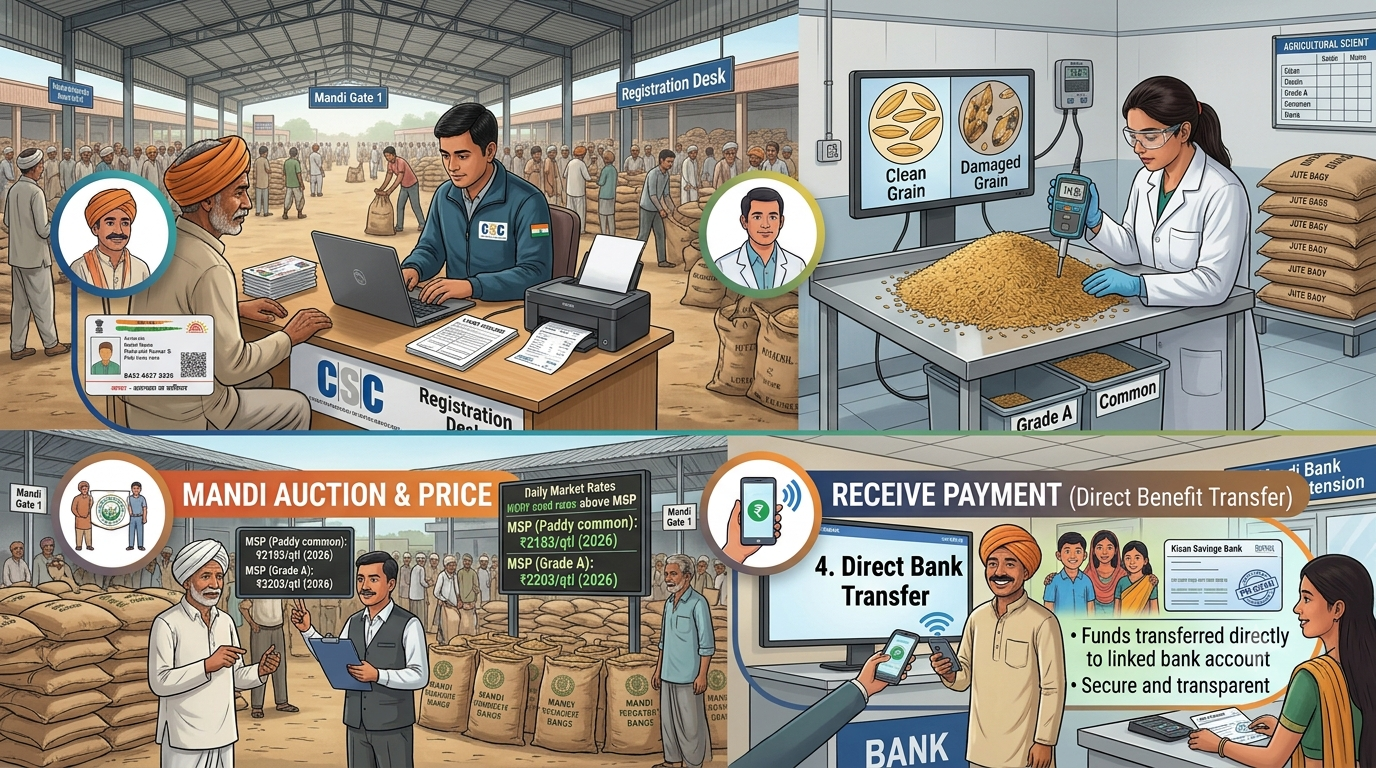
Registration fails most often over small mismatches, not missing papers. The system cross-checks several records, and a spelling difference between two of them can freeze a farmer’s account until the central unit sorts it out. These are the items to have in order:
- Aadhaar card, linked to an active mobile number.
- Krishak Bandhu ID, for farmers enrolled in the scheme, since the land recorded there sets the selling limit. Farmers outside the scheme are generally asked for land records instead, preferably the Record of Rights in their own name.
- Voter ID (EPIC), linked to the Krishak Bandhu record.
- Bank passbook of an account that is active and KYC-compliant.
- Land documents, or a land declaration where the state’s guidelines allow it.
The single detail most worth checking is the name. The name on the Aadhaar must match the name on the bank passbook, because the system verifies both. A farmer whose passbook carries a different spelling is better off correcting it at the bank before harvest than after the paddy has been brought to the centre.
Is Farmer ID Compulsory for Selling Paddy? What the Rules Say Right Now
With the Farmer ID (the AgriStack registry number) being pushed through camps and portals, the obvious question at the start of the season is whether it has become a condition for selling paddy at MSP. On the evidence available so far, no such condition has been officially laid down in West Bengal.
The state food department’s published material for the 2025-26 season lists Aadhaar, the Krishak Bandhu ID, the voter ID, a validated bank account and a mobile number as the credentials checked at registration. The Farmer ID is not on that list. CoreSignal’s own step-by-step guide to paddy procurement registration likewise does not mention a Farmer ID, and treats the Krishak Bandhu ID as optional, with farmers outside the scheme also eligible.
Neighbouring Odisha offers a useful comparison. In the second week of August 2026, its Food Supplies Minister Krushna Chandra Patra stated, as reported by PTI, that an AgriStack ID is not required to register for selling paddy to the government. Farmers had protested because the ID is issued only to those with land in their name, which leaves sharecroppers and farmers without a Record of Rights at a disadvantage. Registration slips issued with and without the ID were both declared valid.
West Bengal has been rolling out the Farmer ID through local camps, and some third-party portals report that it is likely to be needed for linking with schemes such as Krishak Bandhu and PM-KISAN, with online registration at times limited while land-record fetching is under maintenance. None of that amounts to an official rule for paddy sales. Still, enrolling is free, and a farmer who already holds the ID will have one less thing to sort out if a centre or a future order asks for it.
The practical advice is to register on the e-Paddy portal with the documents already listed, keep the Khatian or Record of Rights handy, and approach the block development office if a centre or portal insists on a Farmer ID before accepting registration. Rules of this kind are revised from season to season, and the department’s current circular has the final word.
How Much Paddy One Farmer Can Sell
Procurement is capped per farmer. In the 2025-26 season, the state’s rules allowed a farmer to sell paddy only up to the land area recorded against his or her name in the Krishak Bandhu portal, with an overall ceiling of 90 quintals per season. Earlier official guidance for a previous season had put the limit at 45 quintals, which shows how the cap moves from year to year.
For this season, the safest course is to check the current limit at the block office or the portal before loading the vehicle. Bringing more than the permitted quantity does not help, and the excess may have to be sold elsewhere. A farmer who needs to sell early because of an emergency may be able to do so with a certificate from the block development officer, according to the department’s earlier farmer guidance.
Quality Norms That Decide Acceptance at the Gate
The grain that is bought at MSP is called fair average quality, or FAQ. It must be clean, dry, mature and uniform, and free from mould, weevils and any bad smell. The department’s farmer guide lists the permitted limits as follows:
| Parameter | Maximum allowed |
|---|---|
| Moisture | 17% |
| Foreign matter, organic or inorganic | 1% |
| Damaged, discoloured, sprouted or weevilled grain | 5% |
| Immature or shrunken grain | 3% |
| Admixture of lower-class grain | 6% |
These figures come from the farmer-facing guidance published for an earlier season, and the standards are set at the national level, so they have stayed broadly consistent. Moisture is the one that trips up the most farmers. Paddy above 17 per cent is usually rejected, and a few days of proper sun-drying after threshing is the cheapest insurance there is. Winnowing out chaff, dust and broken grain before loading cuts the risk of deductions.
When a lot falls only slightly short, it may be accepted after a deduction for the excess lower-grade grain. Each centre also has a three-member committee, with a representative of the block office, one from the agriculture department and one from a rice mill, to settle quality disputes. A farmer who disagrees with a rejection can ask for the committee to look at the grain.
Selling Day at the Centre
On the booked date, the paddy goes to the allotted centre in clean, dry bags, along with the documents used for registration. Sales are authenticated by the farmer’s fingerprint or iris scan, so the registered person has to be present. The grain is checked for moisture and quality, weighed, and recorded in the system. The farmer’s bags are returned straight after the sale.
Once the biometric verification is complete, an SMS arrives on the registered mobile number with the transaction details and the bank account that will receive the money. That message is worth keeping, since it is the first proof of sale if a payment query comes up later.
Payment Timeline and What Can Hold It Up
The government’s stated commitment is to credit payment directly into the farmer’s registered bank account within three working days of the purchase. Officers at the centre are expected to track transactions after that window and chase any that are still pending.
Delays usually have a mundane cause. The most common ones are:
- Incorrect or incomplete bank details, including a wrong IFSC code.
- A mismatch between the name on the Aadhaar and the name on the passbook.
- A dormant account, or one that has not completed KYC.
- A Jan Dhan account with a credit limit that the payment exceeds, in which case the money will not be credited.
Anyone whose payment has not arrived can first approach the purchase officer or disbursing officer at the centre. The toll-free helplines 1800 345 5505 and 1967 are also available, and for problems with the sale itself, the sub-divisional food controller or the block development officer can step in.
Common Reasons Paddy Gets Rejected or Delayed
Seasoned farmers and centre staff tend to point to the same handful of slip-ups:
- Bringing paddy straight from the threshing floor without drying it, and landing above the 17 per cent moisture mark.
- Registering late and finding the preferred dates already booked.
- Carrying more than the quantity allowed against the recorded land area.
- Name or spelling differences across Aadhaar, voter ID, Krishak Bandhu and bank records.
- Giving a bank account that is dormant, not KYC-verified or close to its limit.
- Sending someone else to the centre when the registered farmer’s fingerprint or iris scan is required.
Most of these can be fixed in the weeks before harvest, which is why the advice from officials is always the same: register early, correct the records early, and dry the grain properly.
Frequently Asked Questions
What is the MSP of paddy for 2026-27?
The Centre has set the minimum support price at ₹2,441 per quintal for common paddy and ₹2,461 per quintal for Grade A paddy for the 2026-27 kharif marketing season.
Where can paddy be sold at MSP in West Bengal?
Paddy can be sold at Centralised Procurement Centres, mobile procurement centres, purchase centres run by FPOs, self-help groups, societies, LAMPS or PAMS, and through registered rice mills. The block office or the local food office can give the list of centres in each area.
Is registration compulsory before selling paddy?
Yes. In West Bengal, farmers register on the e-Paddy portal, get their details validated, and book a date and centre for the sale. Only a validated and active farmer can book a slot.
Which documents are needed to sell paddy?
Aadhaar, Krishak Bandhu ID, voter ID (EPIC), a bank account and a mobile number for OTP are validated during registration. The name on the Aadhaar must match the name on the bank passbook.
Is Farmer ID (AgriStack) mandatory to sell paddy in West Bengal?
No official order making the Farmer ID compulsory for paddy procurement has been found. The West Bengal food department’s material for 2025-26 lists Aadhaar, Krishak Bandhu ID, voter ID, bank account and mobile number as the credentials checked at registration. Odisha’s Food Supplies Minister said in August 2026 that an AgriStack ID is not required there. Farmers should confirm the current season’s rules with the block office or the e-Paddy portal.
What is the moisture limit for paddy at the procurement centre?
Fair average quality paddy can have moisture of up to 17 per cent. Paddy above this level is usually rejected, so it should be sun-dried and cleaned before it is brought to the centre.
How much paddy can one farmer sell?
In West Bengal, the quantity is tied to the land area recorded in the Krishak Bandhu portal, with an overall ceiling of 90 quintals per farmer per season in 2025-26. The limit for the current season should be confirmed with the block office or the portal.
Is there an extra ₹200 per quintal for paddy in West Bengal?
Chief Minister Suvendu Adhikari promised on 25 October 2026 an extra ₹200 per quintal above the MSP for paddy farmers. How and when it will be paid has not been spelled out in the reports reviewed, so the terms should be confirmed with the food department. A ₹20,000 bonus for farmers selling at least 100 quintals is not confirmed in those reports.
How soon is payment made after selling paddy?
Payment is credited directly to the farmer’s registered bank account within three working days of the sale, and an SMS with the transaction details is sent after biometric verification.
What can be done if the paddy is rejected or payment is delayed?
Quality disagreements are handled by a committee at the centre with representatives of the block office, the agriculture department and a rice mill. Payment problems can be raised with the centre’s purchase officer or through the helplines 1800 345 5505 and 1967.
What is the helpline for paddy procurement in West Bengal?
The toll-free helplines are 1800 345 5505 and 1967. The department’s WhatsApp chatbot number is 9903055505, and Bangla Sahayata Kendras and procurement centres also assist farmers.
Disclaimer: Procurement rules, per-farmer limits, incentives and centre lists change from season to season and differ across states. Some figures above come from the West Bengal food department’s published guidance for earlier seasons. Farmers should confirm the current rules with the block development office, the local food office or the e-Paddy portal before selling. CoreSignal is not a government body.