ECI Form 6 Explained: How to Apply for a New Voter ID Card, Step by Step
Who can use Form 6, which documents count, how the online and offline routes work, and what to do when an application stalls.
Thank you for reading this post, don't forget to subscribe!November 5, 2026|CoreSignal
An Indian citizen’s name has to be on the electoral roll before a vote can be cast, and ECI Form 6 is the application that puts it there. It is the form behind every first-time voter registration, and it is also used when a voter shifts to a different constituency. The Election Commission of India (ECI) accepts it online through the Voters’ Service Portal at voters.eci.gov.in and offline through the local Booth Level Officer (BLO) or Electoral Registration Officer (ERO). Applying costs nothing.
This guide covers eligibility, the four qualifying dates, every section of the form, the documents to keep ready, tracking and what happens after a rejection. It also covers the changes that followed the Special Intensive Revision (SIR) of electoral rolls in West Bengal.
What Form 6 Is and What It Does
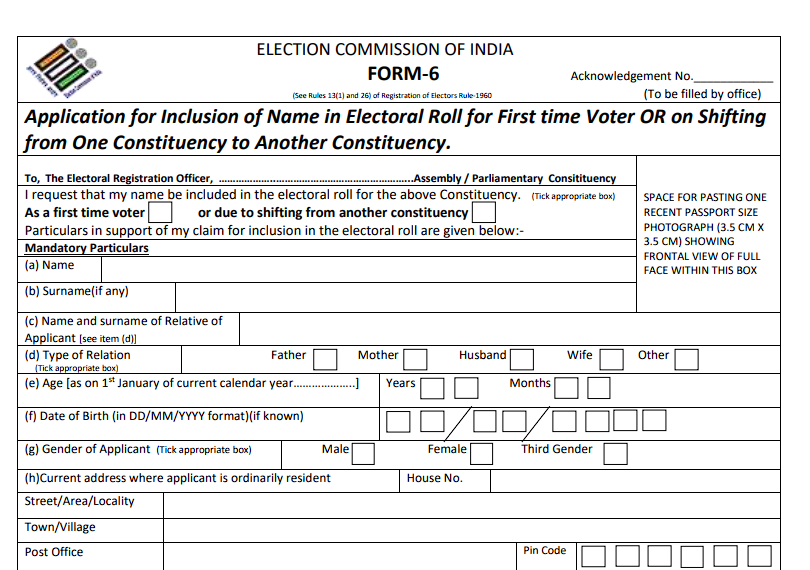
Form 6 is the prescribed application for inclusion of a name in the electoral roll, issued under the Registration of Electors Rules, 1960. It is addressed to the ERO of the Assembly Constituency where the applicant ordinarily lives. In most places the ERO is a senior revenue or administrative officer, and the BLO is the local official who visits homes and checks details on the ground.
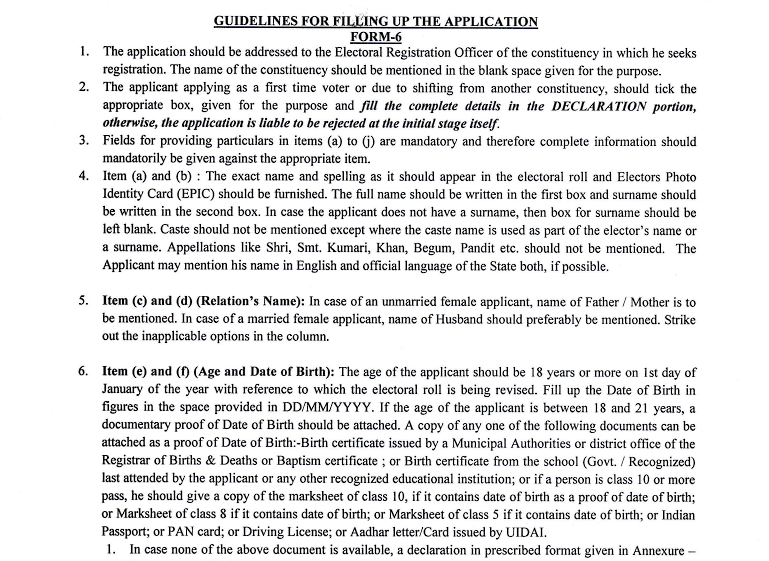
The printed form is titled for use by a first-time voter or a voter shifting from one constituency to another. Anyone who has never been on the roll, or whose name has dropped off it, uses this form. Once the ERO accepts the application, the name is added to the roll and the Elector’s Photo Identity Card (EPIC) is issued. As per the ECI’s own filling guidelines, the card is delivered by speed post at no charge.
Eligibility: Who Can Apply for Voter Registration
Four conditions apply:
- The applicant is a citizen of India.
- The applicant has attained, or will attain, the age of 18 on a qualifying date.
- The applicant is ordinarily resident in the constituency where enrolment is sought.
- The applicant is not disqualified from voting under the law.
“Ordinarily resident” means the place where a person normally lives, not necessarily the ancestral home. The ECI guidelines make two practical points. Students can be enrolled either at the parents’ address or at the hostel or mess where they actually live. Homeless citizens and certain others without documentary proof of residence can still be enrolled, after field verification.
The Four Qualifying Dates and Applying Before Turning 18
Earlier, a young person who turned 18 after January 1 waited a full year. The rules now recognise four qualifying dates in a year: January 1, April 1, July 1 and October 1. Business Standard’s explainer on the form lists the same dates.
A worked example: someone who turns 18 on May 20 is counted from the next qualifying date, July 1, instead of waiting for January. Reports on the rules say people who are 17 can file an advance application, and the name is added once they reach 18. The portal’s current instructions should be checked for how advance applications are handled in a given quarter.
Form 6, Form 6A, Form 7 and Form 8: Choosing the Right One
| Form | Used for | Who files it |
|---|---|---|
| Form 6 | Inclusion of a name in the roll, including first-time registration and shifting to a different constituency | New voters, anyone whose name is missing from the roll |
| Form 6A | Enrolment as an overseas elector | Indian citizens living abroad who have not acquired another country’s citizenship |
| Form 7 | Objecting to the inclusion of a name, or seeking deletion (for example, death, permanent shifting or duplicate entry) | Any elector raising an objection, or a family member reporting a death |
| Form 8 | Correction of details in the existing entry, EPIC replacement, shifting within the same constituency and marking as a person with disability | Existing voters who are already on the roll |
Form 6B is a separate, voluntary form for informing the ECI of an Aadhaar number for the electoral roll. A person who is already registered and only needs a spelling fix or address update should file Form 8, not a fresh Form 6.
Document Checklist: What Is Required and What Is Optional
Required in every case
- One recent passport-size colour photograph.
- Proof of age: a self-attested copy of any one document listed on the form.
- Proof of ordinary residence: a self-attested copy of any one listed document, in the name of the applicant, a parent or the spouse.
Commonly accepted age proofs (the printed form carries the official list): birth certificate, Class 10 or 12 mark sheet showing the date of birth, passport, PAN card, driving licence and Aadhaar.
Commonly accepted address proofs: bank or post office passbook, ration card, passport, utility bills, rent agreement, registered sale deed or a postal letter received at the address in the applicant’s name.
Optional: Aadhaar number. The guidelines say an applicant without one can simply say so in the relevant box.
If none of the listed age proofs exists, the ECI guidelines allow a different document in support, with its name written in the form and the declaration. In that case the applicant has to appear personally before the ERO or a designated officer for verification. Producing a listed document speeds up registration.
Photograph Rules
According to the form’s guidelines, the photograph must be a recent, good-quality, unsigned colour passport-size picture (4.5 cm × 3.5 cm) with a white background. Both eyes must be open and both edges of the face must be clearly visible. Online, the same picture is uploaded as a file.
Filling Form 6 Field by Field
Item numbers below follow the ECI’s filling guidelines, and field numbering can differ slightly between printed versions and online screens.
| Field | What to enter | Practical tip |
|---|---|---|
| Constituency | Assembly or Parliamentary constituency of residence | If unsure, the ERO helps, and the form cannot be rejected merely for this |
| Item 1: Name | Exact name in both English and the state’s official language (Bengali in West Bengal) | If only one language is filled, the system transliterates the other, which may create spelling mistakes |
| Item 2: Relative’s name and surname | Name of a parent or spouse, with relationship type (father, mother, husband and so on) | A married woman may preferably give her husband’s name |
| Contact details | Mobile number and email | Used for updates from the portal and BLO |
| Item 5: Aadhaar | Aadhaar number for authentication, or a mention that none is held | Not compulsory |
| Item 6: Gender | Male, Female or Third Gender | Third gender applicants may also choose Male or Female |
| Item 7: Date of birth | Date plus the age-proof document attached | Match the document exactly |
| Item 8: Present ordinary residence | Full postal address with PIN code, plus residence proof | The BLO verifies this address |
| Declaration | Citizenship, residence and no enrolment elsewhere | Complete every entry |
Entries can be made in English or the state’s official language, and the choice cannot be used to reject the form.
The Declaration and Its Legal Weight
Every entry in the declaration must be filled. A false statement there is a punishable offence under Section 31 of the Representation of the People Act, 1950, carrying up to one year of imprisonment, a fine or both. Applicants who are unsure about a detail, such as a previous registration, should say so and ask the BLO instead of guessing.


Aadhaar and Form 6: What Is Actually Required
The ECI’s guidelines treat Aadhaar as an aid to authentication, not a condition. Applicants without it can say so in the form. The ECI also told the Supreme Court that Aadhaar is one of several permitted documents and not the sole proof of age, and in September 2025 instructed state election officers to treat it strictly as identity proof, not as proof of citizenship, as reported by The Federal. Aadhaar linking remains encouraged to help weed out duplicate entries.
How to Apply Online on the Voters’ Service Portal
- Open voters.eci.gov.in or the Voter Helpline App.
- Register with a mobile number and OTP, or log in if an account already exists.
- Choose the option for new voter registration (Form 6).
- Enter name, relative’s details, date of birth, gender and contact information.
- Fill in the present address and select the state, district and constituency.
- Upload the photograph, age proof and address proof.
- Read the declaration and submit.
- Save the reference number shown on screen. It is the key to tracking the application.
Online filing does not require posting a signed copy. As the ECI’s FAQ explains, the ERO or Assistant ERO downloads the form and a BLO is deputed to visit the applicant’s residence.
How to Apply Offline Through the BLO or ERO
- Download Form 6 from the ECI site or collect it from the ERO’s office or the local BLO.
- Fill it in block letters and paste the photograph in the space provided.
- Attach self-attested copies of the age and address proofs.
- Hand it to the BLO, the Assistant ERO or the ERO of the constituency.
- Collect the acknowledgement. The detachable slip carries an acknowledgement number, and the form itself says it can be used to check the application status.
What Happens After Submission
A BLO usually visits the address to confirm identity and residence, and original documents may be asked for. The BLO files a report, and the ERO then decides whether the applicant is a citizen, at least 18, and ordinarily resident in the constituency. The form includes a section where the ERO communicates the decision, with reasons for either acceptance or rejection. On acceptance, the name enters the roll and the EPIC is dispatched. A digital e-EPIC can also be downloaded from the portal once generated.
Tracking Form 6 Status
Use “Track Application Status” on the portal and enter the reference ID. Typical stages are submitted, BLO assigned, field verification, forwarded to ERO and approved or rejected, though exact labels vary. Offline applicants quote the acknowledgement number. Help is available on the voter helpline 1950 (with the STD code added when calling from a landline).
Pending, Rejected or Questioned: What to Do
Pending for long: Contact the BLO, which the portal lets applicants look up, then the ERO’s office, and escalate through 1950. The Right to Information Act is a last resort for asking about the field report.
Rejected: Read the reason in the status or the ERO’s intimation. Common causes include residence that could not be verified, a mismatch between the name or date of birth and the documents, and a duplicate entry. Fix the gap and apply again if still eligible. The Representation of the People Act, 1950 also provides appeals against an ERO’s decision to higher election officials, and the rejection order should show the route and time limit.
Objection raised: Respond with the missing document or a corrected detail. Spelling and date mismatches are the most frequent trigger, so use the name exactly as it appears on the age proof.
Why a Person Can Be Registered in Only One Place
Under the Representation of the People Act, 1950, no one may be registered in more than one constituency, or more than once in the same constituency. A person with an old entry should not file a fresh Form 6 and hope the old one disappears. Students and workers living away from the family home must choose one constituency, either the parental address or the current residence. Anyone unsure whether a name is already on the roll can search the electoral roll on the portal first.
Moved to a New Address or State?
Shifting to a different constituency means a fresh Form 6 for the new place, as the form’s own title indicates. Shifting within the same constituency is generally handled through Form 8. Proof of the new address is needed, and enrolment at the old address is removed through the deletion process, so the entry is not duplicated.
First-Time Voters and Voters in West Bengal
For a first-time voter, the practical checklist is short: a Class 10 certificate or birth certificate, any residence proof, a clear photograph and a working mobile number. A birth certificate or school certificate is usually the cleanest age proof.
West Bengal’s electoral rolls went through a Special Intensive Revision, with door-to-door verification beginning on November 4, 2025. The Wire reported that more than 58.2 lakh names were removed before the draft roll and that total deletions were close to 91 lakh by the end of the exercise. The Wire’s report said the state Chief Electoral Officer’s office has told at least one category of deleted voters that they can apply through Form 6 online or through a BLO.
In states where SIR has ended, the ordinary Form 6 under the 1960 rules applies, not the SIR-specific declaration seen during the exercise. Anyone from West Bengal who is unsure of their status should search their name on the electoral roll, and apply through Form 6 if it is missing. The Chief Electoral Officer’s website for West Bengal carries state-level notices.
Having an EPIC Is Not the Same as Being on the Roll
An EPIC is proof of identity and enrolment, but the right to vote depends on the name appearing in the electoral roll of the polling area. A card in hand with a missing roll entry does not allow voting. A quick search on the portal before every election is a sensible habit.
Mistakes That Lead to Rejection
- Name or date of birth that does not match the documents.
- Address proof in the name of someone unrelated to the applicant.
- Blurred scans or an incorrect photograph.
- Skipping the declaration entries.
- Applying where the applicant does not actually live.
- Filing a fresh Form 6 when a Form 8 correction was needed.
Frequently Asked Questions About ECI Form 6
What is Form 6 in voter ID?
It is the application for inclusion of a name in the electoral roll, used by new voters and by voters shifting to another constituency.
Who can apply for Form 6?
Any Indian citizen who is 18 on a qualifying date, ordinarily lives in the constituency and is not legally disqualified.
Is Aadhaar mandatory for Form 6?
No. The ECI’s guidelines let applicants without Aadhaar say so in the form, and other documents can be used.
Can I apply for Form 6 online?
Yes, through voters.eci.gov.in or the Voter Helpline App.
What documents are required?
A passport-size photograph, one age proof and one address proof, all self-attested where copies are submitted.
Can a 17-year-old apply for voter registration?
Reports say advance applications are allowed, and the name is added after the 18th birthday. The portal’s current instructions govern the details.
When will the Voter ID card arrive?
After the ERO accepts the application, the EPIC is sent by speed post, free of cost. The ECI guidelines give no fixed number of days, so tracking the status is the reliable way to know.
How can I track a Form 6 application?
Use the reference ID on the portal’s tracking page, or the acknowledgement number for offline forms.
Is Form 6 Application free?
Yes. Neither the application nor EPIC delivery carries a fee.
Can I apply without a mobile number?
The online route relies on a mobile number for login and updates, so the offline route through the BLO is the practical option.
What happens if the application is rejected?
The ERO’s decision carries the reasons. The gap can be fixed and a fresh application filed, and a legal appeal is available.
Can Form 6 be submitted twice?
Duplicate submissions can cause confusion and rejection. A second filing makes sense only after the first has been decided or the first was clearly wrong.
Can I apply after shifting to another state?
Yes. A fresh Form 6 is filed for the new constituency, with proof of the new address.
What is the difference between Form 6 and Form 8?
Form 6 adds a name to the roll, while Form 8 changes details of a name that is already there.
How can I download Form 6?
From the ECI’s website or the voter portal, or collect a printed copy from the BLO or ERO.
Does receiving an EPIC guarantee the right to vote?
No. The name must also be on the electoral roll for the polling area.
Can students register at their college address?
Yes, the ECI guidelines allow enrolment either at the parents’ place or at the hostel or mess where the student lives.