
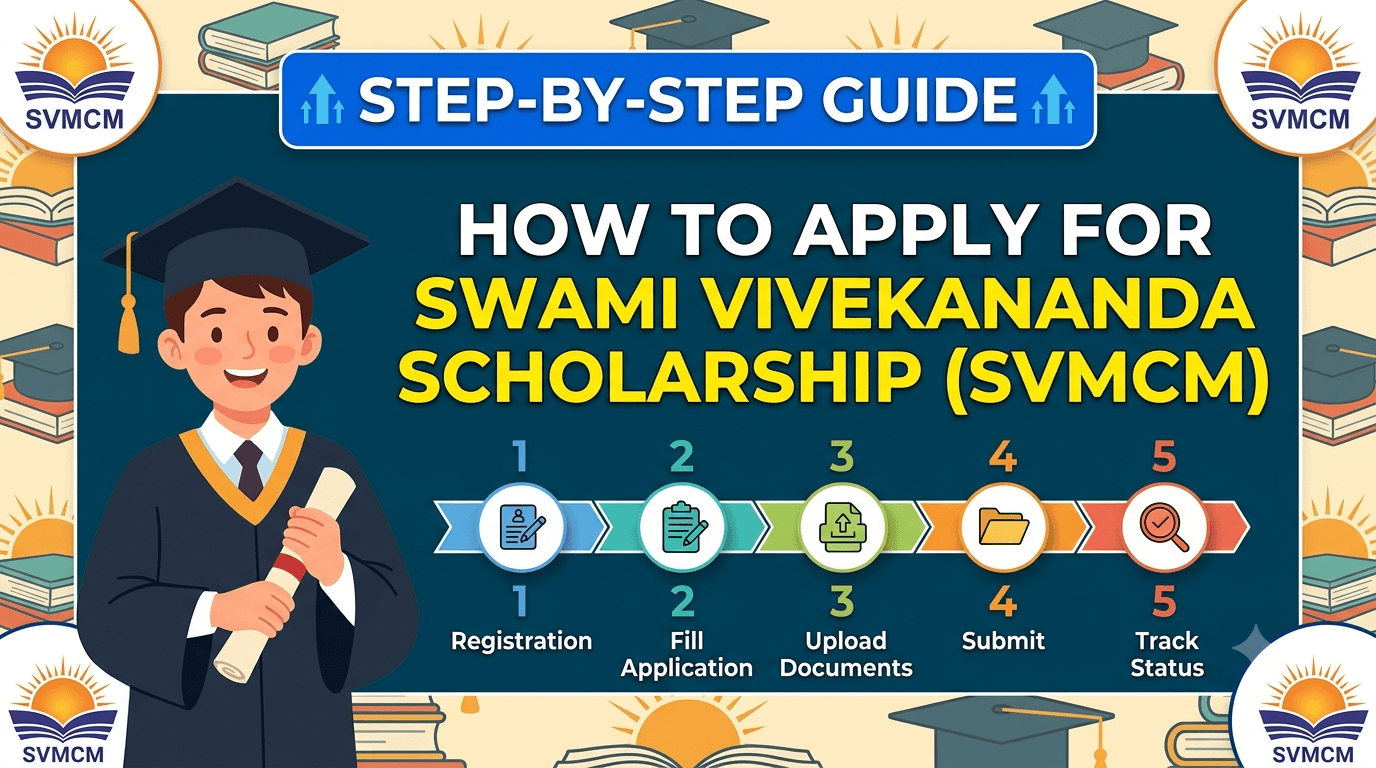
Everything West Bengal students need to know about eligibility, scholarship amounts, required documents, and how to apply online for the Swami Vivekananda Merit-cum-Means Scholarship (SVMCM)
Thank you for reading this post, don't forget to subscribe!September 27, 2026|CoreSignal
The Swami Vivekananda Merit-cum-Means Scholarship (SVMCM) is West Bengal’s flagship state scholarship, named after Swami Vivekananda, who strongly advocated for education as a means of social upliftment and individual empowerment and emphasized the importance of providing quality education to all, irrespective of social or economic status. It is a broad, multi-stream scholarship by the Government of West Bengal that supports students across higher secondary, undergraduate, postgraduate, technical, and professional courses, including medical, engineering, general degree, and diploma programs. It is administered by the Higher Education Department, Government of West Bengal, via the official SVMCM system, which handles application processing, verification, and fund disbursement.
Over 5 lakh students receive this scholarship every year, making it one of the most far-reaching state scholarship programmes in India — covering students from HS level through to postgraduate study, based on strong academic performance combined with family income up to ₹2.5 lakh.
What Makes SVMCM Different
SVMCM follows a merit-cum-means model, rewarding both academic performance and financial need, rather than merit or need alone. It covers an unusually wide academic span — from Class 11 all the way to PhD level.
Eligibility Criteria
To qualify for SVMCM, students generally need to meet the following conditions:
- Domicile: Applicants must be domicile students of West Bengal, studying in regular mode — students studying outside West Bengal are not eligible.
- Course level: Open to students in Class XI/XII, undergraduate, postgraduate, professional, technical, and research courses.
- Academic marks: Students must secure 60% marks in their last board examination (Madhyamik/Higher Secondary), while at the postgraduate level, 53% is required.
- Family income: Annual family income must be below ₹2,50,000, verified through an income certificate. Different sources note this must be issued by a Municipality/Gazetted Officer of Group-A rank or, per other guidance, by the BDO/SDO.
- No double benefit: Students who accept SVMCM generally cannot simultaneously benefit from another state or central government scholarship.
Renewal students are typically required to have passed the previous year with a set minimum percentage — the exact renewal cut-off is published on the portal each cycle and can vary by course.
Scholarship Amount
The monthly stipend varies by course level and stream. Reported figures differ slightly across sources (rates are revised periodically), but a representative breakdown is:
| Course Level | Monthly Amount (approx.) |
|---|---|
| Higher Secondary (Class 11–12) & general UG | ₹1,000/month |
| General Postgraduate | ₹2,000/month |
| UG Engineering & Medical | ₹5,000/month (₹60,000/year) |
| Technical/professional courses & PhD | up to ₹5,000/month, with some listings citing figures as high as ₹8,000/month for the highest tiers |
Annually, this can total anywhere from ₹12,000 to ₹96,000 per year depending on the course and level. Funds are disbursed via Direct Benefit Transfer (DBT) straight into the student’s bank account. Because rates are revised each cycle, always confirm the current figures on the official portal before applying.
Documents Required
Based on standard requirements listed by scholarship trackers, applicants typically need:
- Aadhaar card
- Domicile certificate
- Income certificate
- Academic certificates/marksheets
- Fee receipt
- Bank passbook
- A recent photograph
Step-by-Step Application Guide
The entire process is online, through the official SVMCM portal.


Step 1: Visit the official website
Go to official svmcm portal→. Avoid third-party sites claiming to be official portals.
Step 2: Register
Click the ‘Register’ button on the dashboard, then enter your basic details and an active mobile number to receive your Registration/Applicant ID, verified via OTP.
Step 3: Choose your application category and type
Select the appropriate category, then choose ‘Application Type’ as ‘Fresh Application’ and select the ‘Apply for Fresh’ option before clicking ‘Proceed.’ Returning students instead choose the Renewal option and log in with their existing Applicant ID.
Step 4: Fill in the application form
Log in with your Applicant ID and password, then complete the online form covering personal details, academic records, family income, and bank details.
Step 5: Upload documents
Upload scanned documents — marksheets, income proof, bank passbook, domicile certificate, and photo — in the prescribed format.
Step 6: Submit and save your reference number
Submit the form and note the generated application number/reference ID for future tracking.
Step 7: Track verification and disbursal
You can track verification status by logging into your Applicant Dashboard. Once verified and approved, scholarship payments are scheduled and credited to the bank account provided. For renewals specifically, disbursal starts only after the college/university verifies academic performance and attendance on the portal, and any delay in institutional verification can delay payments.
Note for Kanyashree beneficiaries: Applicants who are also availing the Kanyashree scholarship are required to authenticate their details through that scheme during SVMCM registration — check the portal’s specific instructions for this linkage.
How to Check Application Status
- Visit the official portal and click ‘Applicant Login’
- Enter your Application ID, password, and the captcha code, then log in
- Select ‘Track Application’ from the dashboard
- The status will show as Pending, Institute Verified, Approved, Disbursed, or Rejected — if it’s stuck at Pending, ask your college to complete verification.
You can also reach the official helpline at 1800-102-8014, or by email at helpdesk.svmcm-wb@gov.in, for issues with your application.
Important Dates (2026–27 Cycle)
Application timelines for SVMCM change every year and are announced only on the official portal, so treat any specific date as provisional. As of the most recent updates: the SVMCM 2026-27 application form had not yet been released as of a few weeks ago, with the portal marking the start and closing dates as “Available Soon.” Separately, another tracker noted the 2026-27 Fresh and Renewal application window was open, with a deadline of October 26, 2026, while the 2025-26 cycle’s window had been reopened and left open until further notice. A third source pegged the tentative start date for the 2026 cycle at November 2026, with the last date yet to be announced.
Given these discrepancies across trackers, the only reliable step is to check svmcm.wb.gov.in directly before assuming any deadline. For reference, the previous (2025–26) cycle opened on November 28, 2025 and closed on 30 November 2025 — a similar November-to-late-November window is likely for future cycles, but should not be relied upon without confirmation.
Key Benefits of SVMCM at a Glance
- Covers an exceptionally wide range of academic stages — HS to PhD — under one scheme
- Merit-cum-means model rewards both academic achievement and genuine financial need
- Fully online application and DBT-based disbursal reduce paperwork and delays
- Renewable year-on-year, provided academic performance criteria are met
- No application fee — registration is completely free for all students
- Reaches over 5 lakh students annually, making it one of India’s largest state-run scholarship programmes
Quick Tips for Applicants
- Apply only through the official portal; several look-alike or aggregator sites exist, so always verify the URL is svmcm.wb.gov.in
- Keep scanned copies of all documents (income certificate, domicile, marksheets, bank passbook) ready in the prescribed format before starting the form
- For renewals, follow up with your institution promptly if your status is stuck at “Pending” — verification delays are the most common cause of payment delays
- Track the official portal regularly around September–November, as that is historically when fresh application windows open




One Comment