Tatkal Tickets Sold Out in Seconds: Are Bots and Illegal Booking Networks to Blame?
Share Copy Link copied Spotted something off? Tell the desk about queries, objections or corrections: Home | Contact Us Railways Tatkal Tickets Sold Out in Seconds: Are Bots and Illegal Booking Networks to Blame? Railway data shows automated requests made up nearly 58 percent of e-ticketing traffic this year, yet genuine passengers still find Tatkal…
 Spotted something off? Tell the desk about queries, objections or corrections: Home | Contact Us
Tatkal Tickets Sold Out in Seconds: Are Bots and Illegal Booking Networks to Blame?
Railway data shows automated requests made up nearly 58 percent of e-ticketing traffic this year, yet genuine passengers still find Tatkal seat maps empty within minutes of the window opening.
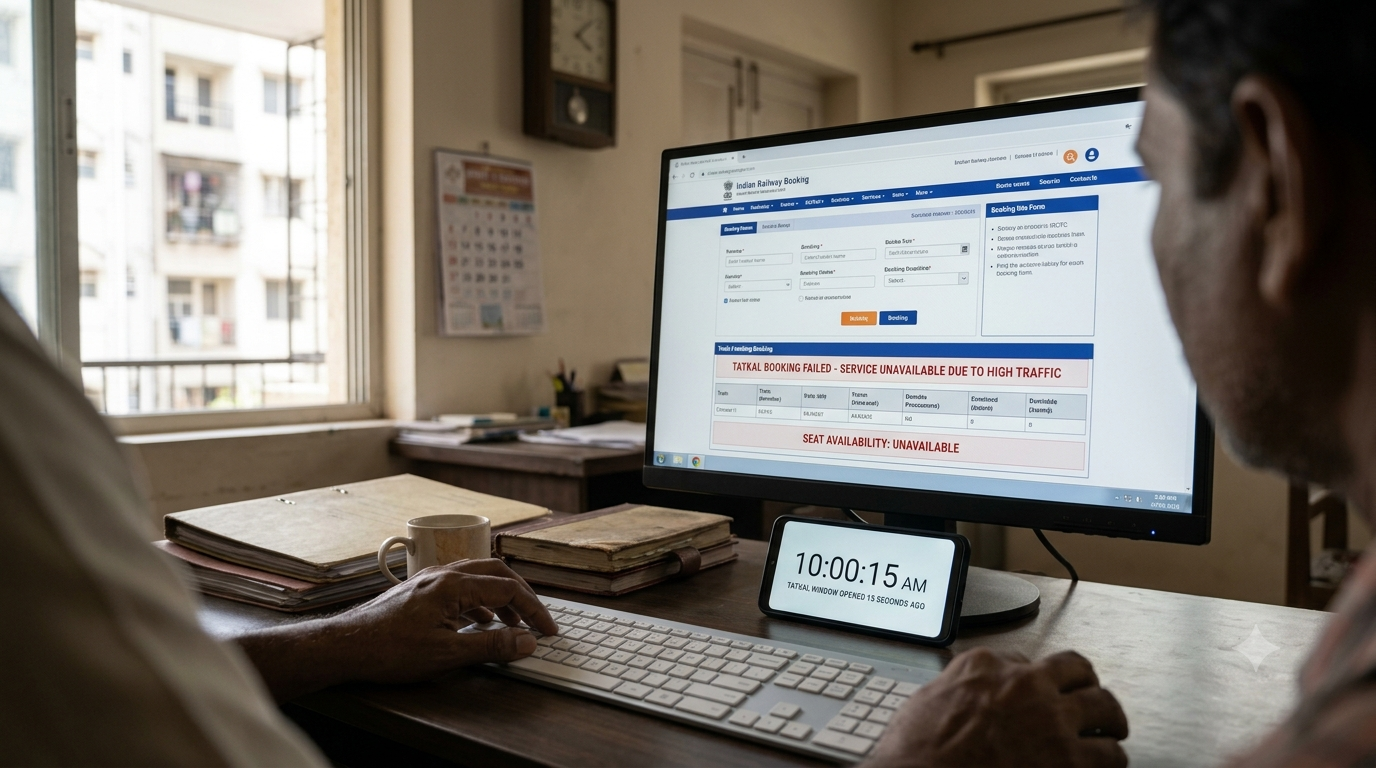
Anyone who has tried to book a Tatkal ticket at 10 am knows the routine: the page crawls, the payment step times out and, by the time it loads, the train shows no seats. Bots and illegal booking networks are the usual suspects, and the railways’ own numbers back that up in large part. Bot-generated requests made up 57.74 percent of traffic to the e-ticketing system between January and June 2026, according to a reply by Railway Minister Ashwini Vaishnaw in the Lok Sabha that Millennium Post reported in July.
Tatkal Tickets Sold Out in Seconds Because Nearly 9 Billion Bot Requests a Month?
The figures given to Parliament are large. An average of 8.88 billion of the 15.38 billion requests the system received each month came from bots, and June was the worst month, with bots accounting for 65.95 percent of all traffic. In the same reply, the minister said 3.04 crore suspicious user IDs had been deactivated and another 6.22 crore accounts had been placed under revalidation.
Those totals are not new in kind. In June 2025 the Ministry of Railways said about 2.5 crore suspected user IDs had been deactivated and that bot traffic peaked during the first five minutes of the Tatkal window, when genuine passengers are also logging in. The 2026 numbers show the clean-up has continued, and also that the problem has not gone away.
Software Sold for a Few Thousand Rupees a Month
The tools behind the quick bookings are sold openly. A November 2025 report in Patrika named apps such as BrahMos, Tesla, Avengers and Dr. Doom, with developers reportedly charging ₹1500 to ₹2500 a month, and one app asking ₹99 per PNR with no cap on tickets. Passenger names and ages are typed in a day ahead, so the software only has to confirm the booking when the window opens, a process that takes roughly 15 seconds.
Reports from mid-2025 described a parallel trade in Aadhaar-verified IRCTC accounts, sold for about ₹360 each, and bots promoted in Telegram and WhatsApp groups. The Railway Protection Force has made arrests: its Mumbai unit said in 2025 that around 50 people, including touts, super sellers and developers, had been caught over the previous two years. The same coverage noted that mandatory Aadhaar verification has raised demand for fake identity cards on the black market, a sign that each new check creates a new workaround.
What the Railways Have Changed
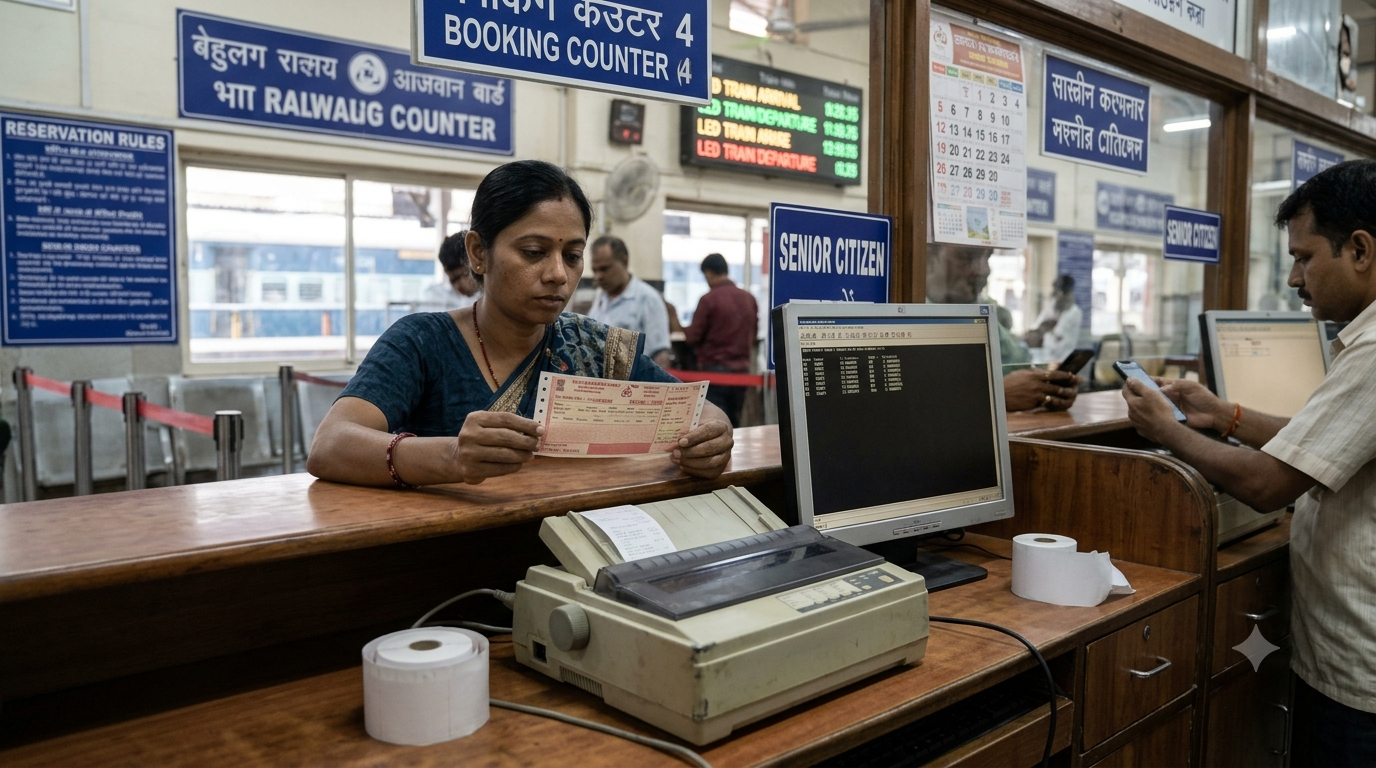
Since 1 July 2025, Tatkal tickets can be booked online only by Aadhaar-authenticated users. Accounts without authentication must wait three days after registration before booking Tatkal or Premium Tatkal, agent bookings are barred for the first 30 minutes of the window, and anti-bot systems and a content delivery network have been added to handle peak load. The railways have said the upgraded platform handled a record 32000 tickets in a single minute in May 2025.
The minister’s July 2026 reply added Aadhaar-based OTP verification on selected trains, round-the-clock security monitoring and tighter network safeguards, and described the reservation system as protected by industry-standard controls meant to stop automated form-filling and fraudulent Tatkal bookings.
Also read: Panchayat Property Tax Collection in West Bengal Jumps 168% Between April and October
“High Load” and “Unable to Process”: What Tatkal Booking Feels Like
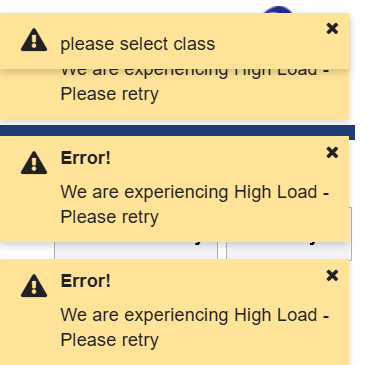
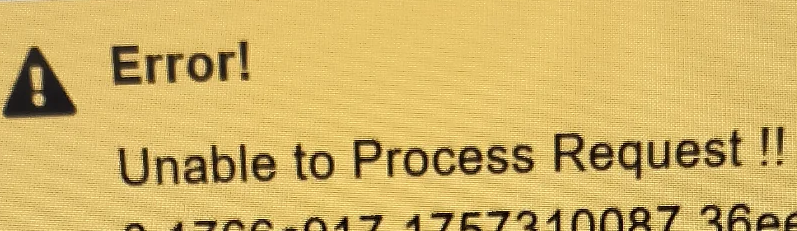
For the passenger on the other side of the screen, the experience is less about bots than about error messages. Users describe the IRCTC site and app freezing just before 10 am, followed by notices such as “We’re experiencing a high load. Please retry” and “We’re unable to process your request. Please try again”. Logins fail, the payment page does not load, or the money is held while the booking screen resets, and by the time the page recovers the berths are gone. Complaints of this kind were widely shared on social media during 2025, as Republic World noted, with users saying the site hangs when Tatkal opens and works normally again within minutes.
The frustration starts well before the Tatkal rush for some users. A post on the r/indianrailways forum on Reddit, headlined “THE IRCTC BOOKING SYSTEM IS TRASH”, came from a non-resident Indian who said creating an IRCTC account was an ordeal in itself. The user described entering two OTPs from two different sources, then being shown four separate error messages saying the account could not be created, with the interface refusing to move ahead until each one was cleared. The same user wrote that it took three attempts before one OTP reached the inbox, and ended with a pointed question for a booking that costs next to nothing.
“How am I to book a simple train ticket if I have to go through the painful process of going to register an IRCTC account through a portal which doesn’t even work, to book something as simple as a 70 rupee train ticket. It’s absolutely shameful.”
A Reddit user in r/indianrailways, describing an IRCTC account registration attempt
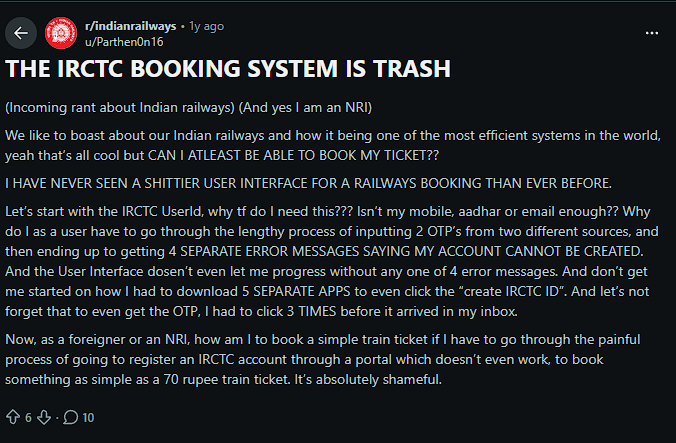
The post is a personal account that CoreSignal has not been able to verify, and it concerns registration rather than Tatkal booking. It does show how the same pattern of failed steps and repeated error screens reaches users at the first stage, long before a seat is in sight.
The two explanations point in opposite directions. The railways say the surge is bot traffic hitting the first five minutes of the window, which is why anti-bot filters and extra network capacity were added. Passengers read the same errors as proof that the platform cannot cope with peak demand at all, and they ask for an audit of the system. Both can be true at once: a flood of automated requests makes the site slower for everyone, and a slow site gives genuine users no chance against software that retries in milliseconds.
Bots Are Only Part of the Picture
Blaming bots alone is too tidy. Tatkal quotas are small and demand for last-minute travel is large, so even a perfectly clean system would sell out quickly on busy routes. The repeated login failures and frozen payment pages point to capacity problems that no Aadhaar rule can fix. Some users have gone further and alleged that insiders help agents, but no evidence for that has been published and the railways have not responded to the charge.
What the data does show is that automated traffic is the bulk of the load at the exact moment Tatkal opens. A survey by LocalCircles quoted in 2025 coverage found 73 percent of users waitlisted within the first minute and about 30 percent turning to agents, the very outcome the Aadhaar rules were meant to prevent.
For passengers, the practical steps are modest: complete Aadhaar authentication on the IRCTC account, save passenger details in the master list beforehand, and log in a few minutes before the window opens. Tatkal for AC classes opens at 10 am and for sleeper and second class at 11 am, one day before the journey.