Janfadayan: Iran Launches Janfada Campaign, Including Women
Share Copy Link copied Contents Janfadayan: Meaning and Origin of Iran’s Janfada Campaign Who Runs It and How Volunteers Sign Up 33 Million Claimed, Fewer Than 4 Million Found The 18 September Rally in Tehran Weapons Training, Women’s Centres and Schoolchildren Two Ways of Reading the Campaign Frequently Asked Questions Spotted something off? Tell the…
 Spotted something off? Tell the desk about queries, objections or corrections: Home | Contact Us
Janfadayan: Iran Launches Janfada Campaign, Including Women
A wartime volunteer drive that officials say has signed up 33 million people is now putting civilians through weapons training in the squares of Tehran.
Janfadayan, the volunteers of Iran’s Janfada campaign, are back in the news after a women’s training centre opened at Azadi Square in Tehran on 10 November. The campaign has run since March, and the questions around it have not gone away: how many people have actually signed up, who is being trained, and what the exercise is meant to achieve.
Janfadayan: Meaning and Origin of Iran’s Janfada Campaign
The word is Persian. Janfada means “one who sacrifices his life”, and Janfadayan is the plural, “those who sacrifice their lives”. Iranian media render the campaign’s name in several ways, among them Jan-Fada, Janfada-ye Iran and “Sacrifice for Iran”.
The drive was launched on 28 March 2026, at the height of the war between Iran and the United States and Israel. Its stated purpose, as the campaign website puts it, is to declare the readiness of Iranians to defend the country. In practice the label covers a wider set of activities: military and defence training, emergency relief, social and cultural work, and logistical support.
The vocabulary carries an older history. In the war with Iraq in the 1980s, volunteer mobilisation was central to Iran’s war effort, and Tehran’s own commentary on Janfada leans heavily on that memory. FactNameh, an Iranian fact-checking outlet, has also noted that “Janfada” was used by protesters and opposition media earlier this year to honour people killed in crackdowns in January 2026, which makes the word contested ground in Persian-language media.
Who Runs It and How Volunteers Sign Up
The campaign was started by a cultural and social headquarters affiliated with the Islamic Revolutionary Guard Corps (IRGC), according to IranWire. Training is handled under the Basij, the IRGC’s volunteer force.
Registration was set up through a website, SMS, phone and in-person desks, and was open to anyone aged 12 or above. Reports from Iranian and exile outlets say a mobile number was enough to sign up, with no full name or national ID number required. A separate international site was opened for Iranians abroad.

33 Million Claimed, Fewer Than 4 Million Found
Iranian state media announced in April that more than 30 million people had joined, roughly half of everyone in the country over the age of 12. By September, the IRGC’s Tehran commander, Hassan Hassanzadeh, was putting the figure at 33 million. Another official said this week that nearly half of them are women.
Those numbers have been challenged. Activists outside Iran who reportedly examined the campaign website’s source code found fewer than 4 million IDs, and a review by FactNameh described the daily totals as growing in an unnaturally straight line, with no dips for holidays or news events. Because sign-up needed only a phone number or an email address, one person could register several times. Organisers have not released data that would settle the question.
| Figure | Who says it | Status |
|---|---|---|
| 30 million+ (April) | Iranian state broadcaster and officials | Disputed; no verifiable data released |
| 33 million (September, November) | IRGC commander and campaign officials | Disputed |
| Fewer than 4 million IDs | Activists who examined the website code | Not independently confirmed |
| 600,000+ registered for training | IRGC Tehran commander, 18 September | Official claim; target of 1 million+ trained |
The 18 September Rally in Tehran
The campaign’s biggest public moment came on 18 September, when volunteers marched through central Tehran in combat uniform carrying flags, with drones displayed on floats. State television estimated more than 300,000 people on the streets, and organisers described a 313,000-strong parade, a number with symbolic weight in Islamic tradition.
President Masoud Pezeshkian and Basij chief Hossein Taeb were among the leaders present, as Al Jazeera reported. Hassanzadeh told state broadcaster IRIB that over 600,000 people had registered to take part in training, with more than a million expected. Pezeshkian used the occasion to ask volunteers to help the government by using less fuel and electricity amid economic strain.
Weapons Training, Women’s Centres and Schoolchildren
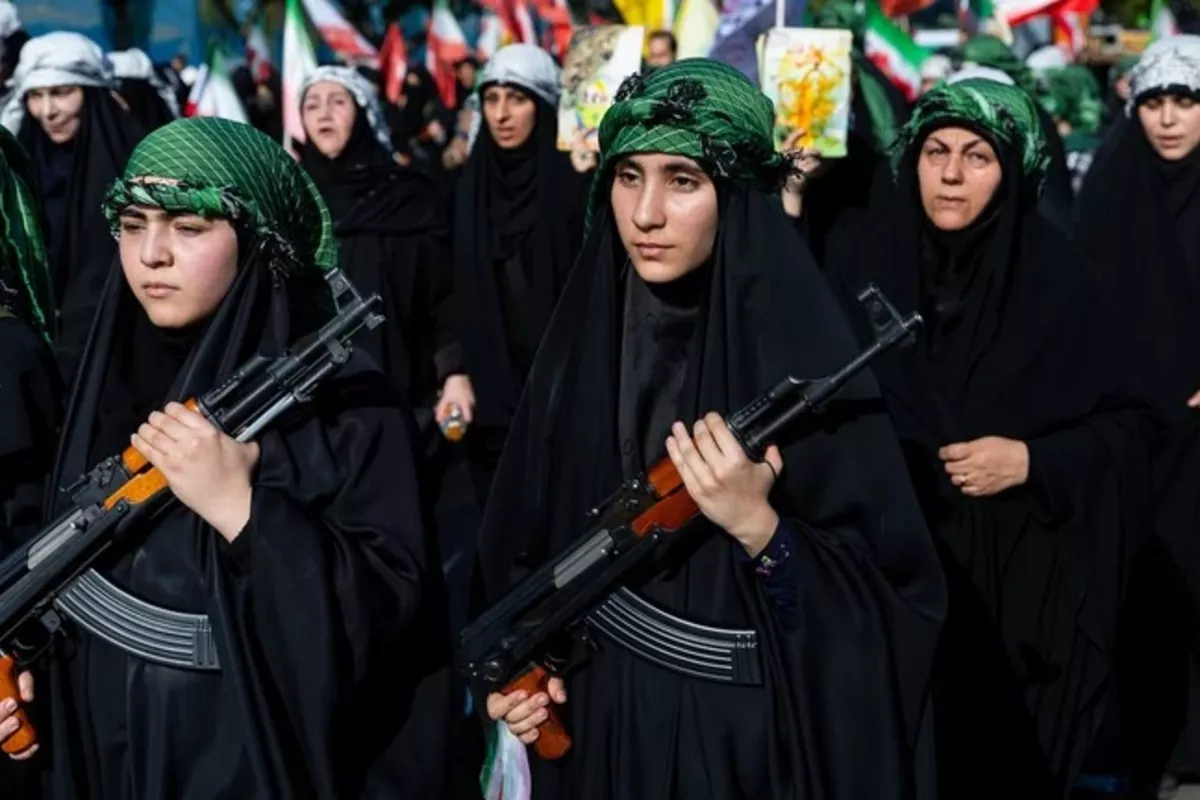
Since the rally the campaign has moved from registration to drills. Al Jazeera reported in October that civilian volunteers are being taught to use weapons, and that Basij training deputy Ali Kowsari said at least 14 major squares in Tehran would serve as training and equipping sites. Centres have been named at Imam Hossein Square, Haft-e Tir Square, Tajrish Square and Lavasan.
On 10 November, the first general Janfada training centre for women opened at Azadi Square. Officials said nearly 50 percent of registered volunteers are women. Schoolchildren are also part of the plan: Education Minister Alireza Kazemi said the Basij is registering students and preparing ceremonies and mobilisation events for them.
The campaign has had a softer side as well. In May, authorities held mass weddings in several Tehran squares for couples who had signed up for the “self-sacrifice” initiative.
Two Ways of Reading the Campaign
Iranian officials present Janfada as a voluntary show of national unity and a reserve that can help with rescue work, social services and logistics, as well as defence. Analysts abroad see more than one purpose. Mehran Kamrava of Georgetown University in Qatar has said the war gave Iran’s hardline revolutionary factions a chance to strengthen their influence, and Janfada lets them display commitment to the revolution’s principles.
Others have pointed to the domestic side. Coverage of the September rally noted that a large trained volunteer force aligned with hardliners could be better prepared to deal with any future street protests. Whether the numbers are 33 million or a small fraction of that, the training sessions in Tehran’s squares are real, and their scale will be visible in the coming weeks as the first batches of volunteers complete their courses.
CoreSignalMore World NewsCoreSignal hub pageFrequently Asked Questions
What does Janfadayan mean?
Janfadayan is the Persian plural form associated with Janfada, meaning those who sacrifice their lives. It is the name people use for the volunteers of Iran’s Janfada campaign.
What is the Janfada campaign?
Janfada, also written Jan-Fada or Janfada-ye Iran, is a state-backed mobilisation drive launched in 2026 during the war with the United States and Israel. Volunteers declare readiness to defend Iran, and some are trained in weapons handling, relief work and logistics.
When did the Janfada campaign start?
Registration began on 28 March 2026, according to Iranian media and the campaign’s organisers.
Who runs the campaign?
It was launched by a cultural and social headquarters affiliated with the Islamic Revolutionary Guard Corps, and training is carried out under the Basij, the IRGC’s volunteer force.
How many people have registered for Janfada?
Iranian officials claim about 33 million registrations. Activists who examined the website’s source code say fewer than 4 million IDs exist, and the figure has not been independently verified. Separately, the IRGC’s Tehran commander said in September that over 600,000 people had registered for training.
Who can register?
Registration was opened to anyone aged 12 or above through a website, SMS, phone or in person. Reports say a mobile number was enough to sign up, with no national ID required.
Are women part of the campaign?
Officials say nearly half of those registered are women. A training centre for women opened at Azadi Square in Tehran in November 2026.